





 Portuguese
  English
  Spanish
  4 min of reading
  54 comments


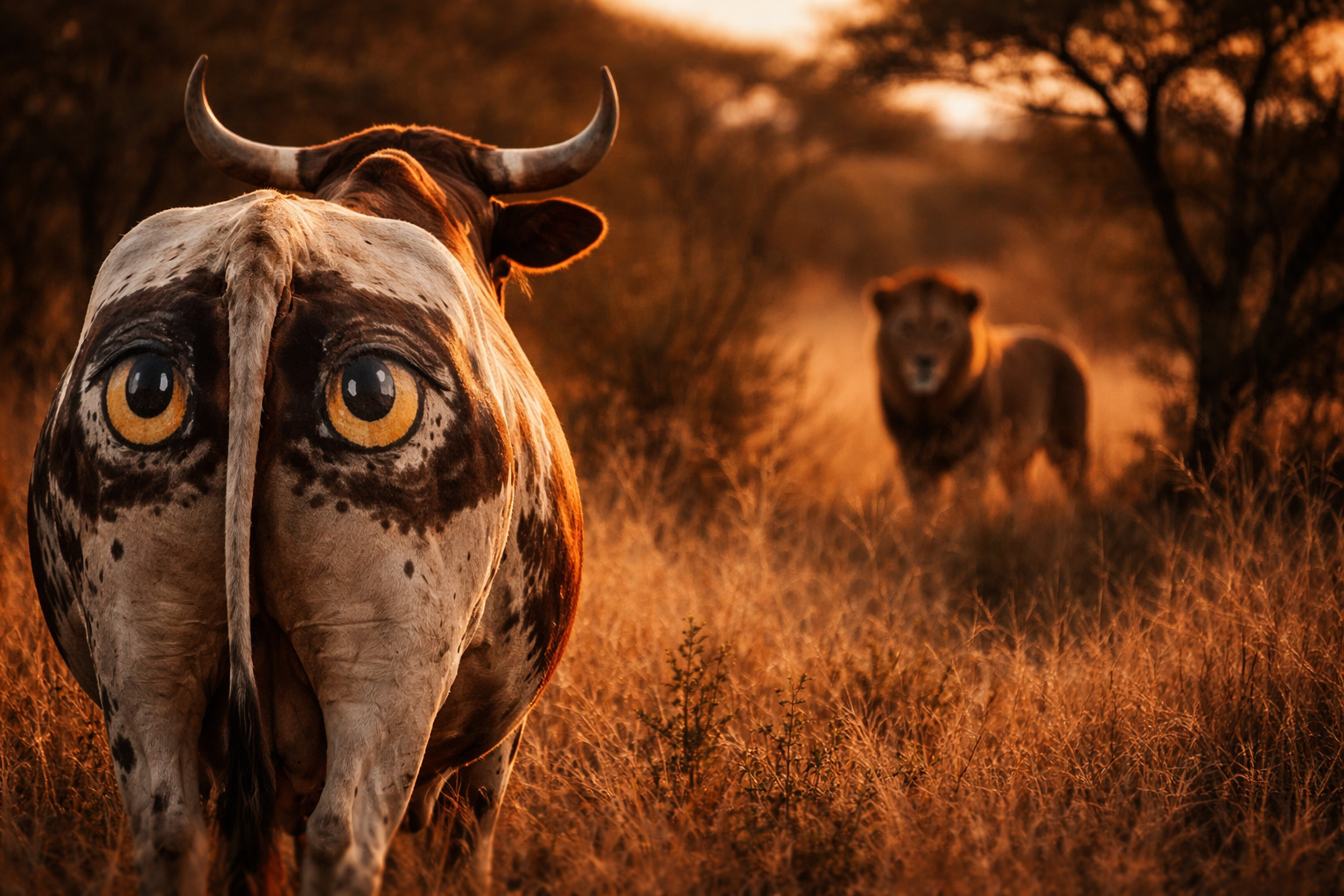


Painting Eyes on Cattle Reduced Lion and Leopard Attacks to Zero on African Farms, Saved Herds, and Prevented Predator Deaths with a Simple and Real Solution.
For decades, the coexistence between large African predators and rural communities followed a predictable and violent script. When lions or leopards attacked livestock, the response was almost always the same: retaliation, hunting the predator, and another blow against already threatened populations. In regions like the Okavango Delta, in Botswana, this conflict was part of the routine for farmers and conservationists — until an unlikely, simple, and almost childlike idea began to completely change this scenario.
The solution did not involve electric fences, drones, or modern weapons. It just took paint and a basic visual concept: drawing large eyes on the backs of cows. The result surprised even the researchers themselves.
The Historic Conflict Between Cattle and Large Felines
Lions and leopards are ambush predators. They rely on the element of surprise, quietly approaching their prey from behind before the final attack. In open grazing areas, domestic cattle became an easy, slow, predictable, and numerous target.
-
The eggshell that almost everyone throws away is made up of about 95% calcium carbonate and can help enrich the soil when crushed, slowly releasing nutrients and being reused in home gardens and vegetable patches.

-
This farm in the United States does not use sunlight, does not use soil, and produces 500 times more food per square meter than traditional agriculture: the secret lies in 42,000 LEDs, hydroponics, and a system that recycles even the heat from the lamps.

-
The water that almost everyone throws away after cooking potatoes carries nutrients released during the preparation and can be reused to help in the development of plants when used correctly at the base of gardens and pots, at no additional cost and without changing the routine.

-
The sea water temperature rose from 28 to 34 degrees in Santa Catarina and killed up to 90% of the oysters: producers who planted over 1 million seeds lost practically everything and say that if it happens again, production is doomed to end.


For local farmers, each attack meant: direct economic loss, food insecurity, and increased resentment toward wildlife.
For the predators, it meant something even worse: almost certain death by human retaliation. This cycle had been repeating for decades, undermining conservation efforts across Southern Africa.
The Unlikely Idea that Turned into a Scientific Experiment
Researchers affiliated with Botswana Predator Conservation, in partnership with international universities, decided to test a simple hypothesis: what if the predator believed it was seen?
The idea is based on a well-documented behavioral principle. Many animals avoid attacking when they realize they have been detected. Visible eyes suggest vigilance, alertness, and the risk of failure in the ambush. To test this, the scientists divided the cattle into three groups:
- cows with large eyes painted on their backs
- cows with painted crosses (visual control)
- cows with no markings
The experiment was conducted on 14 different herds, in areas where lions and leopards roam freely.
Results that Caught the Scientific Community’s Attention
The numbers were clear and unexpected. Throughout the study period:
- none of the cows with painted eyes were killed by lions or leopards
- cows with crosses suffered attacks, but in reduced numbers
- cows without markings continued to be preyed upon
The most impressive result was not just the reduction in attacks, but the absolute zero in deaths in the “eyes” group.
This data transformed the experiment into one of the most cited cases of behavior-based conservation, published in a peer-reviewed scientific journal (Communications Biology).
Why “Eyes” Work Better than Fences or Weapons

Unlike physical fences, which require constant maintenance, or weapons, which escalate conflict, painted eyes: do not harm the animal, do not physically affect the predator, do not alter the ecosystem, and cost practically nothing.
From the perspective of the lion or leopard, the signal is simple: “I was seen”. This breaks the element of surprise, reduces the likelihood of successful hunting, and causes the predator to give up even before attempting.
This is not about permanently deceiving the animal, but about increasing the perceived cost of the attack.
Direct Impact on Predator Conservation
The most important consequence came afterward. With fewer attacks on livestock, farmers began to:
- retaliate less
- tolerate the presence of predators more
- collaborate with conservation programs
In other words, saving cattle ended up saving lions and leopards. In regions where the method was adopted, there was a significant decrease in retaliatory killings of felines, one of the main factors in the decline of these species outside protected areas.
Limitations and Cautions of the Method
The researchers themselves make it clear that the method is not magical or universal. It works best:
- against ambush predators
- in open areas
- when cattle graze freely
In addition, the eyes need to be repainted periodically, as the paint wears off over time. Even so, the cost-benefit remains extremely favorable when compared to any traditional alternative.
A New Paradigm in Coexistence with Wildlife
The case of painted eyes on cattle reinforces a profound shift in modern conservation: coexistence works better than confrontation. Instead of eliminating the predator, the strategy becomes:
- reducing conflict
- altering behavior
- aligning human and ecological interests
It is an approach that does not rely on force but on understanding.
When a Simple Idea Changes an Entire System
Painting eyes on the backs of cattle seems trivial, almost ridiculous at first glance. But the data shows that this simplicity was precisely the key to success.
In a continent where spears, traps, and rifles marked the relationship between humans and predators for decades, two drawn eyes proved to be more effective than violence.
And perhaps this is the greatest lesson of the project: coexistence does not require domination, but understanding.










Perfeito achei uma ideia excelente parabéns 👏
Será que funcionaria nos órgãos públicos do Governo??
E os leões estão comendo o quê, agora?
Presas naturais, selvagens, como gnus, zebras, antílopes, javalis…
Somente vacas que possuem olhos fechados pintados nos seus lombos.