





 Portuguese
  English
  Spanish
  4 min of reading
  7 comments


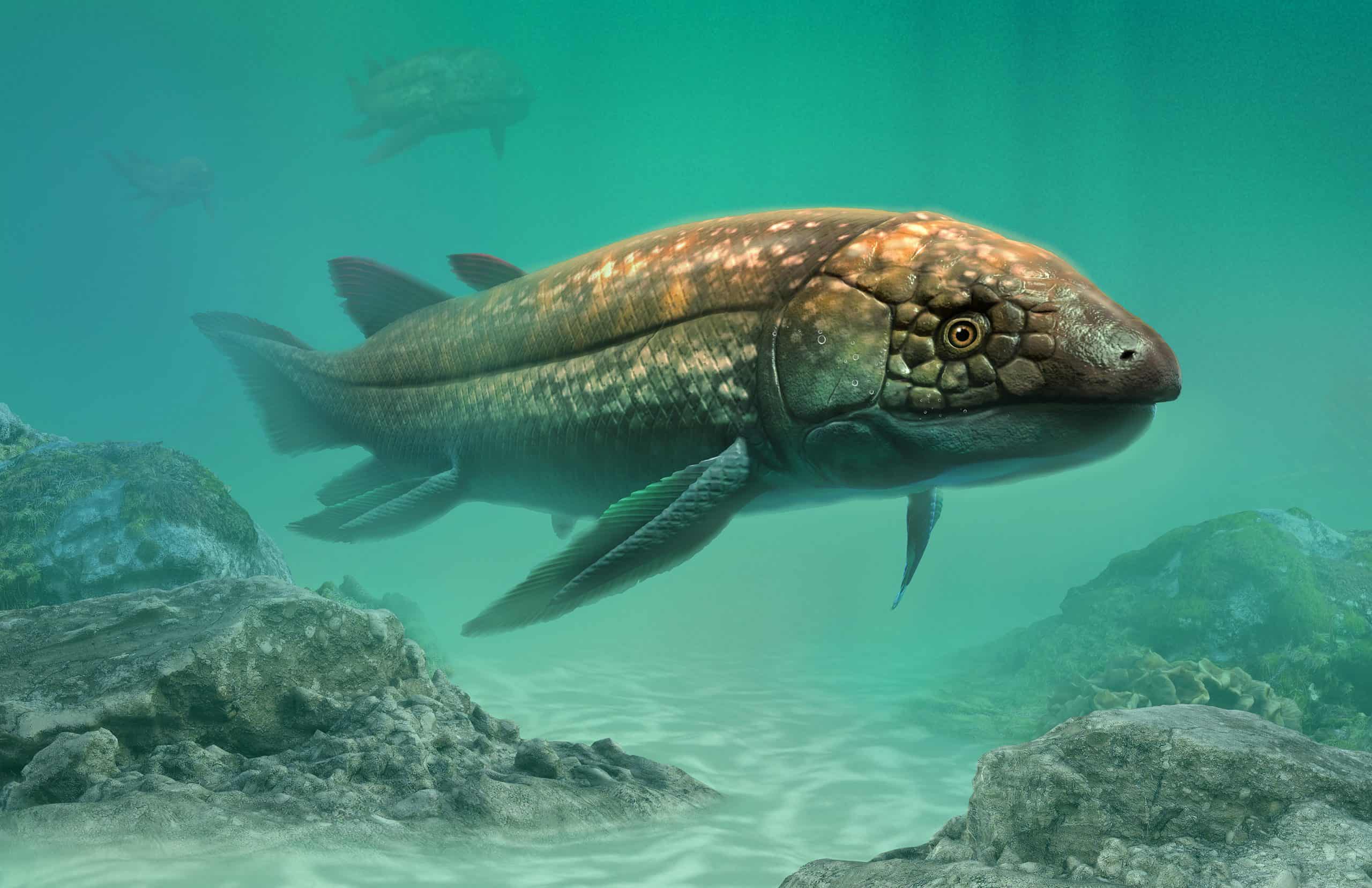


Capable of Surviving Years Out of Water Buried in Mud, This Rare Fish Breathes Air, Slows Its Metabolism, and Challenges Everything Science Knows About Aquatic Life.
For millions of years, evolution has produced creatures that seem to defy basic rules of biology. Among them is a fish so off the standard that, at first glance, it looks more like an extreme experiment of nature than a real animal. It is the African Lungfish, one of the few vertebrates capable of surviving entire years without water, buried in dry soil, maintaining minimal vital functions until the return of the rains. It’s no exaggeration to say that it redefines the limits of animal survival.
This extreme behavior is not legend nor an isolated exception. It is documented by scientific studies, field observations, and laboratory experiments conducted over decades by universities and research centers in animal physiology, evolutionary biology, and tropical ecology.
What Is the Lungfish and Why Is It So Uncommon
The lungfish belongs to the group of Dipnoi, an ancient lineage that emerged over 400 million years ago, during the Devonian period.
-
At an altitude of 400 km by astronauts from the International Space Station, Paris transforms at night into a golden mesh so precise that it reveals the outline of the Seine River, avenues, and entire neighborhoods like a luminous map drawn over the Earth.

-
iPhone 17 reaches historic low price with 256 GB, 120 Hz display, and drops to R$ 5,703 on Shopee, featuring A19 chip, dual 48 MP cameras, battery life of up to 30 hours, and advanced AI features.

-
Trip to Mars getting closer: Pulsar Fusion, from the UK, advances with plasma ignition in fusion engine and could drastically reduce space travel time, making crewed missions faster, safer, and economically viable.
-
Made with recycled plastic, a Lego-inspired brick builds a 180 m² house in 15 days, providing thermal comfort, preventing moisture, and turning waste into income, kits, and accelerated construction in the country.


Today, only six species remain on the planet, distributed across Africa, South America, and Australia. The most extreme among them is the African lungfish (Protopterus), famous for its ability to survive prolonged droughts.
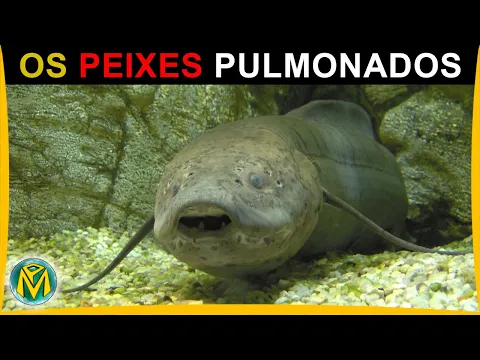

Unlike most fish, it has functional lungs in addition to gills. In practice, this means it can breathe atmospheric oxygen, like reptiles or mammals. In environments where the water becomes low in oxygen — or disappears completely — this characteristic stops being an advantage and becomes the only way to survive.
How It Can Live Buried for Years Without Water
When rivers, ponds, and swamps start to dry up, the lungfish initiates an impressive process. It digs into the muddy bottom with body movements, forms an underground chamber, and coiles inside it. Then, it secretes a thick layer of mucus that hardens upon contact with air, forming a kind of protective cocoon.
Inside this shelter, the fish enters a state called estivation, similar to hibernation but adapted to heat and dryness. During this period, its metabolism plummets to extreme levels. Heart rate drops, oxygen consumption is drastically reduced, and almost all non-essential functions are shut down.
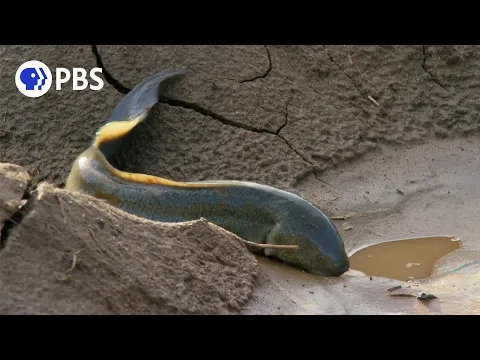
Studies show that it can remain in this state for up to four years, surviving solely on body reserves and breathing small amounts of air through a hole in the ground.
Air Breathing and Metabolism in Survival Mode
During estivation, the lungfish virtually ceases to behave like a fish. It does not actively use gills and relies almost exclusively on its lungs. Breathing is slow and spaced out, just enough to keep the brain and vital organs functioning.
The metabolism enters an extreme conservation mode. Muscle proteins are repurposed, waste excretion is minimized, and even the immune system undergoes adjustments.
Research published in comparative physiology journals indicates that the lungfish’s body can reprogram metabolic genes to withstand long periods without food or hydration.
This type of adaptation is so efficient that it has sparked medical interest, including studies on tissue preservation, human metabolism in extreme situations, and even long-duration space travel.
Where This Fish Lives and Why Drought Is Part of Its Routine
The African lungfish inhabits regions of Sub-Saharan Africa subject to extreme cycles of rain and drought. Temporary lakes, floodplains, and inundated areas may exist for a few months and completely disappear for long periods of the year.
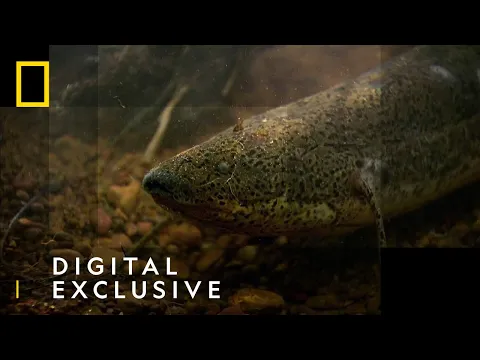
For most aquatic species, this would be a death sentence. For the lungfish, it is just part of the natural cycle. When the rain returns and the soil becomes waterlogged again, the cocoon dissolves, the fish slowly awakens, and resumes aquatic life as if nothing had happened.
Historical accounts and modern observations indicate cases where lungfish were found alive in blocks of dry mud, years after being buried.
Why Science Considers This Fish a “Living Fossil”
The lungfish is often referred to as a living fossil because it retains anatomical and physiological characteristics very close to the first vertebrate forms that began to explore terrestrial environments. It represents an evolutionary bridge between fish and tetrapods, helping to explain how life made the transition from water to land.
Its ability to breathe air, resist desiccation, and survive outside the aquatic environment reinforces hypotheses about the evolutionary transition that gave rise to amphibians, reptiles, and eventually mammals.
A Little-Known Animal That Challenges Everything We Learn About Fish
While giant sharks, colossal whales, and prehistoric animals attract attention for their size, the lungfish impresses with something even rarer: absolute biological resilience. It does not run, does not hunt large prey, and does not dominate ecosystems by size. Its strength lies in its ability to wait, endure, and survive when practically all life around disappears.
It serves as a powerful reminder that, in nature, surviving does not always mean being the biggest or the strongest — sometimes, it means knowing how to shut down almost everything and simply wait for the world to come back to life.








A vida surgiu do barro , não necessariamente na água ! Magnífica criatura pisciana , que ao sobrepujar por tanto tempo a tantas intempéries climáticas e sobressair vivíssima assevera o Poder Absoluto do Criador do Universo ! Terra , Céus e Mar ! God is Able !
Impresionante muy interesante soy afecto a los peced
Interesting, informative and intellectual! Enjoyed the article very much.