





 Portuguese
  English
  Spanish
  9 min of reading
  1 comment


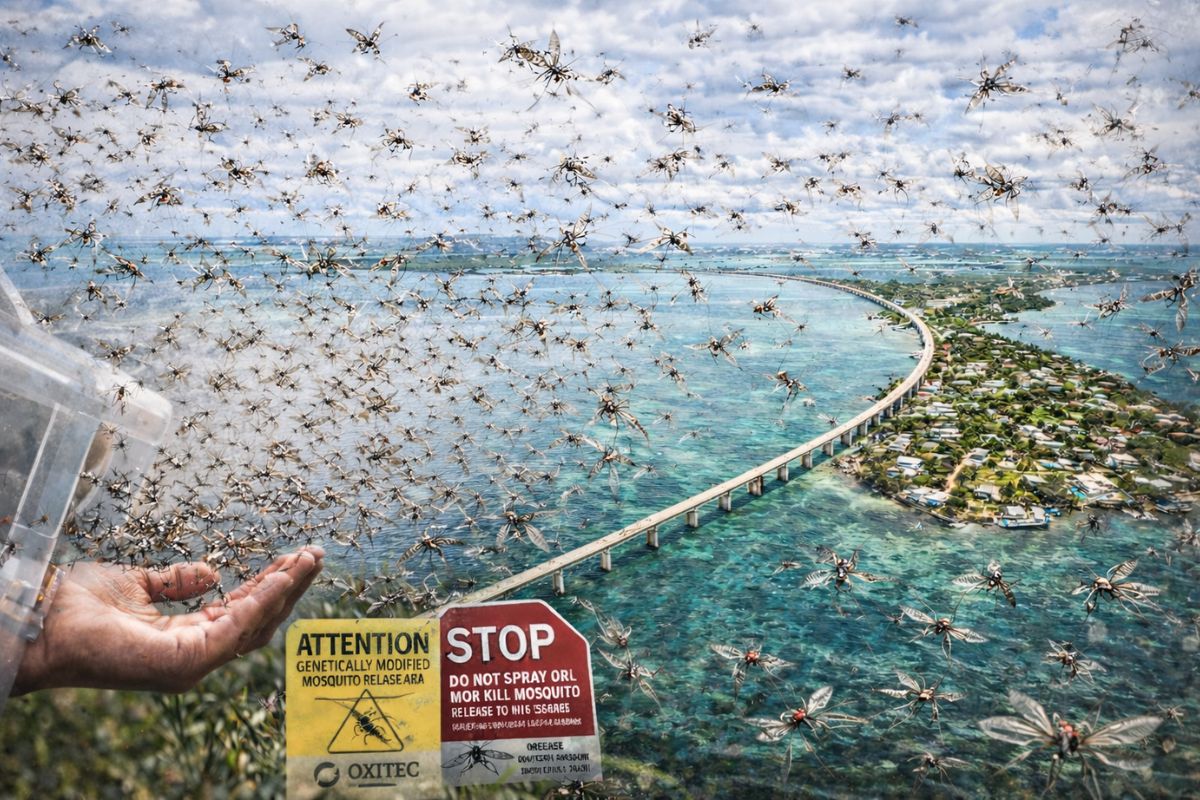


Millions Of Genetically Modified Mosquitoes From Oxitec Were Released In The Florida Keys To Attempt To Reduce Dengue And Zika By Up To 95% In An Experiment That Divides Residents And Opens The Door To Ecosystem Editing.
In a quiet neighborhood in Florida, things began with something that seemed mundane. Gray boxes began to appear in backyards and along the mangroves, accompanied by a simple instruction: fill with water and walk away. No one saw anything special there, just discreet containers scattered throughout the neighborhood. What almost no one noticed was that those boxes were capsules of a global experiment: from inside them would emerge millions of mosquitoes bred in the lab, carrying a genetic code designed to target their own species.
In the following months, those boxes became the starting point for waves of millions of laboratory mosquitoes over the Florida Keys. For some residents, it seemed like the beginning of an apocalyptic movie.
For others, it was a desperate bet to contain outbreaks of dengue and zika that had been creeping closer year after year. And behind it all was Oxitec, a British biotechnology company that transformed a common mosquito into a little flying genetic saboteur.
-
With a cost per shot close to zero, the DragonFire laser could change naval warfare in 2027 and provide British ships with nearly unlimited defense against drones.

-
A British startup creates tires that generate electricity in electric vehicles when passing over potholes, speed bumps, and cracks.

-
Scientists have created robots made with living cells that have their own nervous system, swim on their own, explore the environment, and self-organize without any genetic engineering, and now they want to do the same with human cells.

-
Students create a solar-powered ambulance that operates without a plug, without fuel, and still keeps medical equipment running in remote areas.

The Tiny Villain That Transformed Florida Into A Testing Ground

Before understanding why someone would agree to see millions of mosquitoes being released in their own backyard, it’s important to take a close look at the villain in this story.
It’s not a shark, it’s not a hurricane, it’s not an exotic snake. It’s a tiny striped insect: the Aedes aegypti, the famous mosquito that transmits dengue and yellow fever.
It loves warm cities, plastic buckets, clogged gutters, and any cup of water left forgotten on the porch. During the day, it enters houses, follows people from room to room, and turns any tropical neighborhood into a potential target for diseases like dengue, zika, and chikungunya.
In Florida, Aedes aegypti represents only a small fraction of all mosquitoes that exist. Even so, it is the one that bears practically the entire burden of local outbreaks of dengue, zika, and other arboviral diseases.
Worldwide, this mosquito has helped transform entire countries into risk zones, with dengue cases reaching tens and even hundreds of millions per year.
In the Florida Keys, health authorities saw this threat approaching slowly, like a storm band on the radar. Aedes aegypti was present, outbreaks were growing, and traditional weapons were beginning to fail.
For years, the battle was fought the classic way.
Planes sprayed insecticides over entire neighborhoods. Trucks released smoke down the streets at dusk.
Teams applied larvicides in drains and canals. Residents were advised to turn over pots, empty tires, and clean gutters. And yet, with each new warm season, the mosquito returned.
The modern, warm, humid city filled with containers ended up becoming a perfect machine for Aedes. Drying up all the puddles was impossible.
The chemical products became increasingly expensive and, worse, the mosquitoes began to develop resistance. If chemicals and cleanup efforts were no longer enough, what was left?
How Millions Of Mosquitoes Became A Weapon Against Dengue And Zika

It is at this point that Oxitec comes in with a proposal that seems straight out of science fiction: fight mosquitoes with mosquitoes.
Not just any mosquito, but millions of genetically modified mosquitoes, designed to target their own species.
The central idea is simple to explain, but sophisticated on the inside. In the lab, Oxitec creates a special lineage of Aedes aegypti where:
- only males are released
- these males do not bite, therefore they do not transmit diseases
- they carry a lethal gene that causes nearly all daughters to die before reaching adulthood
Wild females continue to exist in nature. But when they mate with Oxitec males, the offspring inherit this “genetic switch.”
In the controlled environment of the factory, this switch can be artificially turned off to allow the production of large quantities of healthy males. In nature, without this protection, the gene is activated in the daughters and the lineage simply ends within a few generations.
In practice, what the company is doing is filling the environment with millions of male mosquitoes that do not bite but carry a silent message of self-destruction applied to their own species. Each mating with a wild female is one step further in reducing the total Aedes aegypti population.
Instead of poisoning the entire environment with sprays, the proposal is to have millions of mosquitoes work against their own kind.
Florida Keys As An Open-Air Laboratory


When the Florida Keys first heard about this plan in 2011, the reaction was not one of enthusiasm. It was one of shock. The idea of having millions of genetically modified mosquitoes in backyards and mangroves generated petitions, protests, and headlines about “mutant insects” and “Franken-mosquitos.”
Residents claimed they were being turned into guinea pigs without real consent. The phrase that was most repeated at public meetings was straightforward: “Once you release them, there’s no putting them back in the box.” And on that part, they were right. Once millions of mosquitoes are in the air, there’s no way to collect them.
On the other side, regulators and health professionals looked at very different numbers:
- increasing insecticide costs
- declining effectiveness
- global increase in outbreaks of dengue and zika
- records of mosquito populations becoming increasingly resistant to chemical products
Meanwhile, Oxitec’s tests in other countries, such as Brazil and the Cayman Islands, were already showing local reductions of Aedes aegypti between 80 and 95% in treated areas.
In the end, U.S. federal agencies granted an experimental permit. Florida would become the stage for one of the boldest vector control experiments: millions of laboratory mosquitoes released not in a remote jungle, but in residential neighborhoods, with garages, mailboxes, and well-kept gardens.
The first phase, in 2021, started with a few boxes: locked containers installed on private properties. Residents only needed to add water.
Inside, the laboratory eggs were awakening. Over the weeks, each box released batches of modified males, mixing with wild mosquitoes.
Over time, the program grew. The numbers went from thousands per week to millions of mosquitoes over months and years, transforming the Florida Keys into a carefully monitored open-air laboratory.
What Data Showed: Dramatic Falls In Aedes Aegypti
Outside, the environment looked the same. The mangroves were still there, the colorful houses continued along the canals, and the humid heat remained strong at dusk.
An average observer could not distinguish a wild mosquito from an Oxitec mosquito just by looking. They all buzzed the same way.
The difference was inside. Each crossover between a lab male and a wild female carried that genetic message that killed the offspring before adulthood.
To know if this was really happening, it was not enough to look to the sky. It was necessary to measure, capture, analyze DNA.
Scientists tracked the treated areas by installing traps, collecting insects, and using a fluorescent marker inserted in the Oxitec lineage, which allowed identifying laboratory descendants.
Over time, the data from field tests confirmed what the company promised:
- in treated zones, the Aedes aegypti population fell dramatically, often in the range of 80 to 95%
- the need for intense chemical spraying decreased
- the lethal gene disappeared after a few generations, without circulating indefinitely in the environment
To those only looking at the numbers, millions of laboratory-bred mosquitoes began to look like a statistical miracle against dengue and zika.
In Brazilian cities that used the same technology, “add water” style capsules were distributed in thousands of homes simultaneously.
Reports indicated significant reductions of mosquitoes in a few weeks and, in some cases, neighborhoods with substantial drops in dengue cases compared to untreated neighboring cities.
In the Florida Keys, the test was smaller in scope than in Brazil but huge in symbolism: it showed that it is possible to release millions of genetically modified mosquitoes in highly monitored urban communities without immediate system collapse or visible disaster.
A New Era Of Ecosystem Editing

At this point, we are no longer just talking about Florida. We are talking about a global movement.
Brazil, Panama, Cayman Islands, parts of India, and other locations have already tested similar programs. Adding the different initiatives together, over 1 billion Aedes aegypti bred in labs have been released worldwide in a sort of silent race against mosquito-borne diseases.
At the same time, other scientists have adopted complementary approaches. Instead of editing genes to kill offspring, they infect mosquitoes with symbiotic bacteria, such as Wolbachia, that prevent the virus from multiplying within the insect. In this strategy, the mosquito remains alive but becomes a dead end for dengue and zika.
When you put all this together, a bigger picture emerges. Humanity is beginning to rewrite, in practice, its relationship with one of nature’s most deadly animals.
For thousands of years, mosquitoes have been an annoying fact of life and death. Now we are:
- editing their genetics
- infecting them with microorganisms that block viruses
- controlling their reproduction on a city scale
- planning, in some cases, the elimination of entire populations
This is no longer just “pest control.” It is ecosystem editing, even if on a specific scale, focused on a species with a disproportionate impact on human health.
Miracle Or Warning: Risks, Doubts, And Ethical Dilemmas
From a technical standpoint, the results are encouraging. From a social and ecological perspective, the questions are far from over.
Some independent scientists are concerned about the possibility that the genes of the released mosquitoes could mix with local populations in unexpected ways, creating hybrids that are more resistant or have unforeseen characteristics.
Others remind us that Aedes aegypti does not live in a vacuum: it is part of food chains that include fish, bats, birds, and other insect predators.
Even if the impact seems small in the short term, no one can guarantee with 100% certainty what happens if we drastically reduce a species in large areas for many years.
There is also a very human layer to this debate. National surveys in the United States indicate that many people would support the use of genetically modified mosquitoes to contain serious diseases. But at local meetings in the Florida Keys, the support was much more divided.
Residents feared becoming a lab without real voice in the decisions. They wanted to know what would happen if some biting females escaped quality control carrying experimental genes.
Official risk assessments speak of “very low” danger, but very low risk is still not zero risk.
And trust is fragile, especially when the technology belongs to a private company that needs to show results and profit.
Behind it all, there is an even larger question: if we start to feel comfortable “switching off” any troublesome species, how far will we go? Eliminating a vector mosquito may seem obvious.
But what if the next target is another animal that also causes harm, or “just” annoyance? Evolution does not tolerate empty spaces for long. When one species recedes, another usually occupies its place.
What Changes When Millions Of Mosquitoes Become Code
The Florida experiment did not end in disaster. There were no swarms of mutant monsters, nor a sudden collapse of ecosystems. What happened was quieter and, in a way, stranger.
A community concerned about dengue and zika discussed, protested, and, pressed by risks and science, ended up accepting to coexist with millions of mosquitoes bred in laboratories, invisible to the naked eye but carrying codes written by humans.
If you look at aerial images of the Florida Keys today, everything looks the same. The mangroves still surround the islands. The houses still line up in pastel shades along the canals.
The air remains warm and heavy at dusk. At some point in that air, however, buzz two types of Aedes aegypti: some completely wild, others carrying an artificial message designed to take them out of the picture.
The line between the natural and the modified has blended into something new.
And perhaps that is the real turning point. Solving health and environmental crises may no longer mean just building hospitals or spraying poison.
It might mean reprogramming life, from the mosquito that carries a virus to the ecosystem that harbors that mosquito.
The millions of mosquitoes released in the Florida Keys are just one of the first chapters in this story. The next pages will depend on the political, scientific, and ethical choices we are beginning to make now.
And here you come in: in your opinion, releasing millions of genetically modified mosquitoes to reduce dengue and zika is a necessary and smart solution, or a risky experiment with the very ecosystem we live in?







Hello:
I’m so, so sorry to read this because it is rife with errors, inaccuracies, and therefore, is factually misleading.
Are you being paid by Oxitec or Precigen to spread misinformation as marketing for them?
Please disclose any affiliations with Oxitec.
Meagan Tara Morrison, Florida Keys Resident