





 Portuguese
  English
  Spanish
  6 min of reading
  197 comments


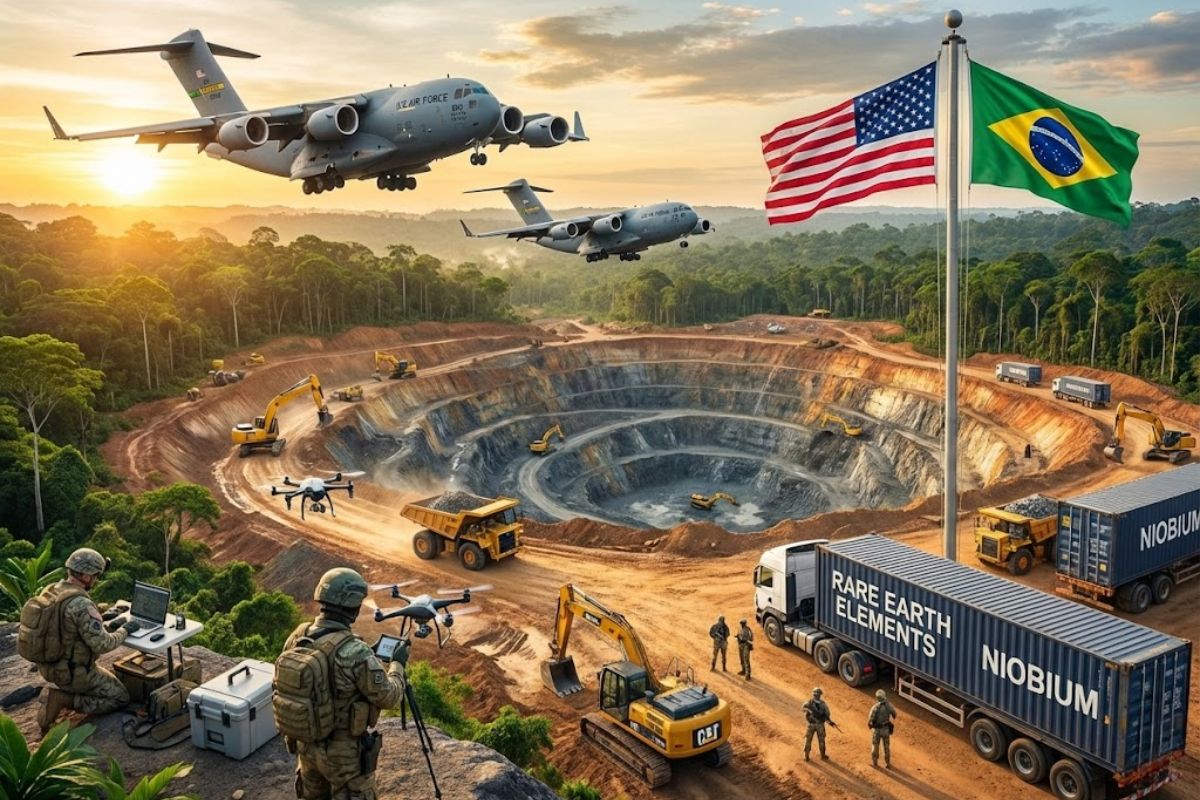


How Brazil Became a Silent Strategic Territory for the United States in the Dispute for Critical Minerals, Rare Earths, and Niobium, Following Movements in Venezuela and Greenland Redrawing the Map of Global Technological, Military, and Energy Power in the Current Century
Little discussed in public debate, the advancement of the United States over regions rich in critical minerals reinstates Brazil as a strategic territory amidst the geopolitical reconfiguration of the twenty-first century, between the pressure for external investments and the risk of structural vulnerability. Instead of tanks or military bases, the central instrument now is contracts, financial contributions, and control of supply chains.
While the escalation in areas like Venezuela and Greenland exposes the American quest for autonomy in rare earths, lithium, graphite, and other high-tech inputs, Brazil starts to be seen as a strategic territory due to its combination of gigantic reserves, low participation in global production, and its presence of niobium on an almost monopolistic scale. The competition is not declared, but it is already occurring in the Brazilian subsoil.
From Movements in Venezuela and Greenland to Focus on Brazil
The recent attack on Venezuela, which ended in the arrest of Nicolás Maduro, and Donald Trump’s insistence on transforming Greenland into a direct interest asset for the United States are not isolated episodes.
-
“No one will make us change the Pix,” says Lula after the US report.

-
Lula responds directly to Trump and says that Pix is from Brazil and will not change under pressure from anyone, after a report from the United States pointed out the Brazilian payment system as an American trade barrier.

-
Amazon has just announced a new fee on all deliveries, and your online purchases will become more expensive starting April 17, including for those buying from the United States here in Brazil.

-
He sold his share for R$ 4 thousand, saw the company become a giant worth R$ 19 trillion, and missed the opportunity of a lifetime.


They function as signs of the same logic: ensuring privileged access to regions considered future resources of global power.
In Greenland, estimates suggest that the territory may hold up to a quarter of the world’s rare earth reserves and around 1.5 million tons of these minerals, in addition to lithium, graphite, uranium, copper, nickel, cobalt, and oil.
Under the “piece of ice” mentioned by Trump, there is a mineral platform that directly interests the American technological, military, and energy industry.
Meanwhile, in Venezuela, the offensive also articulates a matrix of energy and mineral resources in a context of political instability.
The message to other countries with mineral potential is clear: those who control strategic inputs become part of the national security agenda of major powers. Brazil enters precisely this point on the curve.
Critical Minerals and Rare Earths: Why Did They Become a National Security Issue?
The dispute over critical minerals has ceased to be just an economic topic and has become state policy.
Elements used in electric cars, solar panels, wind turbines, smartphones, servers, radars, and high-precision armaments are now treated as power infrastructure, equivalent to oil in previous decades.
International organizations project an increase of up to 1,500 percent in the demand for some of these inputs by 2050, a pace far superior to current extraction and refining capacity.
In parallel, China currently dominates most of the production and nearly all of the refining of rare earths, creating a strategic bottleneck for the United States.
Reducing this dependency has become a priority on Washington’s agenda.
In March 2025, Trump signed a decree to boost domestic production of critical minerals and rare earths, but American geology is not sufficient to ensure autonomy.
The logical solution, within this view, is to diversify sources in allied or influencible countries. It is at this point that Brazil appears as a strategic territory, even without having a robust industry in this area yet.
Brazil as a Strategic Territory for Rare Earths
Studies cited by official bodies indicate that Brazil holds up to 23 percent of the known rare earth reserves on the planet but accounts for less than 1 percent of global production.
This asymmetry is central to understanding the type of approach being built.
The potential is enormous, industrial presence is still low, and the most sensitive areas for exploration are located in environmentally critical regions, such as the Amazon.
This mismatch creates an ideal environment for the country to be treated as a strategic territory by foreign investors and governments interested in ensuring early access to future supply chains.
The case of the Serra Verde mining company illustrates this movement: the company, the first outside of Asia to produce rare earths on a commercial scale, received an investment of 465 million dollars from the Development Finance Corporation, the financial arm of the U.S. government.
In practice, this financing allows the United States to participate in the productive structure without relying solely on formal agreements between states.
The arrangement is discreet: public capital operating through a Brazilian private company, in a sensitive sector, with an explicit focus on minerals considered critical.
This configuration reinforces the view that the country is being treated as a strategic territory in the silent dispute for technological autonomy.
Niobium: Practical Monopoly and Geopolitical Interest
While Brazil is still more promise than productive reality for rare earths, the situation is exactly the opposite for niobium.
The country concentrates about 92 percent of the world’s production of the metal, essential in high-strength steel alloys used in heavy infrastructure, aerospace industry, batteries, and high-tech armaments, including hypersonic missiles.
This combination of supply dominance and application in sensitive sectors places niobium at the center of strategic concerns for any military power.
Not by chance, the issue gained prominence in the internal political debate following successive mentions by former president Jair Bolsonaro about the metal’s potential as a national asset.
This visibility increased external interest and expanded the perception that sovereignty over the Brazilian subsoil has direct effects on global defense and technology chains.
The risk, from a national security perspective, is turning this condition into strategic dependence on contracts or unbalanced partnerships with few buyers.
In a scenario where the United States seeks to reduce vulnerabilities in relation to China, Brazil’s position in niobium tends to be seen as a long-term bargaining tool, both commercially and geopolitically.
External Pressure, Amazon, and Sovereignty Dilemmas
Most of the deposits of interest in rare earths and critical minerals are located in forest areas, sensitive regions, or territories with the presence of traditional peoples.
This means that the transformation of the country into a strategic territory for powers interested in minerals does not occur in an environmental and social vacuum, but in potential conflict zones between preservation, local rights, and industrial exploitation.
At the same time, the historical difficulty of converting reserves into high value-added production opens up space for foreign capital to occupy the most technological segments of the chain, from processing to integration into highly complex components.
Without a strategy of its own, the country risks remaining merely as a raw resource supplier on a board dominated by national security criteria defined in Washington and Beijing.
The pressure to accelerate licensing, relax rules, and attract mining projects under the argument of “taking advantage of the window of opportunity” tends to increase.
The central question shifts from whether Brazil will be seen as a strategic territory, something already in progress, to the terms under which this role will be exercised and with what internal decision-making capacity.
A Strategic Territory That Knows Its Value?
The United States’ advance over regions rich in critical minerals shows that the design of global influence is shifting from oil and military bases to supply chains, financing, and participation in key companies.
Brazil, with significant rare earth reserves and a dominant position in niobium, is already embedded in this map as a first-order strategic territory.
The difference between becoming merely a source of resources and acting as a relevant geopolitical actor lies in how the country organizes industrial, environmental, and foreign policies to deal with this new race. The dispute for the Brazilian subsoil has already begun, even if it does not yet appear in daily headlines.
In light of this, one question remains for you: in your opinion, is Brazil adequately preparing itself to negotiate its status as a strategic territory in critical minerals, or does it run the risk of repeating its historical role as a cheap exporter in a dispute that decides who will have technological power in the coming decades?








Enquanto o povo é preguiçoso, não trabalha e contenta com auxílio, o governo faz cocô no povo, e o povo só ri, é só alegria, assim fica fácil para outros paises, como a China que ninguém fala nada, mas está mandando também no Brasil.
Os EUA são o câncer do mundo, estão sempre maquinando qual será o próximo país que eles vão pilhar
Eu nunca vi na minha vida um país que tivesse tanto político sem prestígio igual ao nosso , e não é de agora que o EUA manda nesse país por ordem do próprio governo que se vendem barato e sem um pingo de escrúpulo para com a nação.
Já passou da hora de todos o povo brasileiro tomar atitude e de forma maciça e subir desde o suí até o Oiapoque até Brasília , porque quero ver qual é o governo que consegue controlar uma nação com 200 000 000 milhões de pessoas contra um congresso de **** que se acham os donos do país.
Fica a dica , acorda povão e tira a **** quadrada do sofá 🛋️🛋️🛋️🛋️