





 Portuguese
  English
  Spanish
  4 min of reading
  0 comments


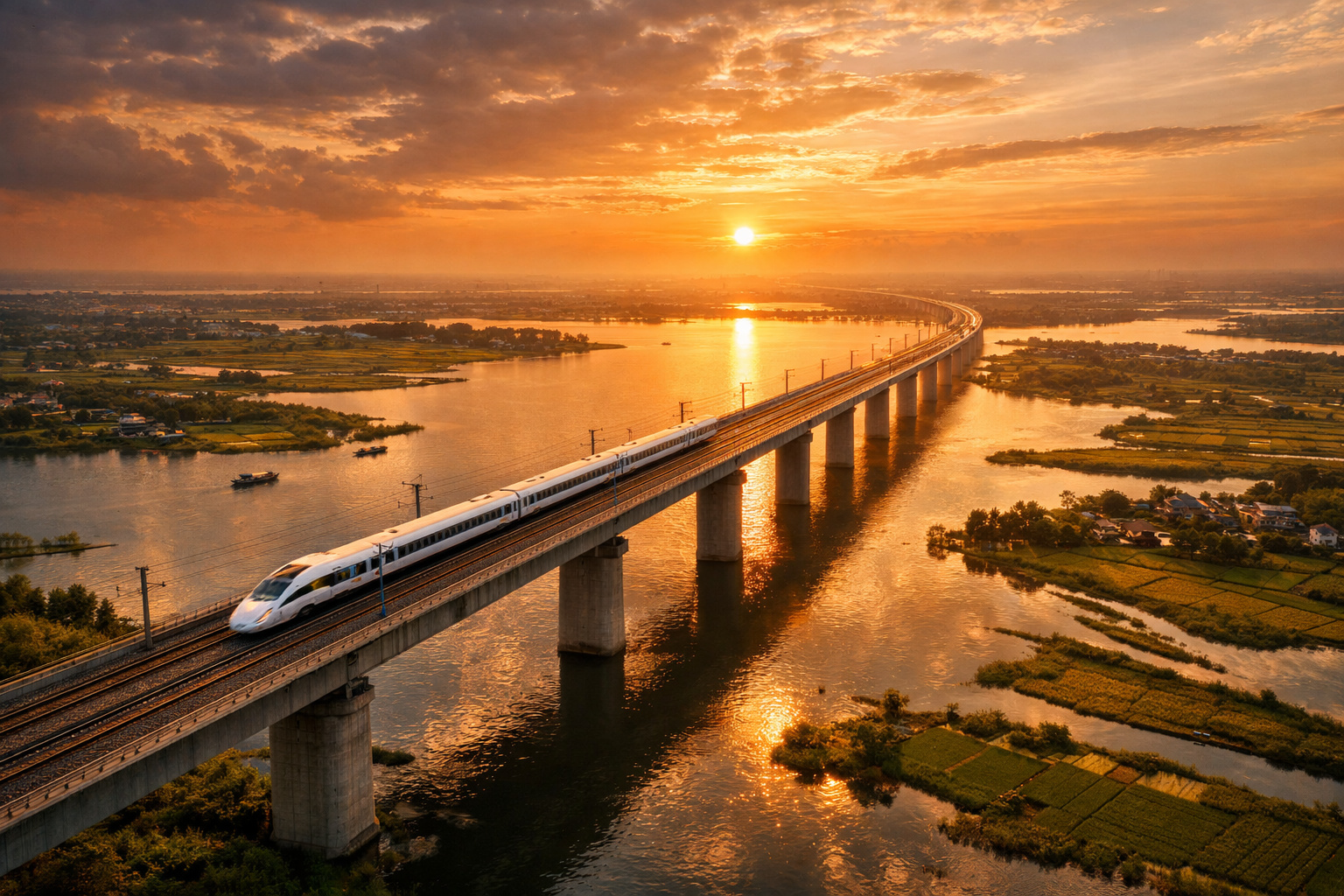
In China, each mega structure is born from a scenario that many countries would consider insurmountable. Abrupt mountains, unstable deserts, gigantic rivers, and seas with high seismic activity do not hinder progress — on the contrary, they drive innovative solutions. This information was disclosed by “Mega Curioso Engenharia Global,” according to a technical survey based on public data of Chinese infrastructure and official technology reports.
By analyzing these projects, we realize that it is not just about physical grandeur. In fact, it is about national strategy. Furthermore, each project incorporates cutting-edge technology, digital planning, and accelerated execution. Consequently, China does not just build — it redefines global standards.
Extreme Infrastructure: When Engineering Conquers Nature
First of all, the Qinghai-Tibet Railway symbolizes this technical dominance. It reaches an altitude of 5,000 meters, becoming the highest railway in the world. At this height, oxygen is limited; therefore, the carriages are pressurized and equipped with additional oxygen. In this way, passengers traverse inhospitable regions safely.
-
Motorola launched the Signature with a gold seal from DxOMark, tying with the iPhone 17 Pro in camera performance, Snapdragon 8 Gen 5 that surpassed 3 million in benchmarks, and a zoom that impresses even at night.

-
Satellites reveal beneath the Sahara a giant river buried for thousands of kilometers: study shows that the largest hot desert on the planet was once traversed by a river system comparable to the largest on Earth.

-
Scientists have captured something never seen in space: newly born stars are creating gigantic rings of light a thousand times larger than the distance between the Earth and the Sun, and this changes everything we knew about stellar birth.

-
Geologists find traces of a continent that disappeared 155 million years ago after separating from Australia and reveal that it did not sink, but broke into fragments scattered across Southeast Asia.
Next, the Danyang–Kunshan Grand Bridge impresses even more. With a length of 161 km, it is the longest bridge on the planet. It was completed in less than 4 years by about 10,000 workers. Thus, it allows the high-speed train to cross rivers and fields without interruptions.
Moreover, the Shanghai Maglev connects Pudong Airport to Longyang Road Station in just 7 minutes, reaching 431 km/h. Since it uses magnetic levitation, it eliminates physical contact with tracks. Therefore, it reduces noise and mechanical wear.


Meanwhile, the Hong Kong–Zhuhai–Macau Bridge combines marine stretches, underwater tunnels, and artificial islands in an active seismic area. At the same time, the Shenzhen–Zhongshan Link extends over 49 km, integrating bridges, tunnels, and artificial structures in an area of variable tides.
In the energy sector, the Three Gorges Dam, inaugurated in 2003 after nearly two decades of work, generates approximately 2% of the energy consumed in the country. Its ship lift transports vessels of up to 3,000 tons in about 40 minutes. In contrast, the traditional lock system would take several hours.
Also, the Tuoketuo Thermal Power Plant has 12 generating units and produces 6.7 GW of electricity. Consequently, it supplies strategic regions such as Beijing and Tianjin.
Skyscrapers, Technology, and Science at Record Scale
If the infrastructure is impressive, verticalization is not far behind. The Shanghai Tower, at 632 m, is the tallest building in China and the third tallest in the world. Its spiral design ensures stability against typhoons and seismic shocks. Additionally, 270 wind turbines generate up to 10% of the building’s own energy.
Shortly after, the Ping An Finance Center, at 599 m and 115 stories, ranks as the second tallest in the country. Similarly, the CTF Tianjin Center, at 530 m, stands as the fourth tallest in China and the eighth in the world.
Meanwhile, Beijing Daxing International Airport can accommodate up to 100 million passengers per year. Its curved corridors reduce internal distances, increasing operational efficiency.
In the scientific field, FAST is the largest and most sensitive radio telescope in the world. It detects signals as weak as a cellphone on Jupiter or emissions from galaxies 13 billion light-years away. Therefore, it places China at the forefront of astronomy.
At the same time, supercomputing centers perform a quadrillion calculations per second. This performance drives artificial intelligence models. In fact, experts project that within 5 to 10 years, humanoid robots will be able to converse fluently and recognize human emotions.
Historical Works and Projects That Span Millennia
However, grandeur is not recent. The Great Wall began about 2,000 years ago and continued until the 17th century, mobilizing approximately 10 million people. It crosses deserts, mountains, and valleys as a historical symbol of territorial protection.
Likewise, the Beijing–Hangzhou Grand Canal, at 1,700 km, is the longest artificial canal in the world. Built 2,500 years ago, it recorded up to 150,000 boats per year, transporting millions of tons of grain.
On the other hand, the Taklamakan Desert highway required the planting of thousands of shrubs to prevent shifting dunes from encroaching on the road. The Atulir Stairway reduced travel times from 2 to 3 hours to just 30 to 40 minutes, even with inclines reaching 70º.
Finally, the Port of Shanghai is consolidating as the largest in the world in cargo volume. In just one day, it handles more goods than some countries process in an entire year.
In light of these numbers and achievements, an inevitable reflection arises: are we witnessing merely great works or the emergence of a new technological power that will shape the 21st century?
Source: Lifeder Portuguese








-

-

-

-

5 pessoas reagiram a isso.