





 Portuguese
  English
  Spanish
  7 min of reading
  0 comments


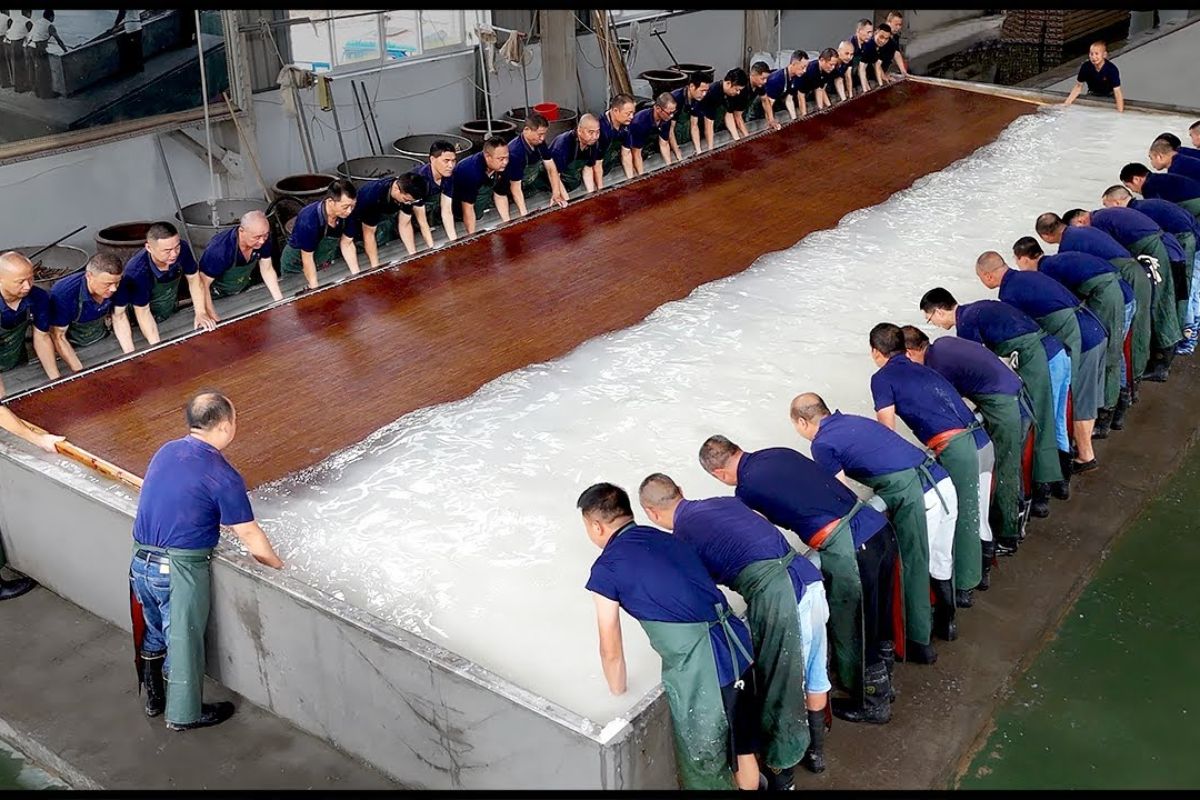
Made With Rice Straw, A Millenary Technique Listed By UNESCO And An Artisanal Process Of Over A Year, The Largest Paper In The World Can Reach US$ 60 Thousand Per Sheet And Has Less Than 30% Yield In Production.
At first glance, it’s just paper. But behind the largest paper in the world, made in China, there is an artisanal chain that starts with rice straw, scales the mountain on the back of workers, and ends at Christie’s auctions for up to 60 thousand dollars for a single sheet. All of this with a tradition so delicate that it has been recognized as an Intangible Cultural Heritage of Humanity by UNESCO.
At China Xuan Paper Co., founded in 1954 and responsible for about 80% of the global supply of Xuan paper, the routine for producing the largest paper in the world involves early mornings, 5-ton cauldrons of straw, year-long air drying, and a manufacturing room over eleven meters long. Each step is a mix of physical strength and almost surgical precision, where one mistake can tear the sheet and turn a masterpiece worth thousands of dollars into a total loss.
Where The Largest Paper In The World Is Born
The journey of the largest paper in the world begins in the city of Wuxi, in Jing County, Anhui Province, China. This is where Hongxing Paper Factory No. 542 is located, part of the traditional China Xuan Paper Co. Ltd., the first Xuan paper factory to resume production after the founding of the People’s Republic of China.
-
These living root bridges and ladders are over 700 years old and help indigenous people survive in one of the rainiest regions in the world.

-
From sertanejo star to international investor: Ana Castela invests millions in a mansion in the USA, creates a themed accommodation in Orlando, and shows that the “boiadeira” also wants to grow away from the stage.

-
The 10 most stunning motorhomes in the world: a $3 million trailer with a rooftop nightclub and garage for a Ferrari, “palaces on wheels” with Italian marble, private cinema, and five-star hotel luxury for billionaires.

-
Trump wanted to spend $400 million on the White House, but the courts prohibited the million-dollar construction.


Since 2009, the techniques used there have been part of the Intangible Cultural Heritage of Humanity recognized by UNESCO. It is not just a simple production line, but a collection of knowledge passed down through generations. The largest paper in the world only exists because millenary knowledge has been preserved and adapted to modern scale, without abandoning manual labor.
From Rice Straw To The First Step Of Transformation

The main raw material for the largest paper in the world is rice straw. It is chosen for its long fibers, ideal for producing a strong and flexible paper, suitable for calligraphy, painting, and large panels.

The workers start early. At three in the morning, the masters are already at work. The rice straw is tied in bundles, soaked in alkaline water to soften the fibers, and then carefully stacked for drainage of excess water. Each soaked bundle can weigh about 7.5 kilos, and filling the huge cooking pot takes three to four hours of continuous effort.

This monumental cauldron can hold up to about 5,000 kilos of straw at once. It is boiled for 6 to 8 hours, in a process that breaks down the original structure and prepares the material to be transformed into pulp. When it comes out of the pot, the straw is still heavy and soaked, ready for the next challenge.
Climbing The Mountain With 50 Kilos On Your Back

After the boiling is finished, one of the most impressive scenes in the production of the largest paper in the world begins. The straw is carried in bamboo baskets up the mountain to dry.
Each load can weigh about 50 kilos. The workers go up and down several times, in firm steps that reveal not only physical strength but also a deep familiarity with the terrain and the routine.
At the top of the mountain, the straw is spread out in the open air. And here comes a step that no machinery can imitate. The straw needs to be exposed to the sun and rain for about an entire year. During this time, sunlight and water slowly wash away the most fragile organic matter, leaving a purer fiber, suitable for Xuan paper.
When the workers return to fetch the straw that has been maturing all this time, it no longer has the same original color. That is the sign that it is ready for the next level.
From Straw To Perfect Pulp For The Largest Paper In The World

After the long natural drying, the rice straw is crushed. From there, the more technical work of preparing the pulp begins. The straw is mixed with bark pulp in defined proportions until it reaches the ideal combination that will give rise to the largest paper in the world.
The mixture passes through screening machines that remove impurities. Then, the purified pulp flows into large tanks, where it will be used in the manufacturing of giant sheets.
None of this is done on the fly, there are proportions, times, and textures that the masters know in practice, from the experience accumulated over decades.
Inside The Workshop Of The Largest Paper In The World
The workshop where the largest paper in the world takes shape is not just any room. The space measures about 11.4 meters by 3.6 meters. It is within this rectangle that a giant sheet is formed on the surface of the water, in a pool fed by mountain springs.
A curious detail is the use of the juice from the wild kiwi vine. It is added to the pulp and acts as a natural adhesive, helping the fibers to bond more efficiently.
Before starting production, the workers hold a small meeting to distribute tasks and align teamwork.
They stir the water with bamboo poles to spread the pulp evenly, ensuring that the largest paper in the world will have no flaws in thickness.
Each sheet of this paper can be sold for about 4 thousand dollars. At auctions like those at Christie’s, there have been cases where a single sheet reached up to 60 thousand dollars, depending on its artistic or historical use. It is literally a blank masterpiece.
Pressing, Separation, And The Risk Of Losing Everything In A Movement
After forming, the sheet of the largest paper in the world is still saturated with water. It then goes to the pressing stage.
Wooden boards are stacked with the paper, and heavy steel beams are placed on top, increasing pressure. This force helps to expel the water and bond the fibers more firmly, stabilizing the paper structure.
When the pressing is finished, one of the most delicate phases begins. Before the sheets are separated, water is sprayed uniformly on the surface of the stack.
Workers then carefully tap on the stack so the sheets begin to loosen from one another. Separating the sheets requires boldness and precision, fully trusting in years of practice. One wrong move can tear the paper and turn a sheet worth thousands of dollars into discard.
The Drying On Iron Wall And Extreme Quality Control
With the sheets separated, the largest paper in the world goes to final drying. The factory uses a huge iron wall that functions like a giant radiator, heated to about 70 degrees Celsius. The sheets are stuck to this surface so that water evaporates quickly and the paper dries evenly.
After drying, each sheet undergoes strict inspection. The standards are so high that the yield rate of giant Xuan paper is less than 30%.
In other words, less than one-third of the produced sheets meet the required quality level. The rest is rejected for details that many people would not notice in a superficial analysis.
Cutting, Counting, Stamping: The Closure Of The Journey

The final stage of the largest paper in the world is quieter but equally careful. The approved sheets are cut when necessary. The knife used seems heavy, but it is extremely sharp, allowing for firm and precise cuts.
The workers then form bundles of 100 sheets and need to count them with absolute attention, as each unit has high value. Special seals are applied to the bundles, marking the origin and authenticity of the paper.
Only after that is the material packaged and sent to artists, collectors, institutions, and art markets. From rice straw to a stack of sealed packages, the journey is long, costly, and profoundly artisanal.
The value of the largest paper in the world is not just in its size or the fact that it is handmade. It encompasses time, technique, physical effort, risk of loss, and a tradition recognized worldwide.
Each sheet is the result of a year of waiting on the mountain, of early morning work, of hikes with 50 kilos on one’s back, of strict quality testing, and a yield rate of less than 30%.
Moreover, giant Xuan paper is sought after for noble uses, such as calligraphy, large-format painting, and works that blend contemporary art with traditional techniques.
It serves as a foundation that becomes part of the work, not just a disposable support. The combination of rarity, scale, manual labor, and cultural recognition helps explain why a sheet can reach 60 thousand dollars at auction.
After learning all this, let me know in the comments: did you imagine that behind the largest paper in the world there was so much technique, effort, and history, or did you always see paper as just a simple material of everyday life?








-

-

-

12 pessoas reagiram a isso.