





 Portuguese
  English
  Spanish
  7 min of reading
  0 comments


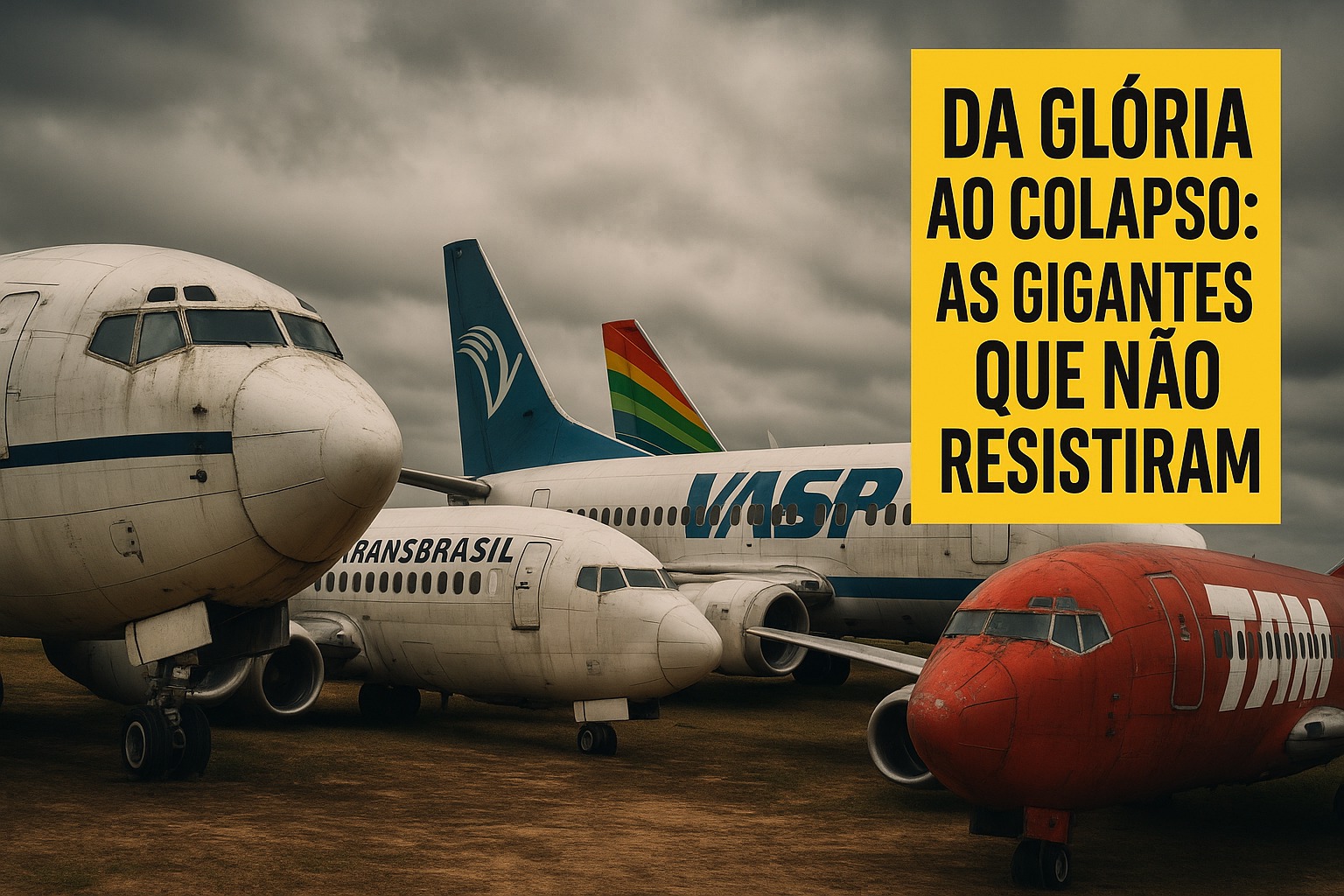
From State-Owned Companies to Global Brands, the Brazilian Aerospace Sector Experienced Marked Rises and Falls. From Varig to Tam, Each Symbolized a Distinct Era Marked by Glamor, Crises, Mergers, and the End of Great Empires of the Skies
The Brazilian aerospace sector has gone through decades of significant transformations. From the days when flying was synonymous with luxury and status to the recent mergers and fierce price battles, the country has witnessed moments of glory and collapse. Companies like Varig, Vasp, Transbrasil, Webjet, and Tam were the protagonists of different eras and reflect, each in its own way, the advancements and crises of national air transport.
For a long time, flying was an experience filled with glamor and distinction. Passengers dressed elegantly, inflight service was almost ceremonial, and airlines competed for sophistication.
However, the landscape changed over the years. Competition increased, costs grew, and many companies could not survive.
-
Historic bankruptcy of Centauro shocks the market, and the century-old company puts more than 500,000 products, machines, and complete infrastructure up for online auction.

-
New shoe factory in Ceará is expected to create 400 jobs and strengthen the local economy.

-
No one imagined it, but a mixture of sawdust with a mineral that fights fires surprises scientists with a result that changes the course of fire-resistant construction.

-
From empty land to a high-end house, wooden construction uses a lightweight system, metal structure for the foundation, ventilated ceramic cladding, and special windows to create an efficient and comfortable living space throughout the year.


Today, only memories and stories remain of a time when Brazilian skies were dominated by brands that seemed eternal.
Vasp: The Rise, The Crisis, and The End of a Pioneer
Founded in 1933, Viação Aérea São Paulo (Vasp) emerged from the dream of São Paulo entrepreneurs to make the state of São Paulo fly higher. In its early years, it faced severe financial difficulties.
In 1935, the state government purchased 91.6% of the shares, turning the company into a state-owned enterprise. Thus, Vasp came to represent São Paulo’s pride in the skies for over half a century.
However, the state-owned nature also brought hurdles. Political management and bureaucracy accumulated, and the company became a burden for the government.
In the 1990s, then-governor Orestes Quércia led the privatization process. The operation became surrounded by controversies and was investigated by a CPI that questioned the low sale price and public investments made shortly before the transaction.
The aging fleet became a costly obstacle. Maintaining old planes required high maintenance expenses, making operations unviable.
Competition increased, and Vasp began losing ground to new airlines. According to data from the Exame portal, in 2004 part of its planes was grounded due to irregularities, while employees initiated strikes.
In 2005, the company suspended regular flights and entered judicial recovery. The effort to rise again yielded no results.
Three years later, in 2008, bankruptcy was declared. To this day, Vasp’s bankrupt estate is suing the Union, claiming billions in losses caused by past price-regulated policies.
Today, what remains of Vasp are carcasses of planes displayed in museums or scrapped. A brand that once symbolized the advancement of Brazilian aviation ended as a nostalgic reminder of an era that has passed.
Varig: The Empire That Collapsed After Decades of Glory
Few brands were as representative in the Brazilian imagination as Varig.
Founded in 1927 by Otto Ernet Meyer Labastille, a German aviator who immigrated to Brazil, the company started small, operating on the route between Porto Alegre, Pelotas, and Rio Grande with the Dornier Wal seaplane, called “Atlântico.”
The beginning was challenging, but the company grew with the support of the government of Rio Grande do Sul. In 1942, it inaugurated its first international flight to Montevideo.
Thirteen years later, it reached New York with Lockheed Constellation aircraft, which became a symbol of the fleet’s modernity. The replacement by Boeing 707 in the 1960s marked Varig’s definitive entry into the global circuit.
Between the 1960s and 1980s, the company became one of the largest and most respected in the world.
Its inflight services were a reference in quality, with elaborate meals, elegant uniforms, and high-standard service. Traveling with Varig was synonymous with status and comfort.
But prestige did not prevent a crisis. In the 1990s, the company accumulated debts after purchasing new aircraft and suffered from the impact of the Gulf War, which reduced the number of passengers and raised fuel costs.
The global recession worsened the situation. Varig laid off thousands of employees and closed dozens of offices abroad.
Even with restructuring attempts, the financial gap grew. In 2005, the debt reached 5.7 billion reais.
Judicial recovery was the last resort. A year later, over 5,000 employees were dismissed in a single day, and the fleet was reduced to just ten aircraft.
In July 2006, the company was split into two parts: one sold to Volo Brasil, and the other retained with the debts.
The new Varig operated briefly, but in 2007 it was purchased by Gol. The former attempted to resist, launching the “Flex” brand, but unsuccessfully.
Definitive bankruptcy came in 2010. To this day, former employees await payments from the bankrupt estate, and multi-million dollar lawsuits are underway in court.
The name Varig remains a reminder of an empire that once made Brazil fly higher.
Transbrasil: From Meat to Collapse
The story of Transbrasil began in 1955 with a very different purpose: transporting fresh meat from Santa Catarina to São Paulo.
The company, founded by Omar Fontana, son of the founder of Sadia, gained momentum quickly and soon began to carry passengers as well.
In a short time, it purchased Transportes Aéreos Salvador and established itself as a commercial airline.
The 1970s marked its peak. In 1973, Omar opened the capital to employees and changed the name to Transbrasil. In the following years, the company grew, modernized its fleet, and initiated international flights.
With the arrival of the Boeing 767-200, the company began connecting Brazil to Orlando, USA. It was the dream of many Brazilians to visit Disney via Transbrasil.
Yet the economic landscape of the 1980s brought difficulties. Successive economic plans and the freezing of ticket prices generated losses as operational costs continued to rise.
In the 1990s, even with efforts to maintain international flights, increased competition and lack of credit made the situation unsustainable.
By the early 2000s, Transbrasil could no longer afford fuel. The planes were grounded, and flights were canceled.
Bankruptcy was declared in 2002, sadly ending the trajectory of one of the most beloved national airlines.
Three years later, rumors of a potential purchase by foreign companies emerged, but nothing materialized.
Thus, Transbrasil remains in the memory of those who lived in an era when flying with it was synonymous with friendliness, efficiency, and Brazilian spirit.
Webjet: The Brief Flight of Cheap Tickets
In the mid-2000s, Brazil encountered a new business model: low-cost airlines. Webjet was one of the first to attempt to follow this path.
Founded in 2004 by executives from the financial sector, the company took flight the following year with the proposal for affordable tickets.
The idea seemed promising, but competition reacted quickly. Gol, Tam, and Varig lowered prices on the same routes, making survival difficult for the new airline. A few months after its launch, Webjet faced a crisis and was sold.
In 2006, it changed hands for the first time. A year later, it came under the control of CVC, which used its planes for charters. This partnership kept the company alive for about five years.
In 2011, Gol acquired Webjet for 310 million reais. The acquisition was part of a strategy to expand the airline’s network.
However, just a year later, the brand was discontinued. The justification was the high operating costs: Webjet’s aircraft required more maintenance and generated expenses 30% higher than Gol’s.
With the closure, 850 employees were laid off. Thus, Webjet had a short trajectory, marked by ambition and challenges in competing in a market that was still unprepared for the low-cost model.
Tam: The Transformation That Led to Latam
Tam was founded in 1961, initially as Táxi Aéreo Marília. Created by ten pilots of single-engine planes, the company operated cargo and passenger transport between Paraná, São Paulo, and Mato Grosso.
In 1967, entrepreneur Orlando Ometto, one of the world’s largest sugar producers, purchased the group.
Shortly after, Commander Rolim Amaro joined the partnership and began to shape the future of the company.
His entrepreneurial vision and commitment to quality service led Tam to grow rapidly.
In the 1990s, the company covered the entire national territory and, in 1998, made its debut in the international market, with flights between São Paulo and Miami.
In the early 2000s, Tam formed partnerships with foreign airlines and became part of the global Star Alliance, strengthening its presence outside the country.
In 2010, the big turning point came. Tam announced its merger with Chilean Lan Airlines, creating the Latam Airlines group.
The operation resulted in one of the largest airlines in Latin America. Six years later, in 2016, both Tam and Lan stopped using their original names and officially adopted the new brand Latam, consolidating the union.
Thus, Tam closed its history as one of the most emblematic companies in Brazilian aviation, becoming part of a multinational group.
The Legacy Left in Brazilian Skies
The stories of Vasp, Varig, Transbrasil, Webjet, and Tam show that the aviation sector is a reflection of the time each one lived. There were times of glamor and innovation, but also crises and restructuring.
These airlines paved the way for national aviation. Their trajectories reveal how air transport in Brazil has been shaped by political, economic, and technological contexts.
Although many have disappeared, they left deep marks: airports, memories of travels, iconic advertisements, and stories of those who dedicated their lives to flying.
Each takeoff and landing of these companies helped to build the country’s air map. Therefore, more than just the end of brands, the disappearance of these companies symbolizes the closure of chapters in Brazilian history in the skies.
With information from Exame.









-

Uma pessoa reagiu a isso.