





 Portuguese
  English
  Spanish
  4 min of reading
  1 comment


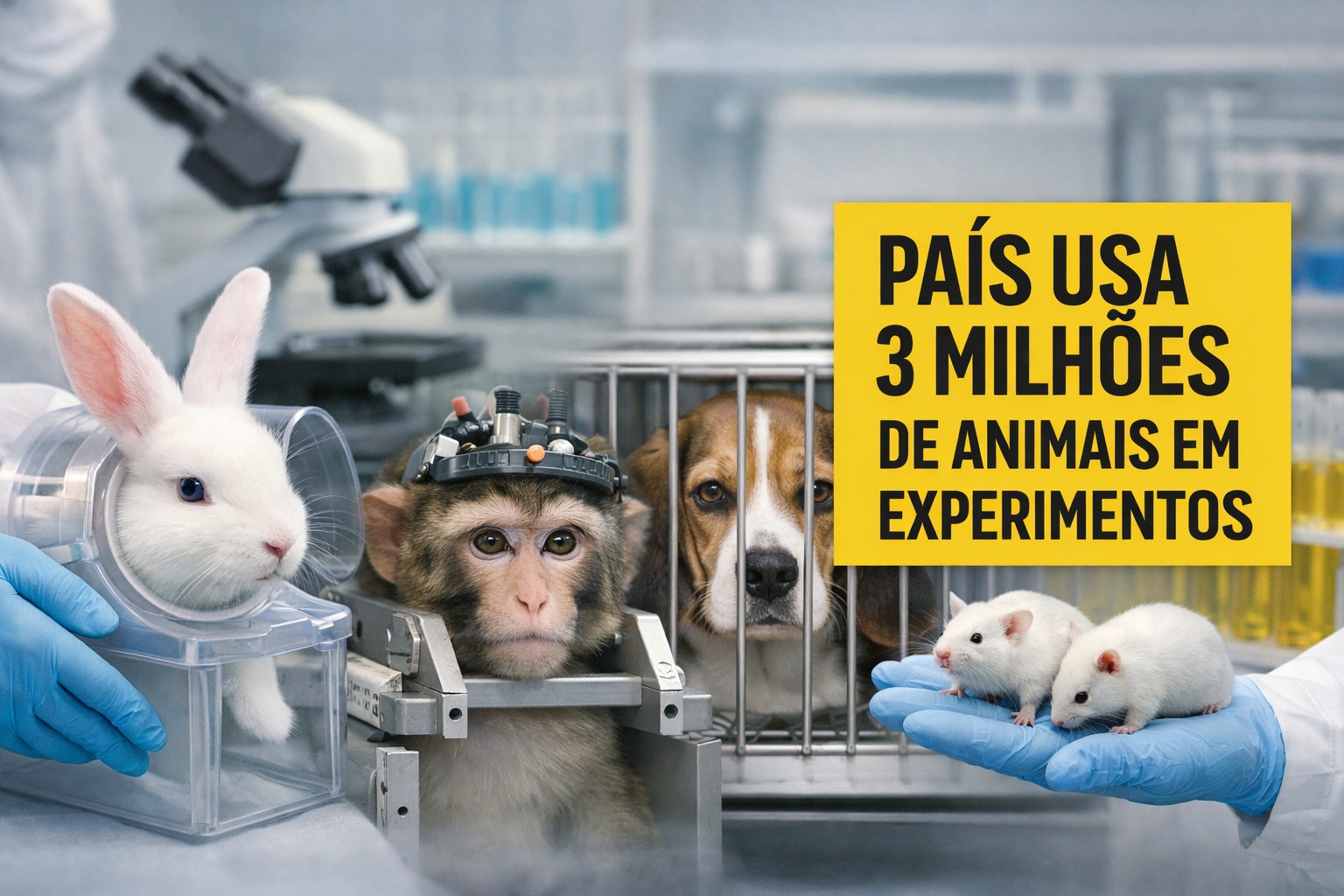


Federal Statistics Show Annual Decline, But Reveal Persistence of Basic Research, Disposal of Surplus, Use of Dogs and Primates, Along with Stagnation in Severe Experiments, Maintaining Ethical and Political Pressure
In 2024, Germany used 3,063,569 animals in scientific experiments, according to official statistics, a number that is 12.5% lower than the previous year, which reignited the debate on ethics, public policy, and the transition to animal-free methods.
Overall Decline in Official Numbers
Federal statistics indicate that the majority of the 3,063,569 animals used in 2024 ended up being sacrificed during or at the end of the scientific procedures conducted in the country.
The data was released by the German Center for the Protection of Laboratory Animals, responsible for consolidating and publishing the official records of the federal government.
-
The Himalayas continue to grow to this day, with tectonic plates advancing 5 cm per year, mountains rising up to 10 mm annually, and the 2015 earthquake that killed 9,000 people may have increased the risk of an even larger seismic mega-event.

-
At an altitude of 400 km by astronauts from the International Space Station, Paris transforms at night into a golden mesh so precise that it reveals the outline of the Seine River, avenues, and entire neighborhoods like a luminous map drawn over the Earth.

-
iPhone 17 reaches historic low price with 256 GB, 120 Hz display, and drops to R$ 5,703 on Shopee, featuring A19 chip, dual 48 MP cameras, battery life of up to 30 hours, and advanced AI features.

-
Trip to Mars getting closer: Pulsar Fusion, from the UK, advances with plasma ignition in fusion engine and could drastically reduce space travel time, making crewed missions faster, safer, and economically viable.


Of the total counted, 1,327,931 animals were directly used in scientific experiments, which almost always result in the death of the individuals involved.
Another 626,538 animals were specifically sacrificed for scientific purposes, such as the collection of organs and tissues intended for laboratory analyses.
In addition, 1,109,100 animals considered surplus were bred for experiments but were slaughtered for not being used later.
Overall, the approximate reduction of 438,000 animals compared to the previous year represents a decrease of about 12.5%.
Reduction of Surplus Animals
One of the most highlighted points was the 19% decrease in the number of surplus animals, which fell to about 1.1 million in 2024.
These animals are bred in the laboratory but discarded for economic reasons, often never participating in scientific experiments.
According to Dr. Johanna Walter, scientific consultant for Doctors Against Animal Experiments, the decline may be linked to a reduction in genetically modified animals.
There was an 11% reduction in this group, whose breeding often generates individuals without the desired characteristics, leading to systematic slaughter.
The reduction in the disposal of surplus animals had already been observed in the previous year, indicating a recent trend in this specific segment.
In 2022, the organization filed a criminal complaint after publicly denouncing the illegal slaughter of surplus animals in the country.
Basic Research Continues to Concentrate the Majority
In basic research, not oriented towards specific objectives, the reduction was much smaller, about 2% compared to the previous year.
Even so, this area concentrated the majority of animal experiments, totaling 758,244 individuals in 2024.
This volume corresponds to 57% of all animals used directly in scientific experiments in the country.
The persistence of this level reinforces the historical weight of basic research in German animal experimentation.
Most Used Species in Laboratories
Rats remained the most used species, with 956,636 animals, representing 72% of the experiments conducted in 2024.
Fish occupied the second position, with a 9% increase, totaling 176,778 animals and about 13% of the total.
In third place were mice, with 83,369 animals, corresponding to approximately 6% of the official records.
These three groups concentrated the vast majority of laboratory procedures conducted in the country.
Use of Rabbits, Dogs, and Primates
Rabbits totaled 57,966 individuals, with almost 88% used in routine production, such as polyclonal antibodies.
Dogs were also used, with 2,220 animals, along with 1,088 monkeys and 698 cats in different types of experiments.
The presence of these species keeps the ethical debate alive, especially when involving invasive procedures and prolonged reuse.
Severely Distressing Experiments
In 2024, 47,708 animals were subjected to experiments classified as severely distressing by the competent authorities.
This number represents only about 3,000 fewer than in the previous year, indicating stagnation in this type of practice.
According to critical evaluations, the real suffering may be greater, as official classifications tend to underestimate the intensity of the procedures.
Decline in Monkey Use and Political Pressure
The number of monkeys used fell by 35%, reaching 1,088 animals, although 19% of them were reused in experiments.
In basic research, these primates are often repeatedly employed in invasive brain studies over the years.
To address this scenario, the organization, in partnership with PETA, presented a petition to the Bundestag, with over 40,000 verified signatures.
Limits of the Current Strategy
Overall, the organization views the downward trend as positive but points to worrying signs of stabilization.
According to the organization, this may reflect the advancement of animal-free technologies, such as organs on a chip and computational models.
Still, more than 3 million animals continue to suffer in experiments whose results are not transferable to humans.
The failure of the reduction strategy promised by the previous government, expected for spring 2025, highlights a lack of political will.
Among the identified issues are the absence of binding funding, little transparency, and insufficient guidelines for alternative methods.
While other countries advance in phased elimination plans, Germany maintains significant untapped potential.
In the end, the organization argues that the progressive elimination of experiments should be promoted politically, prioritizing scientifically superior and animal-free methods.
With information from Aerzte.









THESE INVASIVE UNETHICAL AND INHUMANE **** EXPERIMENTS MUST STOP!!!
THEY ARE NO LONGER SUSTAINABLE IN OUR MODERN CLIMATE IF TODAY..BUT VERY MUCH IN LINE WITH THE DINOSAUR DAYS…
TIME TO CEASE THE CRUEL, UNJUSTIFIED TORTURE OF THESE GOD GIVEN ANIMALS AND INVESTIGATE MANY OTHER GENERIC WAYS!!!