





 Portuguese
  English
  Spanish
  5 min of reading
  2 comments


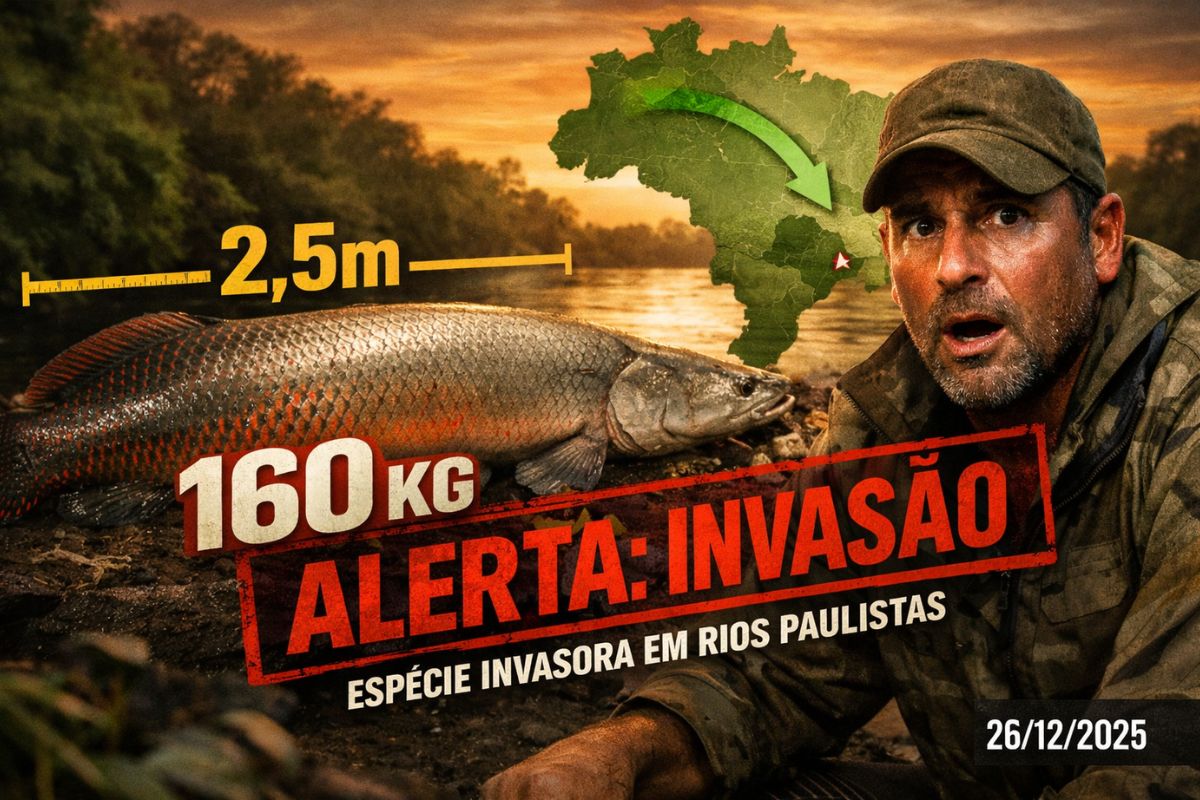


Captured on December 26, 2025, on the Marinhiero River in Cardoso, inland São Paulo, the giant fish of the Amazon weighing 160 kilograms is an invasive species without predators, threatening local fish and has become a target released for incentivized fishing by environmental authorities in the rivers of São Paulo for urgent control of the invasion
On December 26, 2025, a 53-year-old fisherman caught in the Marinhiero River in Cardoso, inland São Paulo, a Arapaima gigas measuring 2.5 meters and weighing 160 kilograms. The record impresses not only due to the size of the animal, one of the largest freshwater fish in the world, but also the fact that a giant fish of the Amazon appearing in a Paulista river outside of its natural biome reinforces the fear of biological invasion.
Throughout 2025, environmental agencies and researchers had been warning of the expansion of pirarucu through the rivers of São Paulo, Minas Gerais, and Pantanal. Classified as an invasive species in these basins, the giant fish of the Amazon has been strictly monitored by the Environmental Military Police, which authorized capture without weight limit or quantity as a way to try to contain the advance of a species without natural predators in these regions.
The Capture of the Pirarucu in Inland Paulista

The case of Cardoso gained prominence for uniting, in a single episode, almost all the elements of the environmental problem.
-
The eggshell that almost everyone throws away is made up of about 95% calcium carbonate and can help enrich the soil when crushed, slowly releasing nutrients and being reused in home gardens and vegetable patches.

-
This farm in the United States does not use sunlight, does not use soil, and produces 500 times more food per square meter than traditional agriculture: the secret lies in 42,000 LEDs, hydroponics, and a system that recycles even the heat from the lamps.

-
The water that almost everyone throws away after cooking potatoes carries nutrients released during the preparation and can be reused to help in the development of plants when used correctly at the base of gardens and pots, at no additional cost and without changing the routine.

-
The sea water temperature rose from 28 to 34 degrees in Santa Catarina and killed up to 90% of the oysters: producers who planted over 1 million seeds lost practically everything and say that if it happens again, production is doomed to end.


In a river in inland São Paulo, traditionally occupied by native species, a giant fish of the Amazon measuring 2.5 meters, 160 kilograms, and apex predator habits emerges, capable of consuming large volumes of fish and crustaceans in a short time.
The image of the animal stretched along the banks of the Marinhiero River, in the heart of rural São Paulo, symbolizes the silent change underway in the fauna of the Southeast’s rivers.
For technicians, the fact that a specimen of this size has already established itself in the region indicates that the presence of the pirarucu is not accidental, but a result of artificial introduction and a population that finds conditions to reproduce far from the Amazon.
Invasive Species Without Predator and Target Released by Police
Outside the Amazon Basin, the pirarucu finds no natural enemies capable of controlling its population growth.
As a top carnivorous predator, it feeds on native fish and crustaceans, directly competing with local species for food and space.
The result is an imbalance that could reconfigure the biodiversity of the Paulista rivers in a few years, unless something is done.
Therefore, the Environmental Military Police adopts a different stance towards the pirarucu and native species.
While local fish have closed seasons and catch limits, the giant fish of the Amazon can be fished without weight or quantity restrictions in Paulista rivers, with the removal of the animal being openly encouraged by authorities as an environmental control measure.
In practice, the pirarucu becomes a target released for fishermen, precisely to try to protect the original fauna.
Biological Advantages of the Giant Fish of the Amazon
Part of the environmental risk is linked to the characteristics of the pirarucu itself.
Commonly known as “cod of the Amazon” due to its white, almost boneless, and highly gastronomic meat, the giant fish of the Amazon possesses a rare adaptive advantage: the ability to breathe atmospheric air.
This characteristic allows the pirarucu to survive in oxygen-poor waters, periodically surfacing to breathe.
In degraded environments, where native species suffer from lack of oxygen, the giant fish of the Amazon remains strong, grows quickly, and further enhances its competitive advantage, favoring the expansion of the species in basins for which it was never intended.
Valued Meat, Luxury Skin, and the Economic Paradox
In addition to being a powerful predator, the pirarucu has high commercial potential. Its meat is widely used in regional cuisine, and the carcass has almost total utilization, from food to handicrafts.
The skin, in turn, is coveted by the luxury fashion industry for the production of accessories, boots, and bags, feeding an economic chain that goes far beyond subsistence fishing.
This market value creates a paradox.
On one hand, the giant fish of the Amazon represents a concrete risk to the Paulista rivers as an invasive species.
On the other, it generates economic incentive for capture, benefiting fishermen, restaurants, and segments of the industry.
The challenge for environmental agencies is to balance this potential for utilization without turning the invasion into an argument to stimulate irresponsible introductions to new basins.
Risk to Southeast and Pantanal Rivers
The presence of the pirarucu is not limited to São Paulo.
The giant fish of the Amazon has also been recorded in rivers of Minas Gerais and Pantanal, where it receives the same label of invasive species.
In all these cases, the logic is similar: different biomes, absence of natural predators, and a large capacity to consume native species.
Environmentalists emphasize that, although the pirarucu is a symbol of the Amazon and plays an important role in its original environment, artificial introduction into rivers of the Southeast and Central West is viewed as a serious management error, with effects that can take years to be fully assessed.
The concern is that, without coordinated control actions, the affected rivers may undergo a structural change, with loss of diversity and dominance of a few resistant species.
Environmental Control and the Role of the Fisherman in the Removal of the Species
In light of this scenario, the fisherman who caught the 160-kilogram specimen in the Marinhiero River is not seen as a villain, but as part of the short-term solution.
The guidance from the Environmental Military Police is clear: whenever the giant fish of the Amazon is captured outside the Amazon, it must be removed from the environment, without being returned to the river.
The incentive for unlimited capture transforms the fisherman into an ally of environmental control, at least while there are no more robust programs for mapping and eradication of the species in the affected basins.
Still, specialists remind us that the removal of already established individuals does not solve the problem on its own if new introductions continue occurring, whether due to poorly managed breeding facilities or deliberate releases into rivers outside the Amazon.
In your perspective as a citizen, facing a giant fish of the Amazon representing a threat to the rivers of São Paulo, do you think that allowing unlimited fishing is enough to contain the invasion or are even tougher control and enforcement measures needed?










Deveriam investigar quem foi o **** que levou o peixe em primeiro lugar. Sou de Manaus e aqui temos leis que nos proíbe pescar esse peixe sem limites.
Isso me lembra do caso do restaurante que pegou uma espécie extrangeira agressiva para cozinhar e por acidente ele caiu no mar.