





 Portuguese
  English
  Spanish
  9 min of reading
  1 comment


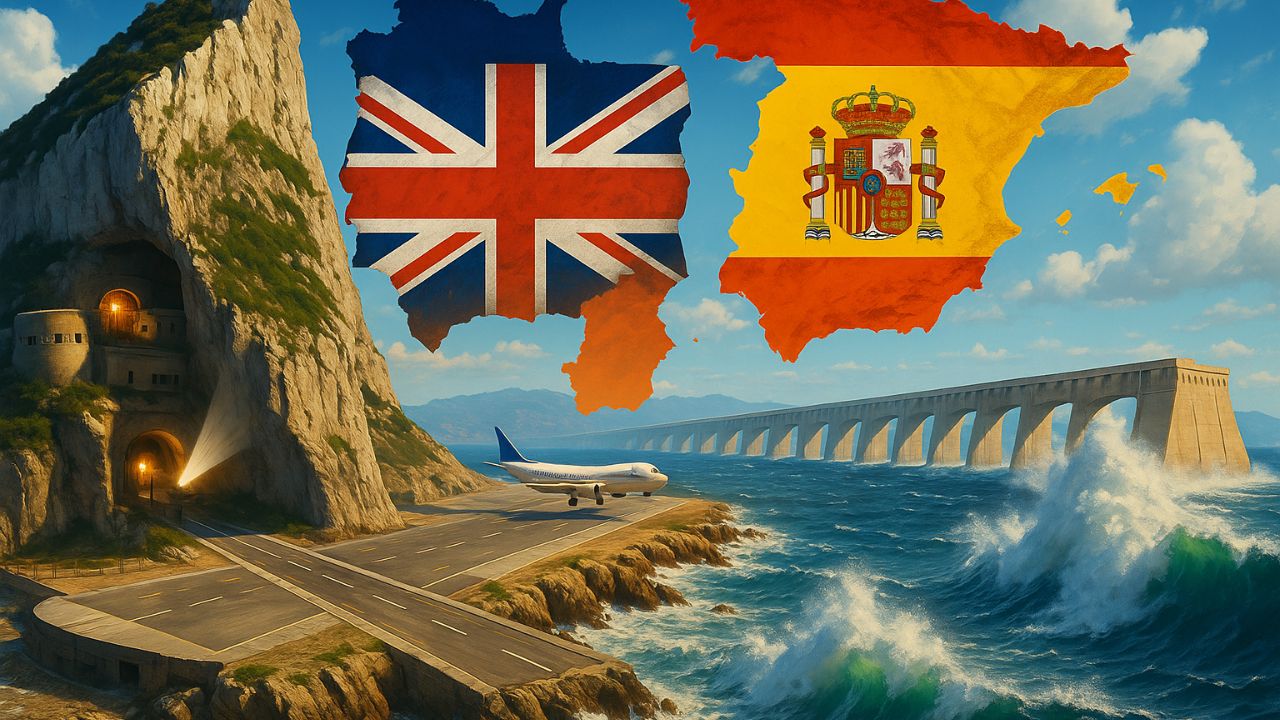


Gibraltar, The Rock That Became An Explosive Point Between The United Kingdom, Spain, And The Future Of Europe
Between the Atlantic Ocean and the Mediterranean Sea, Gibraltar occupies one of the most strategic points on the planet and has become a symbol of how Europe is contested even in its smallest pieces of land. This tiny territory, located at the southern tip of the Iberian Peninsula, is under British rule, although it is adjacent to Spain and separated from Africa by only 14 km, in a region that links two continents and concentrates military, economic, and geopolitical interests. It is there that Europe seems to fold in on itself in a dispute that mixes history, war, diplomacy, and strategy.
At the same time, Gibraltar harbors an almost secret side, with military tunnels carved inside the rock, a unique airport in the world, and the trace of one of humanity’s most ambitious plans.
In the 20th century, the strait separating Europe and Africa was the center of Project Alantropa, an idea that aimed to build a colossal dam to lower the Mediterranean Sea level, create new lands, and generate energy for the entire continent.
-
These living root bridges and ladders are over 700 years old and help indigenous people survive in one of the rainiest regions in the world.

-
From sertanejo star to international investor: Ana Castela invests millions in a mansion in the USA, creates a themed accommodation in Orlando, and shows that the “boiadeira” also wants to grow away from the stage.

-
The 10 most stunning motorhomes in the world: a $3 million trailer with a rooftop nightclub and garage for a Ferrari, “palaces on wheels” with Italian marble, private cinema, and five-star hotel luxury for billionaires.
-
Trump wanted to spend $400 million on the White House, but the courts prohibited the million-dollar construction.

Gibraltar became the stage for a giant engineering dream that promised to change the very geography of Europe but is now seen as an environmental and social nightmare.
Gibraltar, The Strategic Rock Between Europe and Africa
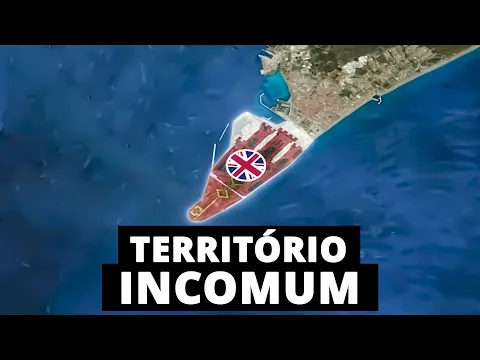

When we talk about Gibraltar, we talk about three things at once: an imposing rock, a tiny city, and a connection point between Europe and Africa. The famous “The Rock” is a massive block of stone about 426 meters high, the result of a very steep hill that dominates the landscape.
This rock is connected to the continent by a small peninsula, where the city and part of the strategic structures are located. The Strait of Gibraltar is also there, the point where the Atlantic meets the Mediterranean, separating Europe from North Africa at a very short distance of 14 km.
Despite being almost an extreme point of the European continent, Gibraltar is not the southernmost place. That title belongs to the Punta de Europa, further south in the region, and yet there is an even more southern point on the Spanish mainland, at Punta de Tarifa in Cádiz.
Even so, Gibraltar is treated as one of the “gates to Europe”, as those who control this strait have direct influence over the passage of ships between the Mediterranean and the Atlantic, something vital for trade, energy, and military strategy.
Colony, UN, and Referendums That Marked The Future Of Gibraltar
Politically, Gibraltar is a unique territory within Europe. For the UN, it is on the list of 17 non-self-governing territories in the world, a term that refers to its colonial past. In 2019, the European Union itself classified Gibraltar as a British colony.
About 34,000 people live in an area of nearly 7 km², making it one of the most densely populated places in the world, second only to regions like Macau, Monaco, Singapore, and Hong Kong. In just a few kilometers, Europe shows how power and territory can be compressed to the maximum.
The physical border between the United Kingdom and continental Europe there is very short, at only 1.2 km, the second shortest in the world. On the Spanish side is the city of La Línea de la Concepción, with about 70,000 inhabitants.
Out of that total, approximately 10,000 cross the border daily to work in Gibraltar. This daily coexistence reinforces the feeling that, although the territory is in the hands of the United Kingdom, practical life remains deeply connected to Spain and Europe in general.
From Succession War To Modern Diplomacy In Europe
To understand why Gibraltar is in the hands of the United Kingdom, one must go back to the early 18th century, during the War of the Spanish Succession. In 1704, amid the conflict, England took Gibraltar by force. Nine years later, the end of the war was sealed with the Treaty of Utrecht.
In one of its articles, Spain agreed to cede Gibraltar to Great Britain, including the city, castle, port, defenses, and fortresses. It was there that the rock officially ceased to be Spanish and was recognized as a piece of Europe under the British flag.
The Spanish desire to regain the territory, however, has never vanished. Between 1779 and 1783, the so-called Great Siege took place, when Spain attempted to retake Gibraltar by force but militarily failed. Over time, the United Kingdom took advantage of various circumstances to expand its area of control, which increased tensions.
If for the British there is a legitimate border, for the Spanish it is seen as a “gate” within a territory they consider originally theirs. From the 20th century on, the dispute migrated from open war to the diplomatic arena, with Spain resorting to negotiations and international pressures to try to reverse the situation.
The Voice Of The Gibraltar Residents, The Referendums, And The Impact Of Brexit
In the midst of this dispute between European powers, the inhabitants of Gibraltar also wanted to be heard. In 1967, a referendum was held to decide whether the territory would remain under British rule or return to Spain.
In 2002, a new referendum was held, this time regarding the possibility of dividing Gibraltar’s sovereignty between the United Kingdom and Spain. Once again, the residents rejected the proposal, reaffirming their desire to maintain the exclusive bond with the British.
In 2016, Brexit happened. In the vote on the United Kingdom’s exit from the European Union, 96 percent of Gibraltarians voted to remain in the European bloc, but the overall result for the UK took them out as well. Crucial decisions about borders, trade, and mobility were made without the will of Gibraltar and Southern Europe being truly decisive.
Border, Passports, And Daily Life Between Europe And The United Kingdom

In practice, Gibraltar has always had a peculiar relationship with continental Europe. Even before Brexit, the European agreement that cuts border controls in over 20 countries was never applied there in the same way.
It has always been necessary to show a passport to enter or exit the territory, and the United Kingdom’s exit from the European Union did not change that specific point. On one hand, this reinforces the idea that it is a sensitive and strategic point. On the other hand, it shows how the border between Europe and the United Kingdom there is as political as it is physical.
Daily life reflects this mix. Many residents of the neighboring Spanish city depend on Gibraltar for work, while the territory relies on this flow of labor and services.
At the same time, there is a unique dialect that mixes Spanish and English with a strong accent, symbolizing this hybrid identity. In just a few kilometers, you can hear languages cross, see different flags, and realize how real Europe is made of interdependence, not just lines on a map.
War Tunnels And An Airport That Cuts Through The City
During World War II, the United Kingdom transformed Gibraltar into a major supply and defense center. About 50 km of underground tunnels were dug into the rock, creating storage for food, water, fuel, power generators, and even hospitals.
This underground city made use of the limited space available while protecting troops and supplies from attacks and blockades. The geography that was already strategic for Europe became even more valuable in wartime.
On the surface, Gibraltar is home to one of the most curious airports in the world. Almost half of the runway was built on filled land, and the landing strip crosses precisely the main vehicle traffic route. This means that cars and planes share the same space, at different times, with traffic being blocked when there are landings and takeoffs.
It is not the only place on the planet with this characteristic, as Tuvalu also has a similar passage, but it is an example of how a tiny territory in Europe had to adapt to fit everything in such a small space.
Monkeys, Nature, And Curiosities At The Edge Of Europe
Gibraltar is also known for housing a species of monkeys that have become almost a local symbol. They are the famous Barbary macaques, usually found only there. They roam the rock and are part of the imagination of those who visit the region.
In such a small space, the coexistence of nature, city, tourism, and military structures serves as a reminder of how Europe concentrates human and environmental stories in very small territories.
This combination of unique fauna, extremely high population density, and military relevance helps explain why Gibraltar goes far beyond its area in square kilometers. It serves as a showcase for larger issues involving sovereignty, colonization, borders, and identity within Europe.
Alantropa, The Project That Wanted To Redesign Europe And Africa
In the 20th century, Gibraltar was at the center of an idea that seems like science fiction. In 1928, German architect Herman Sörgel proposed constructing a gigantic dam at the Strait of Gibraltar. The structure would be approximately 35 km long and 550 meters wide.
The main goal was to generate enough energy to supply all of Europe, using the difference in level between the Atlantic and the Mediterranean to move turbines. It was a plan that saw the strait not only as a strategic point but as a giant energy outlet for the continent.
The ambition, however, went far beyond that. Sörgel intended to lower the Mediterranean Sea level, draining large areas between Europe and Africa and creating new lands in North Africa and Southern Europe. This supercontinent would be called Alantropa, the same name given to the project, and would also require two other large dams: one between Italy and Tunisia and another separating the Mediterranean from the Black Sea.
In theory, this would increase the area available for agriculture and urban development, as well as strengthen European access to Africa’s natural resources. In practice, the project completely ignored the well-being of Africans and reinforced a view of exploitation of Africa by Europe.
Why Alantropa Did Not Come To Fruition And Why It Would Have Been A Disaster
The cost of building dams of such magnitude was monumental and became one of the main obstacles to bringing Alantropa to fruition. Additionally, over time, environmental concerns and questions about the real impact of such intervention began to emerge.
The lack of international political support completed the scenario of impracticality. Nevertheless, the idea shows how far some European projects were willing to go to secure energy and territorial control.
Today, it is understood that implementing the project would have generated severe consequences. Various areas would be completely flooded, rainfall and climate patterns would be unpredictably altered, and flora and fauna would suffer deep impacts. The new lands created would likely have high salinity, making them of little use for agriculture.
Furthermore, the inequality between the continents would tend to increase, leaving Africa even poorer and more exploited. In more recent times, there was even talk of building a bridge between Europe and Africa in the strait region, but that plan also did not advance. Gibraltar remains a crossing point, not a physical bridge between the continents.
Gibraltar Today, Between Colonial Past And The Future Of Europe
Gibraltar is one of those places where the map deceives. Viewed from a distance, it seems just a small tip of land in the giant wheel of Europe. Looking closely, it reveals wars of succession, international treaties, referendums, closed borders, post-Brexit tensions, war tunnels, improbable airports, curious monkeys, and gigantic projects like Alantropa.
In just a few kilometers, discussions about sovereignty, energy, the environment, and Europe’s role in its relationship with Africa concentrate.
At the same time, the territory continues to be a symbol of how decisions made in distant capitals can affect the lives of those living on the border. The Gibraltarians have voiced what they want on multiple occasions but continue to coexist with disputes between the United Kingdom, Spain, and the European Union that shape their future.
Ultimately, Gibraltar reminds us that the history of Europe is not only written in the grand capitals but also in small rocks surrounded by sea, tunnels, and engineering dreams that never materialized.
What do you think? Do you believe that giant projects like Alantropa should have been pursued by Europe, or was it better for the world that they remained just in the imagination of engineers?






As one of the 34 people who live in Gibraltar this is the biggest load of nonsense about the place, and these days airport traffic goes through a tunnel. Maybe there was an idea to build a dam in 1928 by a German. It was never serious.