





 Portuguese
  English
  Spanish
  6 min of reading
  0 comments


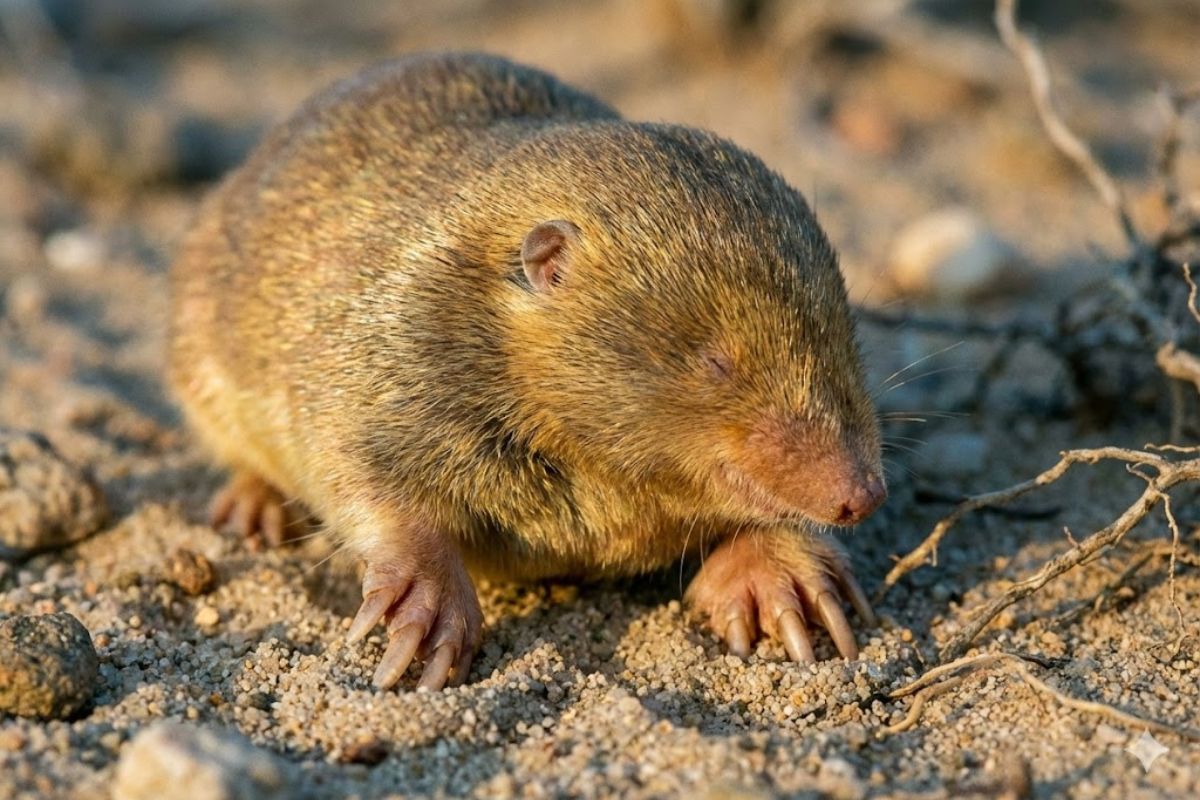
On The Northwestern Coast, Near Port Nolloth, De Winton’s Golden Mole Has Been Missing Since 1937. In November 2023, Conservationists And Geneticists Tracked Environmental DNA In Dunes, Collected Over 100 Samples, And Confirmed The Animal After A 300-Km Expedition With The Dog Jessie On McDougal’s Bay Beach
The golden mole that “swims” through the sand and avoids human contact has returned to the conservation map in South Africa after 86 years without a confirmed record, a gap that seems almost unbelievable for a mammal species. Last seen in 1937 in the small port town of Port Nolloth, De Winton’s golden mole was officially declared extinct and remained out of scientific reach for decades.
The confirmation came in November 2023, when a team of conservationists and geneticists from the Endangered Wildlife Trust, Stellenbosch University, and University of Pretoria tracked environmental DNA in coastal dunes, found genetic evidence in the soil, and, additionally, captured a live animal to sequence the DNA and confirm the species’ identity.
Why The Golden Mole Deceived Scientists For So Long

Golden moles are described as small elusive animals that spend almost their entire lives underground, rarely seen by humans. When they emerge to the surface to seek insects, this tends to occur at night, and often the only sign of their presence is a raised crest in the soil, suggesting a shallow tunnel beneath.
-
With a cost per shot close to zero, the DragonFire laser could change naval warfare in 2027 and provide British ships with nearly unlimited defense against drones.

-
A British startup creates tires that generate electricity in electric vehicles when passing over potholes, speed bumps, and cracks.

-
Scientists have created robots made with living cells that have their own nervous system, swim on their own, explore the environment, and self-organize without any genetic engineering, and now they want to do the same with human cells.

-
Students create a solar-powered ambulance that operates without a plug, without fuel, and still keeps medical equipment running in remote areas.


In the case of species that live in loose sand, like De Winton’s golden mole (Cryptochloris wintoni), even that sign can disappear. Tunnels collapse in the sand, erasing traces and turning the search into a task of high uncertainty, especially across extensive and unstable dunes.
Another factor that complicated tracking for decades was the presence of a very similar species in the region, the Grant’s golden mole (Eremitalpa granti). With a “lookalike” still present in nearby areas, distinguishing by eye becomes even more difficult, contributing to the long condition of a “lost” species.
Last Record in 1937 and Mining Pressure on The West Coast

De Winton’s golden mole was last detected in 1937, in Port Nolloth, on the northwestern coast of South Africa. Over the last century, the species has been described as severely impacted by diamond and other mineral mining on the west coast, with suspicion that the population may have decreased substantially during that time.
This combination of environmental threat and extreme difficulty of detection helps explain why, even without new records for over 80 years, the species remained in limbo between “extinct” and “unconfirmed.”
Lost Species Is Not The Same As Extinct Species

There is an important criterion that separates the two categories. Lost species are those that have disappeared from science for at least 10 years, often for much longer. Meanwhile, extinct species are those that are not detected for over one generation of their life, even after exhaustive searches in their habitat.
Although De Winton’s golden mole had not been seen for over 80 years and was presumed extinct, it was highlighted that no comprehensive search had been conducted during that time. Therefore, it could also be understood as a “lost” species, a detail that shifts the scientific and operational weight of disappearance.
The 2021 Expedition: 300 km of Coastline, 18 km of Dunes Per Day, And A Dog On The Team
The path to rediscovery was paved with prior testing. In 2020, a pilot study took place in Lambert Bay, where the sister species Van Zyl’s golden mole (Cryptochloris zyli) lives, which is endangered. The pilot showed that detection techniques would be effective for golden moles, reinforcing the viability of the method.
In July 2021, an expedition began along the west coast to Port Nolloth, the only site with a historical record of the species. The team explored a stretch of 300 km of coastline, from the mouth of the Groen River to Alexandra Bay to the north. Surveys were conducted on foot for one week, covering 18 km of dunes daily.
The group had five people and included the border collie Jessie, trained to identify other golden moles. One operational detail gained relevance: when the team found tunnels and Jessie showed no interest, it suggested they might be in the presence of something different from the more common species, strengthening the hypothesis of a “new” presence in the dunes.
Environmental DNA In The Soil And Confirmation By Museum Reference Sequence
The central confirmation came from environmental DNA (eDNA). The team collected over 100 soil samples from inside subterranean tunnels. The reasoning is straightforward: animals release DNA into the environment through skin cells, fur, excretions, and secretions, and this material can be extracted from the soil even though it is invisible to the naked eye.
Then, the eDNA was extracted in the laboratory and sequenced using barcode, allowing for comparison of the genetic signature with a reference. The sequence found matched a reference sequence of De Winton, generated in 2010 from a museum specimen deposited at the Ditsong National Museum of Natural History.
This step is crucial because it does not rely on casual “sightings.” The proof is in the genetic material, reducing the scope for confusion with similar species and raising the level of scientific certainty.
Re:wild, Endangered Wildlife Trust, And The Pressure To Find A Species Coveted By Conservation
The work was carried out within the Endangered Wildlife Trust’s Arid Zones Conservation Program, which received funding from Re:wild, a non-profit organization founded by conservation scientists with participation from Leonardo DiCaprio, and which had included De Winton’s golden mole on the list of the world’s most sought-after extinct species.
Additionally, molecular biologist Samantha Mynhardt, involved in the effort and affiliated with Stellenbosch University, described seeking non-invasive alternative methods to study golden moles, after facing the practical challenge of capturing them in the wild for genetic samples.
Where It Appeared Most Strongly And What Still Cannot Be Asserted
The activity of the golden mole was considered particularly abundant at McDougal’s Bay beach in Port Nolloth, suggesting the possible existence of a healthy population in the area. There were also detections at other points, indicating that the species may be more widespread than previously thought.
At the same time, there are clear limits on what can already be concluded. It was stated that it is not yet possible to estimate the population size at this stage, and future research should focus on that goal. A concrete piece of data reinforces the importance of the find: in addition to the environmental DNA, one golden mole was captured and confirmed by sequencing, and then a second De Winton’s golden mole was found in the same area.
What The Rediscovery Changes In The Race To Save The Golden Mole
The rediscovery of De Winton’s golden mole creates two immediate consequences. The first is scientific: it opens up the chance to learn more about a mammal described as fascinating and poorly understood, with characteristics such as blindness, iridescence, and strong hearing ability.
The second is conservationist: it revitalizes efforts to protect threatened golden moles and reinforces the use of environmental DNA as a tool to locate other “lost” or at-risk species. In a scenario of historical mining, sensitive habitat, and detection difficulty, the method of tracking eDNA in the dunes becomes a central piece to decide where to act and with what urgency.
Do you think that the use of environmental DNA should become a priority in conservation operations to find “lost” species, or does it still depend too much on luck and long field expeditions?







-

-

-

-

-

-

25 pessoas reagiram a isso.