





 Portuguese
  English
  Spanish
  3 min of reading
  1 comment


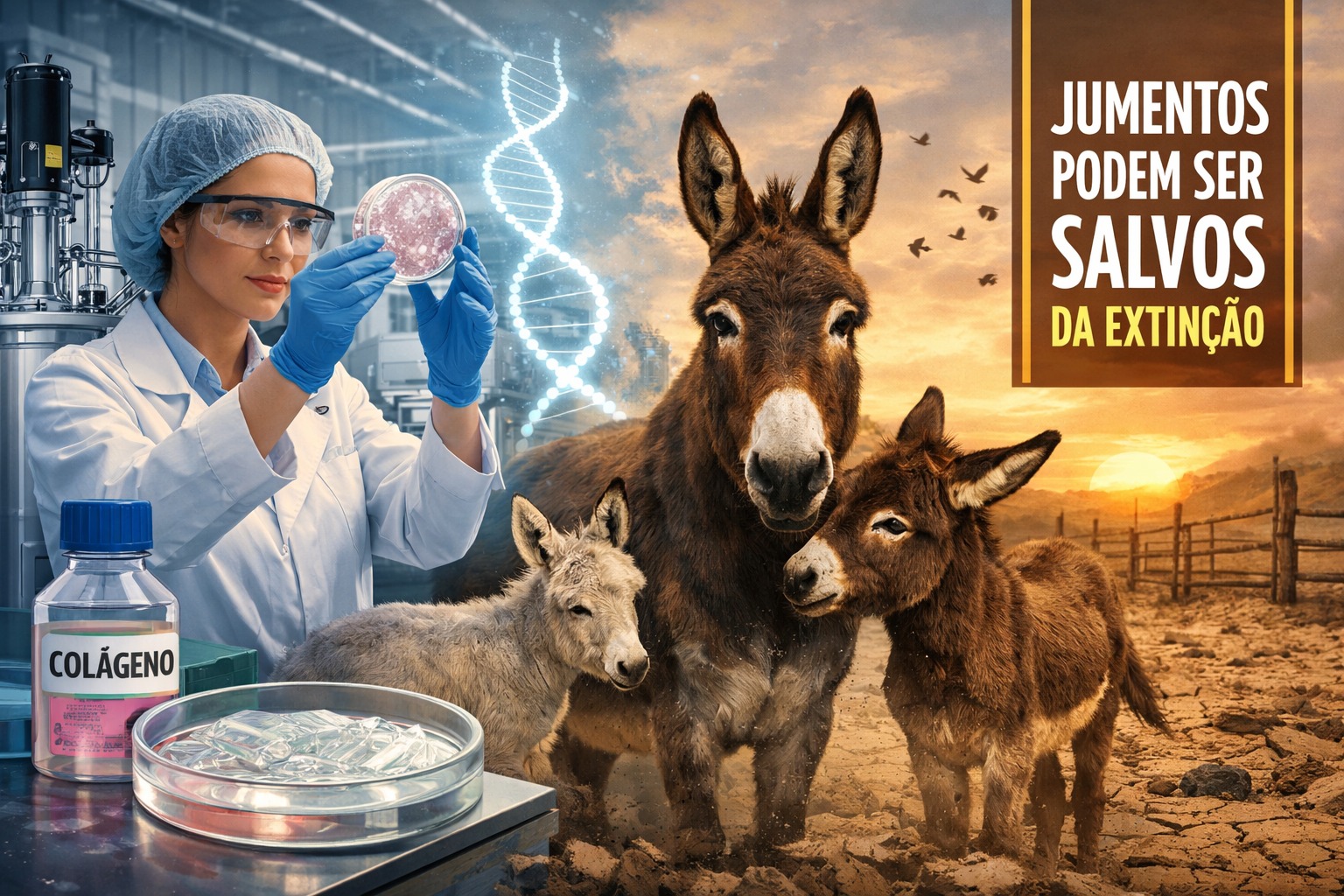


University Project Uses Precision Fermentation to Produce Collagen Identical to Animal, Avoid Collapse of Donkey Population, Respond to Billion-Dollar Chinese Market, and Seek Investment of US$ 2 Million Needed
A technology developed at the Cell Zootechnics Laboratory of the Federal University of Paraná promises to transform the future of donkeys in Brazil by producing collagen in the laboratory, reducing slaughter, meeting Chinese demand, and creating a sustainable industrial alternative.
Technology Seeks to Replace Extractive Slaughter
The initiative emerged after researchers concluded, in 2025, laboratory stages aimed at creating collagen identical to that of animals, without skin extraction.
The project uses precision fermentation to reproduce the protein, providing a direct response to the pressure from the beauty and health market in China.
-
With a cost per shot close to zero, the DragonFire laser could change naval warfare in 2027 and provide British ships with nearly unlimited defense against drones.

-
A British startup creates tires that generate electricity in electric vehicles when passing over potholes, speed bumps, and cracks.

-
Scientists have created robots made with living cells that have their own nervous system, swim on their own, explore the environment, and self-organize without any genetic engineering, and now they want to do the same with human cells.

-
Students create a solar-powered ambulance that operates without a plug, without fuel, and still keeps medical equipment running in remote areas.


To move forward, the team is now seeking to raise US$ 2 million, the amount needed to scale production in industrial bioreactors and validate the production process.
According to the researchers, the proposal simultaneously addresses species conservation and the maintenance of supply for a billion-dollar global market.
Donkey Population Is Collapsing in Brazil
The national scenario is described as critical by experts involved in the project, given the rapid population decline observed over the past decades.
Data from FAO and IBGE indicate that the donkey population in Brazil fell 94% between 1996 and 2024, source FAO and IBGE.
“Of every 100 donkeys that existed 30 years ago, only six remain today,” stated Patricia Tatemoto, PhD from USP, source statement from the researcher.
The slaughter occurs in an extractive manner, aimed at the production of ejiao, a gelatin used in traditional Chinese medicine and highly valued in the country.
The ejiao sector is valued at US$ 1.9 billion and is projected to double by 2032, putting even more pressure on the species.
Precision Fermentation Creates Biofactory
Precision fermentation employs genetically modified microorganisms to produce specific proteins in a controlled environment.
In this process, the DNA responsible for donkey collagen is inserted into a yeast, which starts to function as a biofactory.
In bioreactors, the yeast produces large quantities of the protein, in a process similar to beer but with high molecular control.
The main advantage is eliminating farms, pastures, and slaughter, resulting in a highly purified and environmentally efficient product.
“Now we are ready to turn the yeast into a biofactory,” explained Carla Molento, lab coordinator, source statement from the researcher.
Economic Impact and Next Steps
Laboratory production is considered more efficient, allowing higher volumes of protein in a single facility with lower input consumption.
The reduced environmental impact is seen as a strategic differential compared to the conventional model based on extensive farming and animal slaughter.
The goal is to present proof of concept, with the production of the first integral milligrams, by December 2026.
If the investment of US$ 2 million is confirmed, pilot production could begin in 2027, focusing on the global B2B market.
The project is funded by the Ministry of the Environment, source MMA, and partnered with Wageningen University, a reference in alternative proteins.
With information from Itatiaia.







Meio que a extinção deles foi iniciada devido a essa de: “Animais não podem trabalhar”. O **** veio de um cruzamento e era usado para trabalho de carga já que era mais barato que comprar um veículo para isso e eles são bem fortes, porém, com o tal da lei de trabalho **** que pode gerar multa bem salgada, com isso, os fazendeiros e semelhantes começaram a parar de comprar ou cruzar pois eles já não tinham retorno, afinal, como iriam manter um **** que consome muito e não gera nada? Não é como um **** ou gato que precisa o mesmo ou até menos que um humano.