





 Portuguese
  English
  Spanish
 5 min of reading
  1 comment





Chinese Technology of BUD, the Digital Urban Tram, Puts the Trackless Train on the Radar of Seven Brazilian Capitals and Attracts Attention from Latin America
The trackless train, that vehicle that keeps going viral on social media for dispensing with physical tracks and running directly on the pavement, has ceased to be just an internet curiosity to become a concrete project in Paraná. Guided by virtual tracks, with rubber tires and the look of a modern LRV, the system promises to combine high capacity, railway technology, and operation on asphalt in a mix that engages the imagination of those who depend on public transport every day.
Now in the assembly and testing phase in the state, the model named BUD, the digital urban tram, has already sparked immense interest from other regions. At least seven Brazilian capitals have approached the Paraná government to get a closer look at the trackless train, while cities and governments from Argentina, Costa Rica, Colombia, and Chile also want to understand how this solution can be applied outside Brazil.
What Is the Trackless Train


The so-called ART, short for Autonomous Rail Rapid Transit, is the technological basis of the trackless train that arrives in Paraná. Although many people look at the vehicle and say that “it’s just a bus,” the proposal goes beyond: it runs on rubber tires, on asphalt, but follows a virtual path as if it were attached to invisible tracks, combining features of buses, LRVs, and modern railway systems.
-
These living root bridges and ladders are over 700 years old and help indigenous people survive in one of the rainiest regions in the world.

-
From sertanejo star to international investor: Ana Castela invests millions in a mansion in the USA, creates a themed accommodation in Orlando, and shows that the “boiadeira” also wants to grow away from the stage.

-
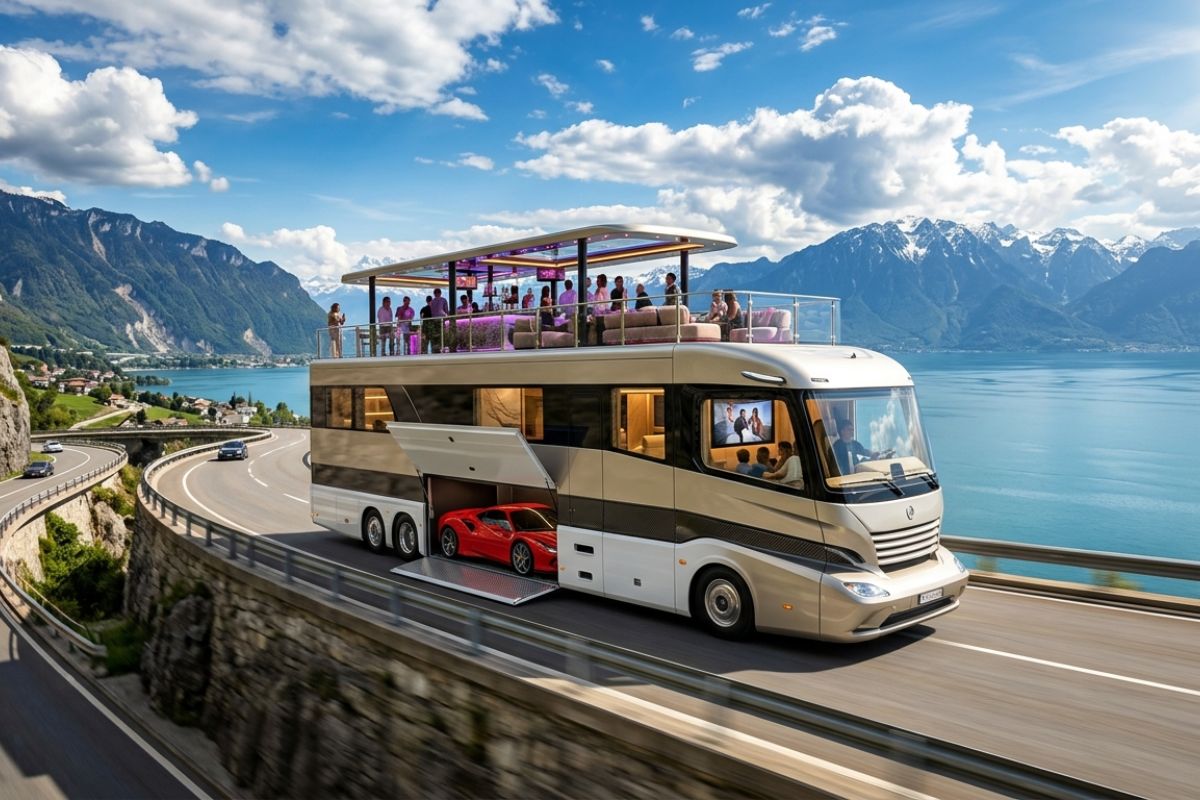
The 10 most stunning motorhomes in the world: a $3 million trailer with a rooftop nightclub and garage for a Ferrari, “palaces on wheels” with Italian marble, private cinema, and five-star hotel luxury for billionaires.
-
Trump wanted to spend $400 million on the White House, but the courts prohibited the million-dollar construction.


The vehicle was developed by the Chinese company CRRC, a global giant in train manufacturing, and is seen as a bet on innovation, sophistication, sustainability, and low operational cost compared to traditional LRV lines. It is about 30 meters long, has three axles, and can carry up to 280 passengers, reaching speeds of up to 70 km/h, placing it in the category of high-capacity corridors.
In technical terms, the trackless train uses rail detection resources, coordinated axle control, and automatic tracking. This brings the system closer to the reliability of trains regarding departure and arrival times, something conventional buses still struggle to achieve. Therefore, experts argue that it cannot be “downgraded” to the status of a simple bus: BUD ends up being positioned between an articulated bus and a modern LRV, creating practically a new category of light vehicle on tires.
Paraná Leads the Way with BUD
In Brazil, the state government of Paraná has taken the lead by implementing the trackless train on a route connecting Pinhais to Piraquara, in the metropolitan region of Curitiba. The project is led by the Paraná Metropolitan Affairs Agency (AMEP) and was officially presented in September, with tests scheduled to begin in November, serving as a sort of “showcase project” for the country and South America.
According to Governor Ratinho Júnior, bringing the system to the state is a cause for celebration, as it represents an innovation for public transport in South America, designed to enhance the convenience and quality of life for workers and those who use public transport daily. The current phase involves assembling the vehicle and preparing the necessary infrastructure, a stage that has attracted delegations from different states eager to see the trackless train functioning in a real environment.
Gilson Santos, director-president of AMEP, emphasizes the expectation to begin testing soon before operating with the public. With each new technical visit, the feeling grows that BUD could inaugurate a new way of planning transport corridors: without the need for physical tracks, but with organization, high capacity, and control typical of railway systems.
Seven Brazilian Capitals Eyeing the Trackless Train
The movement surrounding the trackless train has not been restricted to Paraná. According to the state government, Florianópolis, São Paulo, Brasília, Belo Horizonte, Rio de Janeiro, Porto Alegre, and Cuiabá have already reached out to the state for more details about the system. Each of these cities has long been discussing LRV, BRT, and alternatives to alleviate crowded corridors and pressured bus networks.
Florianópolis is studying LRV or BRT projects to tackle the complicated mobility of the insular and continental region. São Paulo, in turn, has a history of bus corridors and LRV projects under discussion, making the trackless train a possible solution for already saturated avenues, but without immediate space or budget for conventional tracks. Brasília, Belo Horizonte, and Rio de Janeiro are also analyzing different models of structured corridors, with Rio even considering deeper transformations in the BRT network.
Cuiabá stands out for a special reason. The capital of Mato Grosso experienced the trauma of a LRV project that never fully came to fruition and faced allegations and execution problems. For cities with this history, understanding the trackless train could mean a new chance to invest in high-capacity transport with fewer heavy construction requirements, as the system operates directly on asphalt and dispenses with the construction of traditional tracks.
International Interest and Impact on Mobility
The radar for the trackless train has already crossed Brazilian borders. Argentine cities like Buenos Aires and Córdoba, as well as representatives from Costa Rica, Colombia, and Chile, have also shown interest in the model implemented in Paraná. The visit of these delegations demonstrates that the combination of Chinese technology with a Brazilian corridor at real scale has turned into an open-air laboratory for the region.
At the same time, the system reignites a classic debate: after all, is it a train, bus, or LRV? For many users, the appearance resembles a more sophisticated articulated vehicle. For experts, the fact that it has railway truck, a control system similar to trains, and operation guided by virtual tracks weighs in on its classification. In practice, the trackless train is born as a hybrid, attempting to combine the best of three worlds: the reliability of trains, the flexibility of buses, and the modern look of LRVs.
If the tests in Paraná are successful, the trackless train could gain traction as an option for structured corridors in major Brazilian and Latin American cities, especially where there are plans for LRV or BRT stalled by costs, deadlines, or political issues. A 280-seat vehicle, guided by advanced technology and running directly on asphalt, changes the level of conversation about public transport, especially in a scenario where mobility, the environment, and urban efficiency are increasingly connected.
And you, if you had the chance to choose in your city, would you invest in a trackless train as an alternative to traditional buses and subways?







Não vi nenhum Representante do nordeste se manifestar sobre essa tecnologia