





 Portuguese
  English
  Spanish
  4 min of reading
  0 comments


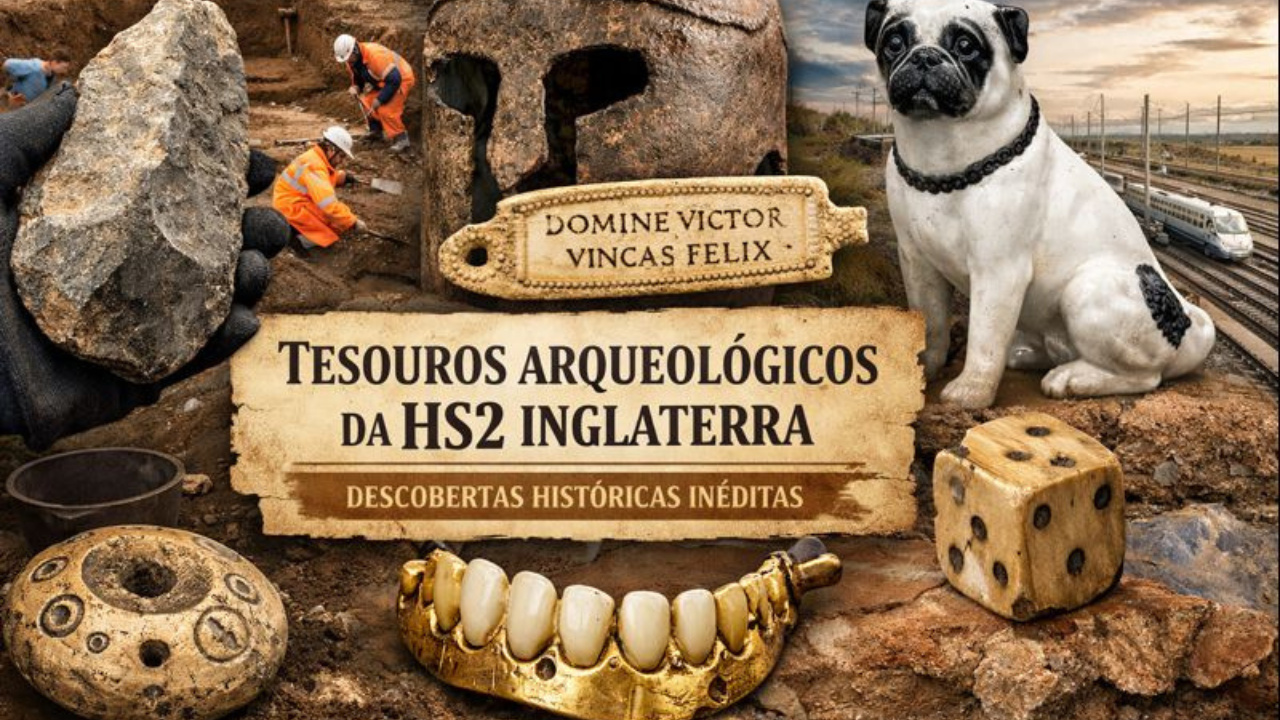
HS2 England Archaeological Excavations Reveal Rare Historical Treasures and Help Preserve the UK’s Historical Heritage.
What started as an infrastructure project has become one of the UK’s largest archaeological revelations.
During the HS2 England archaeological excavations, archaeologists found over 450,000 historical objects, many classified as archaeological treasures, along the route of the high-speed railway that will connect London to Birmingham.
The discoveries have been made since 2018, by around a thousand specialists, at more than 60 different sites, with the aim of preserving the historical heritage before the project advances.
-
He started running at 66 years old, broke records at 82, and is now a subject of study for having a metabolic age comparable to that of a 20-year-old, in a case that is intriguing scientists and inspiring the world.

-
Oldest tree on the planet reappears after 130 years of searches: Wattieza, 385 million years old, was 10 meters tall and had no leaves or seeds; Gilboa fossils in New York solved the mystery in 2007.

-
A 48-square-meter house assembled in hours with 4,000 bricks made of recycled plastic that does not absorb moisture, has natural thermal insulation, and costs less than 90,000 reais in a complete kit.

-
Luciano Hang revealed that Havan’s air fleet has already accumulated more than 20,000 landings, 10,000 flight hours, and 6 million kilometers traveled, and he says that without the planes, the company would never have grown so quickly.


The findings occurred as part of the British legal protocol, which requires prior archaeological studies for major undertakings.
Thus, while the railway faces delays and criticism, the historical discoveries unveiled help to understand how different civilizations occupied and transformed the British landscape over millennia.
Archaeological Treasures Stored in a Secret Warehouse
Much of this collection is stored in a confidential location in northern England, in the Yorkshire region.
The space houses around 7,300 boxes of artifacts ranging from Prehistory to the 19th century.
Among industrial shelves, there are items ranging from heads of Roman statues to coffins from the late 18th century, preserved as silent records of ancient communities.
The future of these items is still undefined.
It is not yet known exactly which pieces will be displayed to the public, where they will be stored, or who will be their final owner, as English law allows objects to belong to the State or to the landowners where they were found.
Prehistoric Axe and Heritage of Ancient Peoples
Among the most impressive historical discoveries is a hand axe over 40,000 years old, found in Northamptonshire.
Experts believe that it may have been produced by Neanderthals or even by an earlier human species.
The artifact, held directly by hand, features a sharp blade likely used for animal slaughter.
“There’s something tactile about it when you hold it,” said Sara Machin of the Access + archaeology team. “Even today, it fits perfectly in my hand.”
So this type of object reinforces the relevance of archaeological excavations in understanding the early inhabitants of the region and their relationship with the environment.
Roman Tag Suggests Connection with Gladiators
Another notable item is a small piece of carved bone with an inscription in Latin.
If complete, it would read “DOMINE VICTOR VINCAS FELIX,” translated as “Lord Victor, may you win and have good fortune.”
The object was found in a funerary urn with cremated remains and may be linked to a Roman gladiator.
According to Machin, the piece could have belonged to a combatant, a former gladiator, or even a spectator.
John Pearce, a professor at King’s College, considers that “a connection with a gladiator is possible,” but notes that further forensic analyses may reveal another story.
Everyday Life Revealed in Small Objects
Thus, the archaeological excavations also brought to light items related to everyday life.
An Anglo-Saxon spindle whorl, made from bovine bone, indicates textile advances of the time.
“It’s a very interesting evidence of textile advances in the Anglo-Saxon period,” said Willow Major, a post-excavation assistant.
A medieval die, found in an abandoned village, shows that gambling was part of social life, although its irregular shape reveals artisanal production methods.
Art, Memory, and Identity in Historical Heritage
Among the most symbolic finds is a porcelain figurine of a pug dog, produced between 1770 and 1800, found in the grave of a woman in London.
There are also lower gold dentures from the 19th century, with six teeth and engraved numbering, recovered from an old church.
“These are objects, but all are related to people,” noted Machin. “We can start writing the stories of their lives.”
HS2 England: Controversy, Costs, and Archaeological Legacy
Thus, despite the historical wealth revealed, HS2 England continues to divide opinions.
Critics point to billion-dollar costs, delays, and environmental damage. Estimates suggest that the railway could cost around US$ 7 billion per mile.
Still, institutions like Historic England praised the archaeological project for revealing “new and exciting areas spanning over 10,000 years of our past.”
For historian Graham Evans, the legacy is clear: “If they built the railway and we didn’t conduct the archaeological study, it would be much more tragic.”
See more at: The Surprising Treasures Found in the Controversial Railway Works in England – BBC News Brazil









-

-

-

4 pessoas reagiram a isso.