





 Portuguese
  English
  Spanish
  3 min of reading
  0 comments


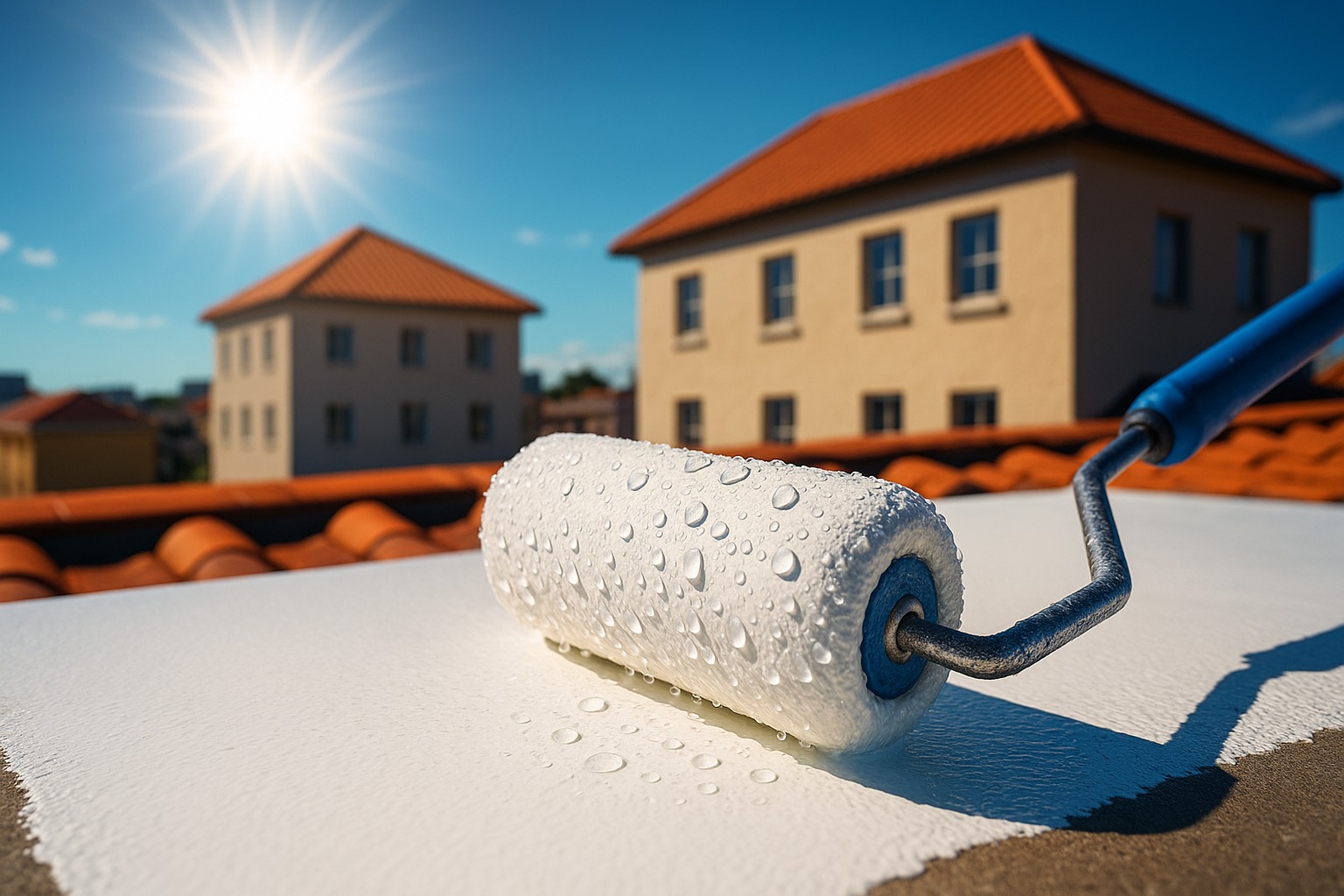
Australian Researchers Created a Polymeric Coating Similar to Paint That Reflects Up to 97% of Solar Light, Reduces Temperature by Six Degrees, and Collects Up to 390 mL of Water per Square Meter Daily.
Researchers from the University of Sydney and the startup Dewpoint Innovations developed an innovative material that promises to transform how buildings interact with the climate. It is a nano-structured polymer coating, similar to paint, that passively cools surfaces and captures water directly from the air, without any energy consumption.
Smart Coating That Reflects Heat and Creates Water
The new material features a porous structure capable of reflecting up to 97% of sunlight and radiating heat into the environment, keeping surfaces up to six degrees cooler than the surrounding air, even under intense sunlight. This characteristic reduces the need for artificial cooling systems and therefore decreases energy consumption.
In addition to keeping environments cooler, the coating creates ideal conditions for the condensation of atmospheric water vapor. Just as vapor accumulates on a bathroom mirror after a shower, the cold surface of the material allows droplets to form and be collected.
-
How the terraforming of Mars can transform the planet: artificial aerosols can increase the temperature by up to 35°C in 15 years, creating conditions for liquid water.

-
Scientists drilled nearly 8,000 meters into the ocean floor above the fault that caused the 2011 tsunami in Japan and discovered that a layer of clay 130 million years old was responsible for making the wave much worse than any model had predicted.

-
Thousands of years after causing the largest eruption of the Holocene, one of the world’s largest supervolcanoes is rebuilding itself beneath the sea south of Japan, receiving new magma and alarming scientists with its transformation.

-
China has activated a magnet 700,000 times more powerful than the Earth’s magnetic field that operates for over 200 consecutive hours while consuming little energy, and now the world wants to know what Beijing plans to do with this technology in 2026.


Professor Neto, from the Institute of Nanotechnology and the School of Chemistry at the University of Sydney, explained that the technology not only enhances cool roof coatings but also represents a breakthrough in the search for sustainable, decentralized, and low-cost sources of fresh water.
He emphasized that, in light of climate change, solutions like this become essential to address the global water scarcity.
Test Results Under Real Conditions
For six months, the researchers conducted outdoor tests on the roof of the Sydney Nanoscience Hub. During this period, they managed to collect dew for over 32% of the year, demonstrating the coating’s ability to provide water even without rainfall.
Under ideal conditions, the material collected up to 390 milliliters of water per square meter per day. Thus, a surface of 12 square meters can generate enough to meet the daily needs of one person.
The design of the coating achieves high reflectivity thanks to its internal structure, without the use of pigments that cause environmental impacts.
According to Dr. Ming Chiu, the lead author of the study and Chief Technology Officer of Dewpoint Innovations, the removal of materials that absorb UV rays has allowed them to surpass the traditional solar reflectivity limit, avoiding visual glare and making the product more pleasant and functional for urban use.
Durability and Efficiency Under the Australian Sun
The team recorded minute-by-minute data during the test, confirming that the coating maintained consistent performance and did not suffer degradation even under intense solar radiation. This differentiates it from similar technologies that show rapid deterioration when exposed to the external environment.
The scientists also highlighted that the material can help reduce the urban heat island effect, decrease air conditioning use, and provide resilient water sources against climatic variations. The study further shows that dew collection is feasible even in dry regions, challenging the notion that the process would only work in humid climates.
Simple Application and Potential for Large-Scale Use
To make the technology accessible, Dewpoint Innovations is developing a water-based version that can be applied with rollers or common sprayers. According to the company’s CEO, Perzaan Mehta, the partnership with the University of Sydney represents an important step in transforming this innovation into a practical and scalable solution.
He stated that the goal is to create an alternative capable of turning rooftops and remote structures into safe and continuous sources of drinking water, without the need for electricity.
The study, published in the journal Advanced Functional Materials, demonstrates that the coating is robust, functional, and suitable for prolonged use in outdoor environments, potentially contributing to the advancement of urban cooling technologies and the development of sustainable atmospheric water sources.










-

Uma pessoa reagiu a isso.