





 Portuguese
  English
  Spanish
  9 min of reading
  0 comments


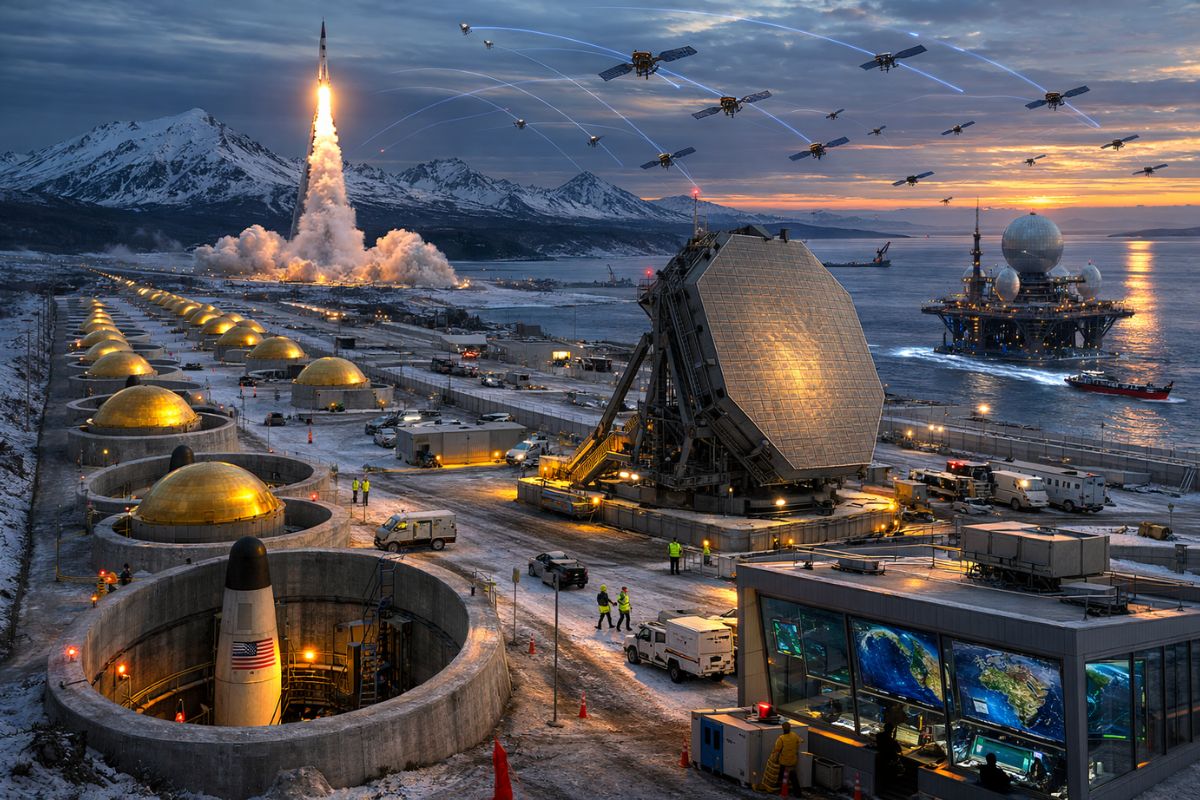
The Golden Dome Combines Land Defense in the Arctic, Semifloating Mobile Radar in the Pacific, and Mass Production of Satellites in Texas to Form a Multilayered Anti-Missile Shield Supported by 175 Billion Dollars, Hit to Kill Tests, Extreme Logistics, and Continuous Integration Between Land, Sea, and Space Against Strategic Threats.
The Golden Dome was designed to solve a problem that seemed bigger than any practical solution for decades: intercepting weapons crossing the atmosphere at extreme speeds before they hit American territory. By the described model, the United States is erecting a 175 billion dollar system that combines land defense in Alaska, maritime surveillance with X-band radar, and a space constellation of 1000 satellites launched by SpaceX.
The project relies on two parallel and complementary fronts. In the far north, the effort focuses on increasing the capacity to observe, track and react from a frozen zone, with 60 new silos, deep foundations, and fixed and mobile radars. In space, the goal is to create an orbital mesh capable of detecting launches, closing coverage gaps, and feeding interceptors with real-time data. The logic of the Golden Dome is simple in theory and brutal in execution: see first, decide first, and hit first.
Alaska as the Frontline of the Shield

The terrestrial layer of the Golden Dome begins at Fort Greely, Alaska, a hostile environment where engineering must first overcome the ground itself.
-
The lack of welders, electricians, and operators becomes a structural threat in 2025, with the construction industry and manufacturing already suffering from delays, cost pressures, and labor shortages in Brazil.

-
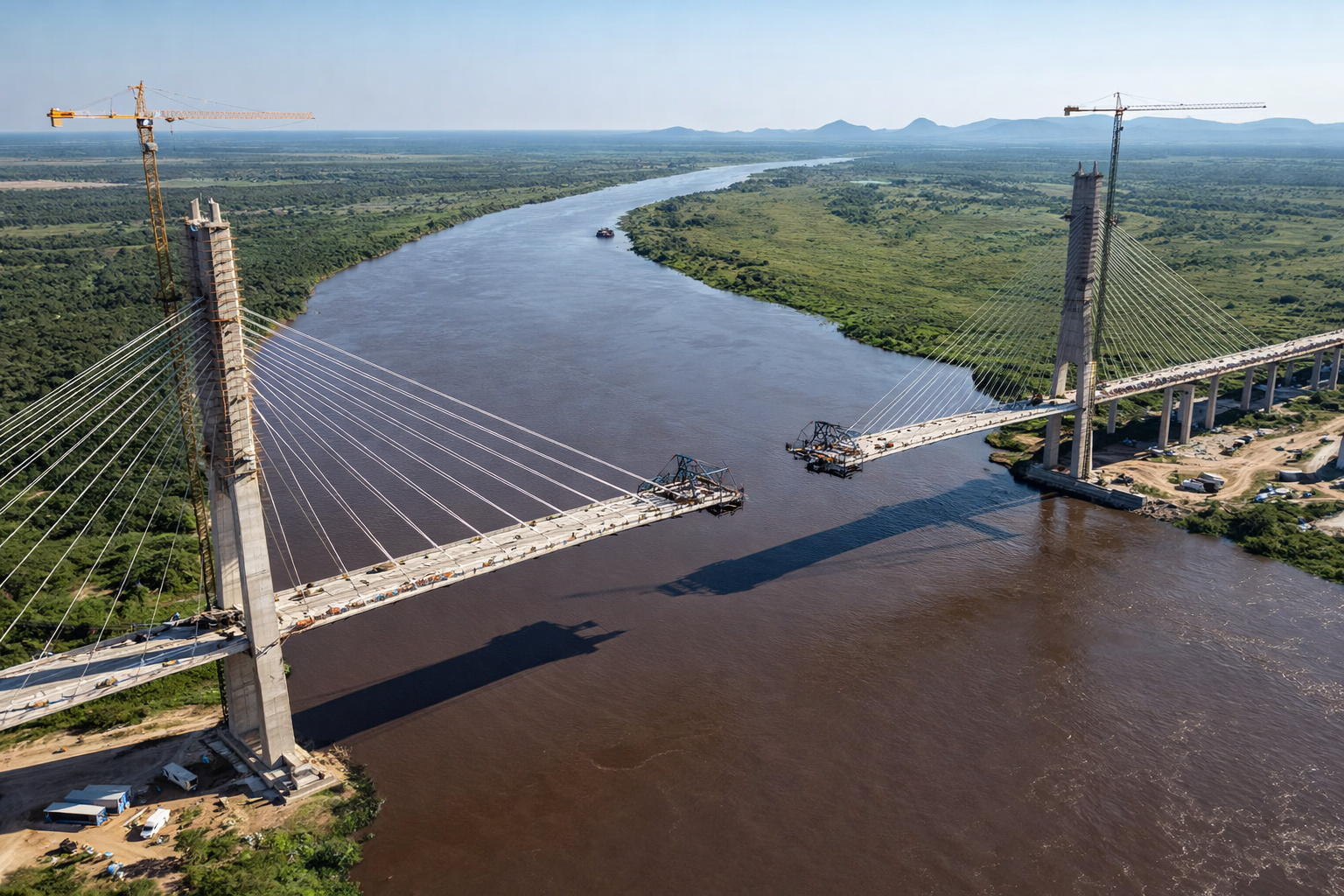
Brazil and Paraguay are just 46 meters away from a historic union on the bioceanic bridge that promises to revolutionize trade between the Atlantic and the Pacific.
-
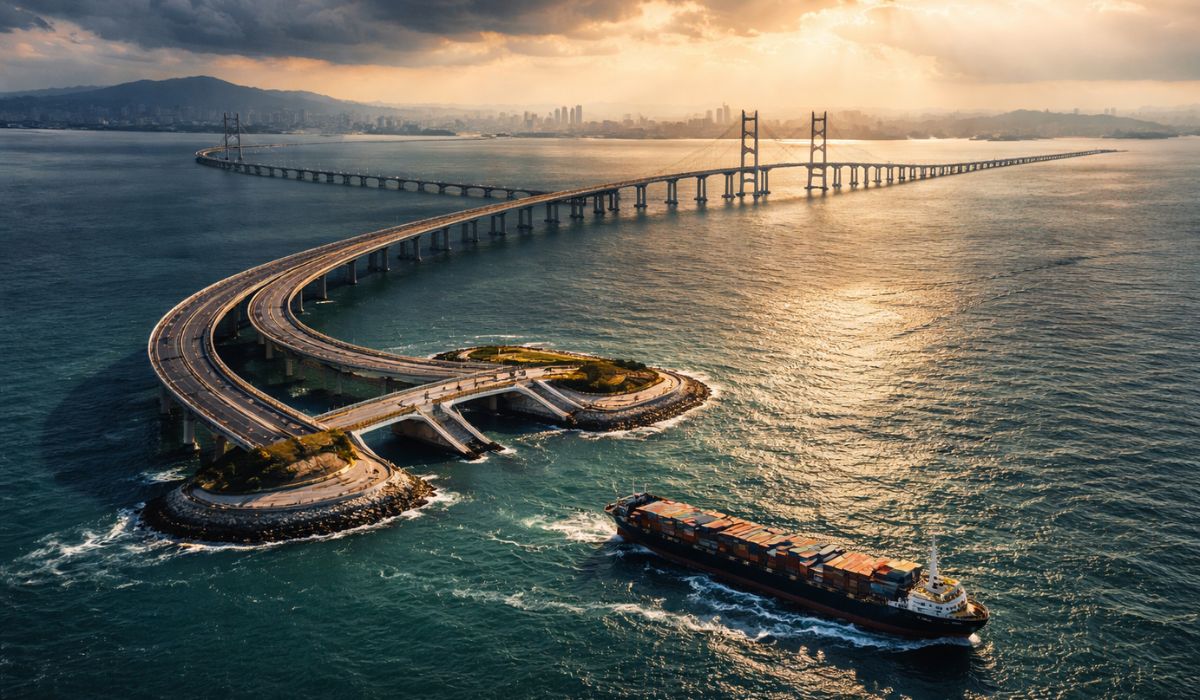
With 55 km over the sea, a cost of US$ 20 billion, and enough steel to build 60 Eiffel Towers, China’s largest project has connected Hong Kong, Zhuhai, and Macau in a colossal bridge that defies the logic of engineering.
-
A trick with joint compound transforms a Styrofoam ceiling into a plaster-like ceiling: leveled panels, wires and mesh at the joints, sand, paint, and change the environment while spending little today.

The terrain is made up of permafrost, forcing teams to drill about 30 meters to reach solid rock before starting any significant foundation. This is not merely a geological detail.
If the base gives way, the whole system loses stability even before becoming operational.
Therefore, the foundations use thermal piles that keep the ground continuously cooled.
Concrete, in this context, also becomes a technical problem. In the Arctic, the mix needs to be heated and applied quickly, before the cold freezes it improperly.
What would be a schedule for a regular construction becomes a race against the weather.
It is in this scenario that the 60 new silos for interceptors are set to appear. They are not just vertical shafts in the ground.
They have been designed larger, already prepared for a next generation of faster, more powerful, and more precise rockets.
The real challenge lies in the mechanism that needs to eject a 20-ton rocket in a few seconds, with enough reliability for a minimal reaction window.
Surrounding this infrastructure, the terrestrial system extends its reach with another observation point in Greenland.
The intention is to create an architecture where the frozen north is not just a physical border, but also an advanced surveillance post.
In the Golden Dome, the Arctic ceases to be peripheral and becomes the operational center.
The Fixed Eye, the Moving Eye, and the Obsession to Eliminate Blind Spots

At the terrestrial heart of the Golden Dome is a 50-ton radar panel composed of thousands of transmission and reception modules.
It functions as one of the system’s big eyes, installed in a main structure designed for continuous threat reading.
This radar gives depth and permanence to land surveillance, but it does not solve the problem of variable risk direction by itself.
That is why the project also incorporates a maritime platform with X-band radar, protected by a 30-meter inflatable armored dome.
This floating system does not exist to adorn the technological package. It exists because the perception war depends on flexibility.
A radar in open sea can be relocated to areas where a fixed sensor does not reach with the same efficiency.
The platform is described as semifloating. In rough seas, it partially sinks to preserve stability and keep the radar aligned.
This reduces the system’s vulnerability to sharp movements and allows functionality to continue even in harsh Pacific conditions.
The radar needs to see not just far; it needs to see accurately while the ocean tries to throw it off course.
Having two main observation lines, one on land and another at sea, adheres to a central logic of the Golden Dome: avoiding blind spots.
What one radar cannot see from its angle, the other may capture from another position. In this model, redundancy is not excess.
It is safe operation for a shield that promises to operate against threats too fast to tolerate coverage failures.
The Space Factory in Texas and the Turn to Mass Production


If Alaska builds the terrestrial muscle, Texas appears as the industrial heart of the orbital layer. Under the Starbase sun, the Golden Dome gains its most ambitious part: a constellation of 1000 advanced satellites.
The crucial point here is not just launching a lot of hardware into space, but manufacturing that hardware on an assembly line rather than as isolated artisanal pieces.
The infrared sensors are at the center of the orbital mission. They need to detect missile launches from orbit, which requires extreme sensitivity and resistance to a hostile environment.
The main structure of the satellites is assembled by robots, in a process driven by speed and precision, while components follow a modular logic, almost automotive, to allow for scale.
Each satellite carries kilometers of cables connecting sensors, processors, and control systems. It also receives large solar panels, designed to sustain operation for more than ten years, as well as a krypton ion propulsion system.
This engine allows for fine maneuvers, orbital corrections, and reorganization of the constellation when coverage gaps arise.
The Golden Dome relies on quantity, but only functions if that quantity is coordinated as a network rather than a hodgepodge of objects in orbit.
Before launch, each unit undergoes severe vibration, heat, and freezing tests in a vacuum, simulating both the violence of takeoff and the thermal brutality of space.
Afterwards, they are stacked and sent in batches, because the project cannot accommodate an artisanal pace. Without continuous production, the promise of a complete orbital mesh simply does not hold.
The Falcon 9, the Stage Return, and the Logistics of a Long-Term Shield
The mission of placing this constellation into orbit falls on SpaceX and the Falcon 9, chosen as the main launch vehicle for the Golden Dome.
The rocket enters the project not only for its capability to place payloads into space, but because the reuse of the first stage is treated as a piece of economic viability.
Without return and reuse, the orbital accounting of a system with 1000 satellites would become even heavier.
After stage separation, the booster executes its return maneuver and lands precisely on a maritime platform.
Meanwhile, the second stage continues to the parking orbit and releases the dispenser. Deployment begins in sequence, but the satellite does not reach the final point immediately.
Each unit uses its own ion engine to gradually raise the orbit to the operational position, in a process that can take more than six months.
This silent stage is one of the most important.
The launch draws more attention, but the consolidation of the network depends on this fine-tuning period, where each satellite takes its place within a coordinated mesh.
The promise is that data will travel in light beams between the units, circulating around the planet at nearly the speed of light.
Without instant and continuous communication, space becomes an expensive showcase; with it, it becomes a useful layer of the shield.
The challenge, therefore, is not just to launch a lot. It is to ensure that everything connects without noise and without operational delay.
The Golden Dome only becomes a shield when land, sea, and orbit cease to operate as separate projects and begin to react as a single system.
The Fist of the System and the Cold Logic of Hit to Kill
Seeing is part of the equation. Reacting is the other. That is why the Golden Dome does not stop at radars and satellites.
It also relies on the exoatmospheric interceptor, described as a kinetic weapon that does not use explosives. Its principle is direct impact: hit to destroy.
The idea may sound simple, but it requires extreme precision, as the target and interceptor cross paths at combined speeds exceeding 40,000 km/h.
The “eye” of this vehicle is an advanced sensor that must distinguish real warheads from decoys in the cold of space.
The “brain” is a radiation-resistant computer capable of recalculating its path in milliseconds. The “muscles” are small thrusters that make final adjustments before collision.
At the tip, the kinetic energy at about 10 km per second is enough to vaporize the target.
Unlike satellites, these interceptors do not follow pure automated mass production logic.
They are assembled manually, with precision comparable to that of a Swiss watch. Afterwards, they are attached to the booster to form the complete interceptor, a 20-ton set with a kinetic weapon of 60 kilograms at the tip.
In the Golden Dome, sophistication lies not in the noise of the explosion, but in the accuracy of the impact.
The real-scale tests described in the project serve precisely to validate this hit to kill doctrine.
When direct impact is confirmed, the system demonstrates that it does not depend on proximity or fragmentation, but on exact meeting.
It is the most demanding form of interception and precisely for that reason the most symbolic for a program that presents itself as a next-generation shield.
Greenland, Subterranean Energy, and the Arctic as a Total Strategic Zone
The Golden Dome is not limited to interception. The described project connects anti-missile defense, polar infrastructure, and logistical control of the Arctic.
In Greenland, a strategic base is modernized with a runway over 3 kilometers long, lights capable of cutting through fog and polar darkness at up to -60 degrees, flexible bridges to accommodate permafrost, and thermal piles that keep the ground stable.
Under the ice, the base would feature a subterranean power plant to ensure continuous energy, even in emergency scenarios. This gives the system a layer of redundancy that goes beyond radar.
Surveillance must continue even under storms, extreme isolation, or external failure. It is not enough to detect. It is necessary to keep detecting when the environment tries to shut down the base.
There is also a mineral dimension embedded in the strategic narrative. According to the described material, millions of tons of rare earths would be hidden beneath the ice, which helps explain why Greenland emerges not only as a military outpost but as a territory of resources and logistical interest.
Heated drillers, local laboratories, special roads, and modular power plants compose a design where defense, mining, and maritime routes cease to be separate themes.
This combination repositions the Arctic. It starts to be seen as a center of surveillance, resources, and commerce at the same time.
In practice, the Golden Dome appears as part of a larger system, where the top of the world ceases to be a frozen void and becomes the main board for competition over influence, data, and access.
The Golden Dome was conceived as a multilayered shield of 175 billion dollars that combines 60 silos in Alaska, a 50-ton land radar, an X-band maritime platform, and a constellation of 1000 satellites launched by SpaceX.
The design is gigantic because the problem it tries to face is also gigantic. To function, it needs to unite ice, ocean, orbit, industrial production, software, kinetic interception, and polar logistics into a single gear.
The most revealing point is that it is not just about anti-missile defense. The described architecture transforms Alaska and Greenland into pieces of a system that combines security, extreme infrastructure, strategic mobility, and resource control.
If you had to pinpoint the real core of this project, what would weigh more in your reading: the interception in space, the surveillance mesh in the Arctic, or the way defense and geopolitics begin to blur within the same engineering?









-

-

-

-

-

-

30 pessoas reagiram a isso.