





 Portuguese
  English
  Spanish
  9 min of reading
  3 comments


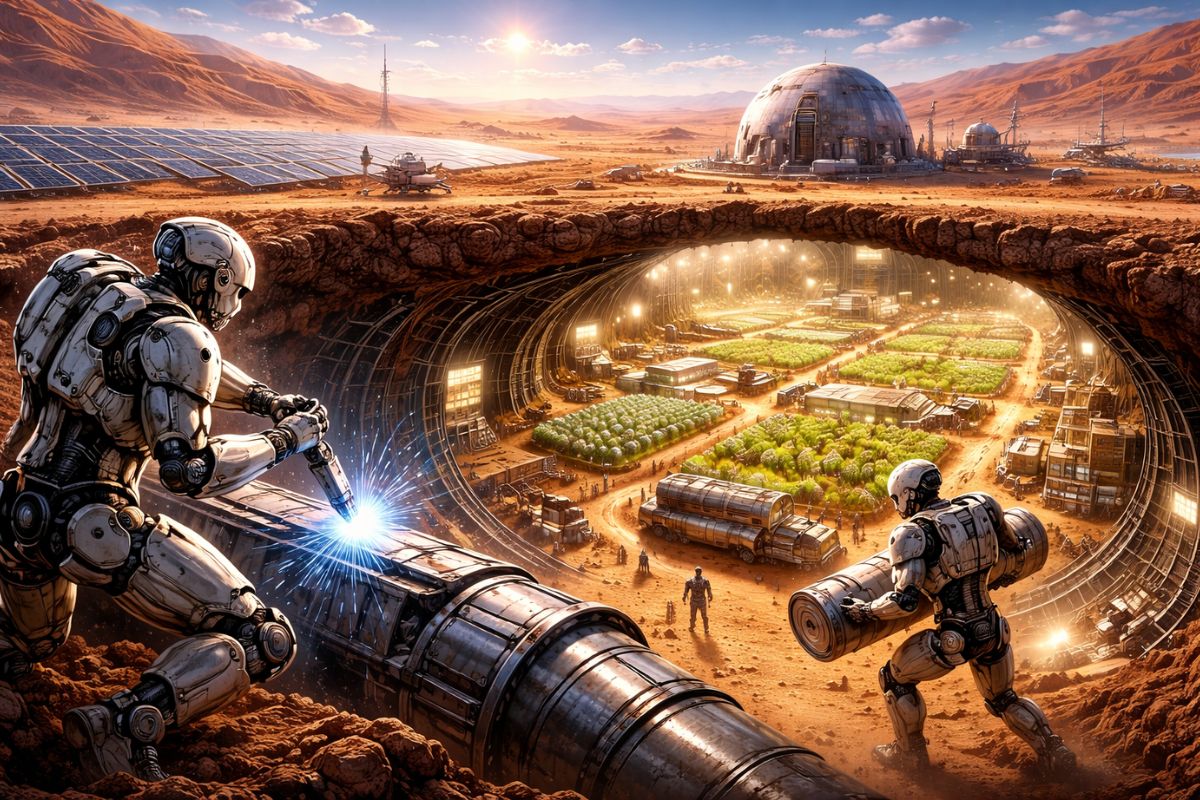


In 2035, Robots on Mars Set Up Solar Farm on Mars, Bury Nuclear Reactor on Mars and Prepare the Subterranean City on Mars That Will Sustain a Colony on Mars.
The year is 2035. The idea of transforming Mars into a human home has ceased to be just a distant dream. A first major vehicle lands on the red surface, but it is not a luxury space condominium. It is not a ready habitat. It is a flying construction kit, full of autonomous machines, designed to build the first subterranean city on Mars from scratch. Instead of human engineers descending the ramp, the first to set foot on Martian soil is a robotic exploration vehicle, ready to start the most ambitious construction project in history.
This subterranean city on Mars does not appear by magic, nor with a single spacecraft. Waves of freighters arrive, each bringing key components of the ecosystem: a solar farm covering dozens of acres, a buried compact nuclear reactor, a tunnel boring machine that digs and builds walls, a chemical plant that converts ice into water, air and fuel, and finally the tools to assemble closed farms capable of feeding human settlers. Before anyone can reside in this subterranean city on Mars, an army of robots builds energy, shelter, atmosphere and food using primarily what the planet itself offers.
The First Task on Mars: Energy for the Subterranean City on Mars
The starting point is obvious: without energy, nothing else happens. The first autonomous exploration vehicle arrives on the surface with a very clear mission: to establish the electrical backbone that will power the entire future subterranean city on Mars.
-
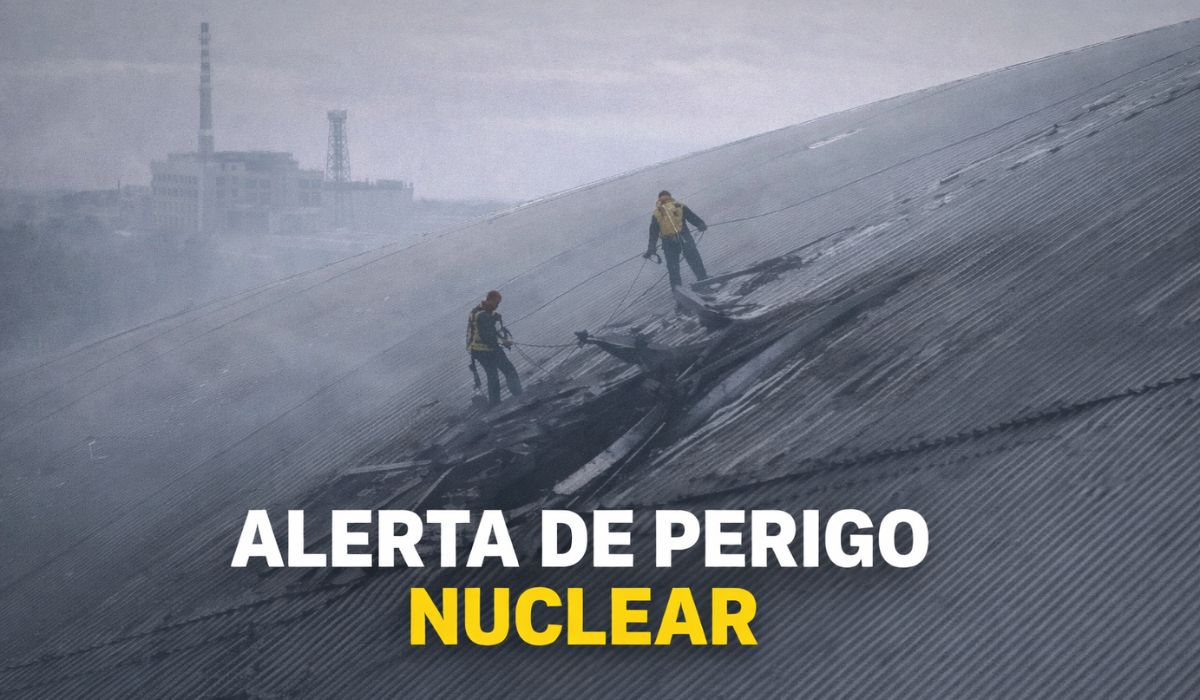
The gigantic steel shell built to contain Chernobyl for a century has been pierced by a drone, exposing a critical system and creating a hole that could cost over 500 million euros to repair.
-
Brazilian Navy reaches a new level by taking over an airport with a 1,600-meter runway used by 1,800 military personnel and autonomous attack drone testing.

-
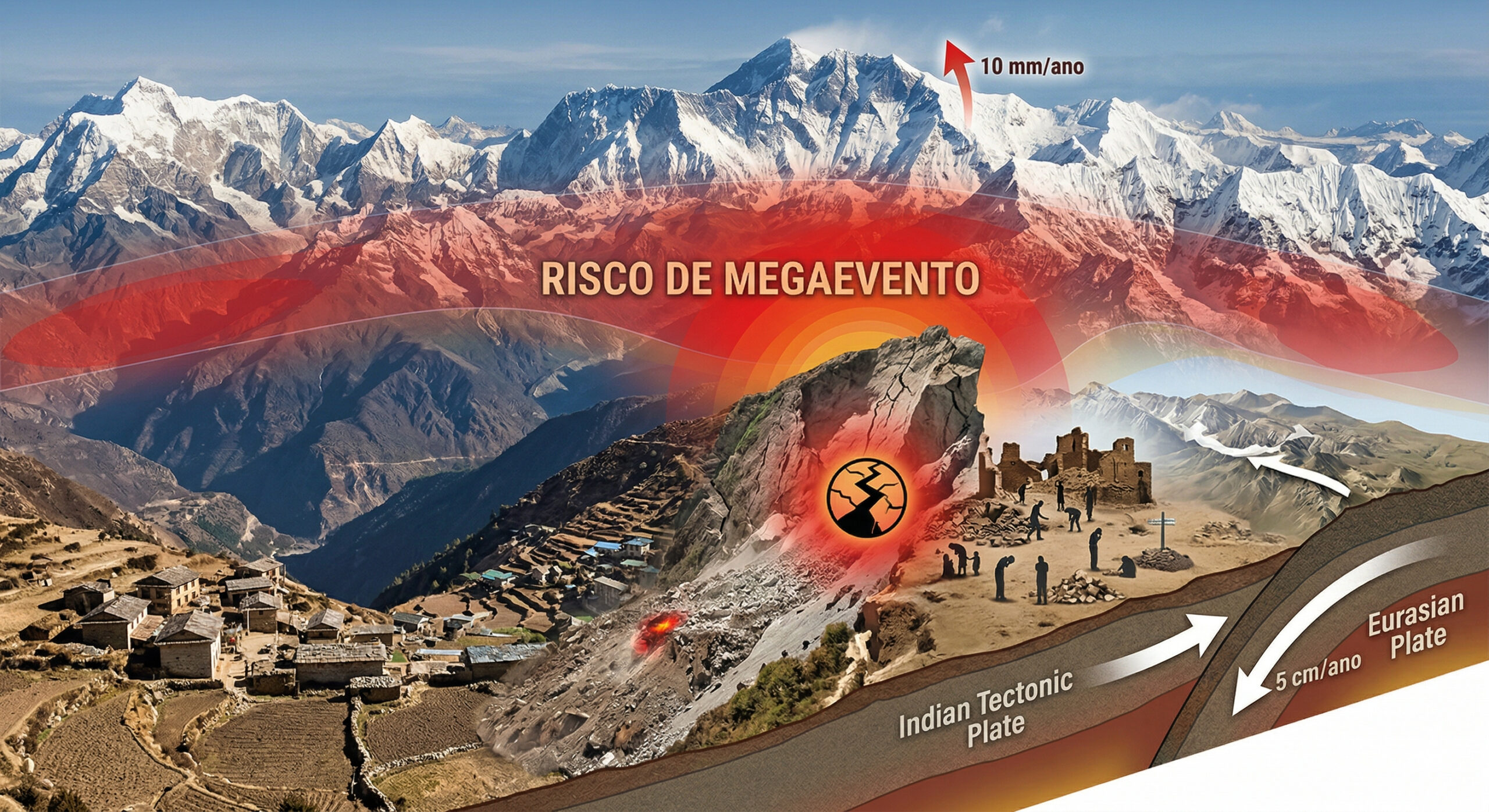
The Himalayas continue to grow to this day, with tectonic plates advancing 5 cm per year, mountains rising up to 10 mm annually, and the 2015 earthquake that killed 9,000 people may have increased the risk of an even larger seismic mega-event.
-
At an altitude of 400 km by astronauts from the International Space Station, Paris transforms at night into a golden mesh so precise that it reveals the outline of the Seine River, avenues, and entire neighborhoods like a luminous map drawn over the Earth.


This mission begins with the deployment of a massive solar farm. The spacecraft did not bring traditional rigid panels but flexible thin-film solar sheets, rolled up like carpets. As soon as they land, two rovers work together, connected by a cable, in a synchronized mechanical ballet.
They unroll strips of high-efficiency photovoltaic cells directly over the Martian dust, anchoring the material to the ground to withstand the planet’s fine, fast winds.
Soon there are not just two rovers. A small army of ten vehicles expands the farm day by day, covering several hectares with these solar leaves.
In less than a week, this robotic front assembles a farm of about 10 acres, capable of generating around 5 megawatts.
It is enough energy to sustain a small city, and it is the first major engineering success behind the future subterranean city on Mars.
But Mars is not kind to solar panels. Planet-wide dust storms can block the sun for weeks.
The solar farm is perfect for the initial phase, but it cannot be the only permanent energy base. For a subterranean city on Mars that operates 24 hours a day, a source that does not depend on light is needed.
The Buried Reactor That Becomes the Heart of the Subterranean City on Mars
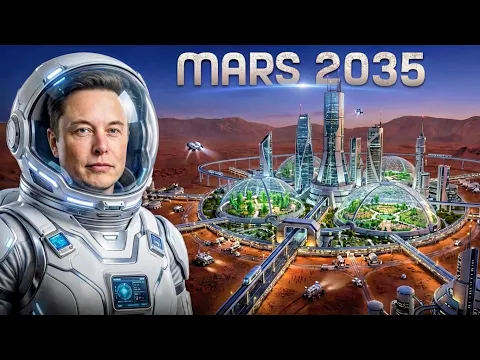

The solution arrives on the second major ship. Inside is the heart of the future hybrid energy grid: a compact nuclear reactor, designed specifically for hostile environments like Mars. It is not a complicated pressurized water reactor, filled with giant circuits.
It is a solid core of uranium, a fission design of the kilopower type, which uses a heat pipe to transfer the intense heat from the core to a simple piston engine.
This piston drives a generator and creates a constant flow of electricity. However, this reactor cannot be exposed on the surface. Before it can operate, it needs protection.
The robots dig a deep hole, lower the reactor, and use the Martian soil itself as a shield. Buried under the red sand, connected by cables to the growing base, the reactor begins to provide continuous energy, immune to the Martian night and dust storms.
In practice, the subterranean city on Mars is born with a hybrid grid. During the day, the solar farm provides large amounts of energy.
At night or during low-light periods, the nuclear reactor takes the lead. Together, the two sources give the base the energy confidence needed to take the next step: move from “outpost mode” and begin building a civilization.
When the Surface Kills, the Solution is the Subterranean City on Mars
Mars is not a friendly place to live outdoors. Without a magnetic field, its surface is constantly bombarded by solar and cosmic radiation. The atmosphere is too thin to filter this radiation and hold heat.
Temperature variations can reach dozens of degrees in just a few hours. In practice, trying to create an exposed city on the surface would be asking for radiation and cold to destroy any hope of long-term life.
That’s why the solution chosen for 2035 is clear: do not build upwards, build downwards. The subterranean city on Mars needs to be born in sealed tunnels and caves, where rock and soil act as a natural shield.
That’s where the third major spacecraft comes in, bringing the star of Martian construction: a next-generation tunnel boring machine, designed by artificial intelligence and set up like an underground factory on wheels. This machine not only digs but also removes the debris and leaves behind the nearly completed tunnel.
About 100 meters long, it is installed in a launch pit and prepares to make the first cut, the first “street” of Base Mars Alpha.
Tunnels, Seals and the Birth of Streets Under the Sand

Drilling on Mars is not like on Earth. The lower gravity changes how to push the machine against the rock.
The tunnel boring machine uses hydraulic claws to brace against the walls of the tunnel itself, anchoring itself while its rotating head grinds the terrain ahead and expels a constant flow of fragmented rock backwards.
Automated trains carry this debris away, clearing the way for the machine to advance uninterrupted.
At the same time, robotic arms lift concrete segments and line the walls, forming the finished tunnel as excavation progresses. The obvious question is: where does all this concrete come from? The answer is simple and elegant.
The very rock dug by the tunneling machine becomes raw material, processed in a concrete factory on the surface that 3D prints the segments to be installed in the next section of the tunnel. The train that carries debris away returns loaded with the ready-made pieces made from that same rock.
Still, a concrete tunnel is not enough. Concrete is not airtight. To transform this space into a breathable environment, a perfect seal is needed. Engineers use a two-component epoxy mixed with Martian dust.
Sprayed over the joints, this material reacts and forms a foam that penetrates every micro-crack. The hardened foam becomes a continuous sealant that turns the tunnel into a pressurized cocoon.
In this way, the first sections of the subterranean city on Mars gain air, controlled temperature, and protection from radiation.
The tunnels function as main streets. The tunneling machine then begins to excavate large lateral caverns, which become central halls, laboratories, housing, and common areas.
In a year, the result is a network of tunnels, intersections, side streets, exits to the surface, and even a Martian elevator connecting the subterranean city on Mars to the world above.
Seen from the outside, almost nothing reveals the scale of the work; under the dust, there is a multi-level city, shielded from radiation and ready to be filled with life.
The Factory That Transforms Mars Into Air, Water and Fuel
Shelter is not enough. A subterranean city on Mars needs to breathe, drink, and have a way to get back home. The next piece of the puzzle is a life support factory, a chemical refinery built on the surface to transform the Martian environment into raw materials for civilization.
The first target is water. On Mars, it is not flowing on the surface but frozen in icebergs buried under the dust. Drilling robots, real mechanical “moles,” descend meters deep until they find deposits of ancient ice.
When they find a large glacier, pumps start to melt the ice and bring liquid water to the surface. For the first time in a long time, water flows on Mars to supply a subterranean city on Mars.
The refinery receives this water and, along with the energy from the solar farm and the reactor, initiates vital processes. A pipeline transports water to the central modules.
In parallel, giant compressors harvest carbon dioxide directly from the thin atmosphere, freezing the CO₂ and concentrating it.
With water and energy, the first “chemical miracle” takes place: electrolysis. The factory uses electricity to break down water molecules into oxygen and hydrogen.
The oxygen is separated, compressed, and stored. It is the air that the settlers will breathe in the tunnels of the subterranean city on Mars. The hydrogen goes to the next stage, the Sabatier reaction.
In this process, hydrogen combines with carbon dioxide to produce two things: more water and methane. The water returns to the cycle, reinforcing the stock. The methane becomes rocket fuel, the same type of fuel that allowed the spacecraft to get there.
For the first time, a rocket is refueled on another planet using local resources, opening a road back to Earth for those living in the subterranean city on Mars.
From Shelter to Life: Farms Under an Artificial Sun

With energy, shelter, water, and air guaranteed, what is missing is what transforms an outpost into a home: food. The same factory that produces water, air, and fuel begins to extract nitrogen and generate fertilizers, closing the agricultural cycle.
In the most protected levels of the subterranean city on Mars, the first farms appear. Referred to as the “green heart” of the city, they are controlled environments illuminated by a “synthetic sun,” powered by the constant energy of the nuclear reactor.
There, the first Martian seeds are planted. The cultivation structures, irrigation systems, temperature control, and CO₂ management are operated almost entirely by robots.
Over time, these farms begin to produce real crops, the result of a closed ecosystem where nothing is wasted.
Water is recycled, nutrients circulate, organic waste becomes inputs. At this moment, the subterranean city on Mars officially ceases to depend entirely on freighters for survival; it becomes capable of producing a significant part of its own food.
This agricultural factory does not only produce food. It is the boundary between “temporary base” and “permanent city.”
From the moment the subterranean city on Mars can generate energy, air, water, and food locally, the countdown for the arrival of the first human settlers is officially open.
The Arrival of Humans to the Subterranean City on Mars

As Mars silently transforms beneath the dust, a new type of spacecraft is prepared on Earth. It is not a cargo ship of machines; it is a passenger vehicle.
Inside it, the most precious cargo of all: the first settlers who will live in the subterranean city on Mars, built for them by an army of robots.
After months traveling between two worlds, the spacecraft lands near Base Mars Alpha. Inside, everything is already ready. Clean, pressurized, and illuminated tunnels connect the living areas, main halls, farms, and technical corridors. Water reservoirs and oxygen tanks sustain the internal atmosphere. The hybrid energy grid keeps everything running.
The settlers descend, crossing the harsh landscape of Martian surface and entering the airlock that leads underground.
The pressure is equalized, the inner door opens, and they see for the first time the subterranean city on Mars that the robots have built.
Wide streets, metal corridors, housing modules, the green glow of the farms, and the constant sound of machines working in the background.
It is the first human home on another planet built almost entirely without human hands, a direct testament to the species’ creative capacity.
What the First Subterranean City on Mars Reveals About Our Future
In the end, the first subterranean city on Mars is not just a bold engineering feat. It is a new way of thinking about colonization, construction, and survival.
It is born buried beneath the sand, shielded from radiation, powered by a combination of sun and nuclear core, supplied by water from ancient glaciers, and sustained by subterranean farms.
All of this is constructed by machines decades after the idea of a city on Mars seemed just a distant dream.
The subterranean city on Mars becomes living proof that it is possible to take a hostile world, full of limitations, and transform it into a closed ecosystem where energy, air, water, and food are manufactured from local resources.
It is a real-scale laboratory on what humanity can achieve when it combines robotics, chemistry, energy, and long-term planning.
And you, would you dare to live in a subterranean city on Mars knowing that everything was built by robots before you arrived?







Me parece que éste proyecto, es un prototipo del Arca de Noé.
Los protagonistas o directrices de la futura tercera guerra mundial, están buscando un medio de escape, porque es inminente su estallido del conflicto y la extinción de la vida en la tierra también, ellos lo saben, y como única salida están asegurando su escape y supervivencia en Marte ( será unos cuantos los elegidos, para preservar la vida)
Después de un tiempo prudente o razonable, ósea de la postguerra, disipado la contaminación ambiental por las radiaciones atómicas en la tierra (aproximadamente unos 500 años según cálculos científicos), regresarán para repoblar la tierra.
Por otro lado, si éste proyecto de colonización tiende a estabilizar o perennizar en el tiempo y espacio, pués sea bienvenido la repoblación ; pero hay que acotar que el clima, falta de agua, relieve inhóspito, radiaciones y la atmósfera ionizadas es muy agresivo e insoportable para la vida según cálculos científicos, por lo tanto, su repoblación en masa y para siempre es casi imposible.
El desarrollo o supervivencia de la vida dentro de la roca y polvo acondicionado por los robots y de acuerdo a este proyecto, puede ser un medio vivible por un tiempo prudencial, para una pequeña población, nada más.
Prefiro viver no planeta que Deus criou, e preparou, que é a terra!
Bom de imaginacao se vive…,em Marte