





 Portuguese
  English
  Spanish
  6 min of reading
  0 comments


Italian Immigrant House Was Designed To Survive Attacks, Built With Clay From The Very Land It Sits On, Has An Entire Side Without Windows, And Is Now Part Of Rural Tourism Plans In Guaricanas, In The Itajai Valley
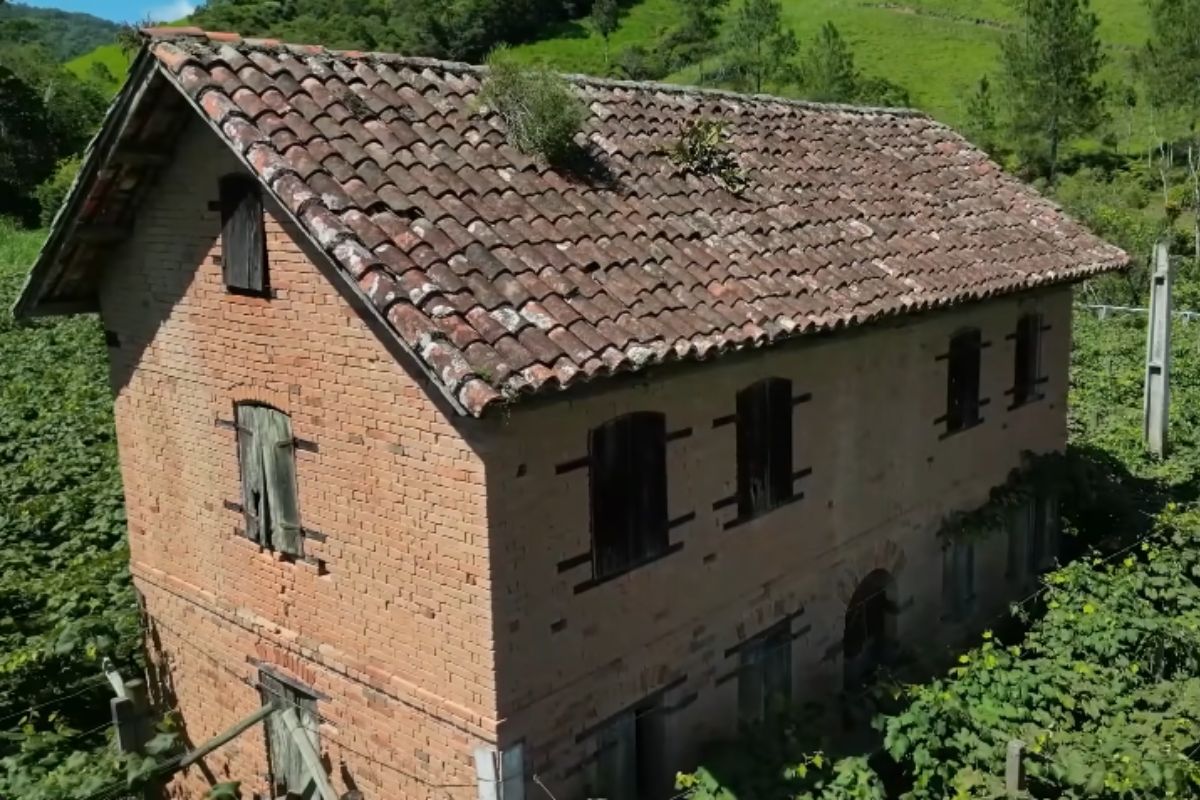
A few kilometers from the center of Ascurra, amidst a vineyard, a 150-year-old house stands out for a detail that completely deviates from the norm: on one side, the windows are wide and imposing; on the other, there are simply none. It is not a design flaw, nor a cost-cutting measure. The structure was designed to survive attacks in a time when conflicts with indigenous people were still part of the routine of the settlers arriving in the Itajai Valley around 1880.
Today, welcoming visitors is José, 86, a direct descendant of the builder, alongside his wife, Zília, 78, and son Sálvio, 52. The house was built by great-grandfather Luís Rinco, who left the Veneto region in Italy, crossed the ocean by sailing boat, lost a relative during the journey, and ultimately established roots in Santa Catarina. Among the thick clay walls and the old wood, the memories of this family’s courage, fear, and survival still live on.
A House Designed To Survive Attacks In The 19th Century

In the landscape of the Guaricanas community, the house stands out not only for its age but for the built-in logic of defense in every wall.
-
He started running at 66 years old, broke records at 82, and is now a subject of study for having a metabolic age comparable to that of a 20-year-old, in a case that is intriguing scientists and inspiring the world.

-
Oldest tree on the planet reappears after 130 years of searches: Wattieza, 385 million years old, was 10 meters tall and had no leaves or seeds; Gilboa fossils in New York solved the mystery in 2007.

-
A 48-square-meter house assembled in hours with 4,000 bricks made of recycled plastic that does not absorb moisture, has natural thermal insulation, and costs less than 90,000 reais in a complete kit.

-
Luciano Hang revealed that Havan’s air fleet has already accumulated more than 20,000 landings, 10,000 flight hours, and 6 million kilometers traveled, and he says that without the planes, the company would never have grown so quickly.


The upper side without windows was not an accident: it was designed to protect the inhabitants from arrows and nighttime attacks, in a region still occupied by indigenous people when the Rinco family arrived.
According to family accounts, Luís knew that if he opened windows on all sides, it would increase vulnerability. Therefore, the house was literally designed to survive attacks, with blank walls where the risk was higher.
On the side that was more exposed, no openings were made; light and ventilation mainly came from the section of the facade facing the vineyard and the safer area of the land.
Inside the house, the logic of protection continued. There was an internal staircase that was pulled up at night, isolating the upper floor.
The inhabitants would close a wooden gate and turn the upper floor into a kind of suspended refuge, making it as difficult as possible for intruders to enter.
It was an architecture of survival, far from the idea of modern comfort, but absolutely coherent with the reality of 1880.
Clay From The Land, Split Wood, And Tiles Molded On Thighs
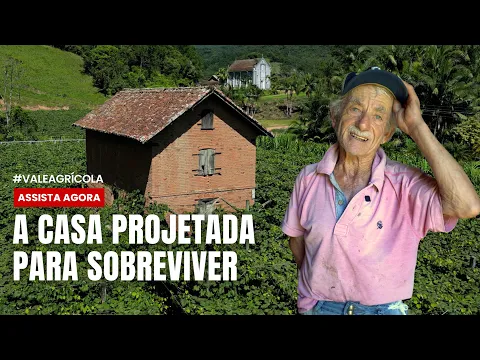

In addition to being designed to survive attacks, the house is a faithful portrait of the typical construction of the region’s early immigrants.
Almost all the material came from the very land. A large hole was dug only to extract the clay that would serve as a base for the bricks and structure. Nothing was purchased ready-made: everything was made right there, with what the land provided.
The hardwood was split by hand to form beams, rafters, and battens. One detail that draws attention is the roof: the tiles, known as ‘goivas’, were molded on people’s thighs. Each piece bore the mark of the body used as a mold.
Because of this type of tile, the roof battens were placed vertically, rather than horizontally, as seen in modern houses.
Inside, it is still possible to see parts of the old wood, marked by time, but not replaced, according to José.
The feeling is like stepping into a time tunnel where every crack in the wood and every irregularity in the clay tells a piece of the Rinco family’s history.
Memory Of Indigenous Attacks And Marks Left On The Walls
The decision to erect a house designed to survive attacks did not come out of nowhere: it relied on real stories of violence.
In one of the episodes recalled by the family, indigenous people invaded the back area and killed a woman who was preparing polenta early in the kitchen.
Another person managed to flee with a child in her arms and hid under a rock, escaping by a narrow margin.
There is also an account that the invaders, upon entering the house, attempted to eat the hot polenta on the griddle, not understanding that it was boiling.
When they burned themselves, they wiped their hands on the walls, leaving pieces of skin stuck in the clay. What now sounds like a movie scene was, at the time, part of the brutal daily life of a frontier in the making.
These memories help to understand why immigrants gave up comfort and aesthetics in exchange for safety.
Nothing there was casual: the staircase that retracted, the internal gate, the side without windows, the care with the accesses.
The house was envisioned as a shelter of resistance in a time when each night could bring real risk.
Cinnamon Rooms, Original Windows, And Childhood On Foot In The Countryside

The two upper floors housed the family bedrooms. The floor is made of cinnamon wood, sturdy, and some of the windows are still original.
José recalls that when he was a child, he lived with his parents in another house further back on the property and walked through the countryside to visit his grandparents and uncles who lived in this old house.
He remembers that he studied in a school near the church, from 1935, and that recess had its own ritual: his grandmother insisted that the grandchildren come eat polenta with cheese in the old house, as there was no such meal at school.
For today’s youth, accustomed to structured snacks, the contrast is enormous, but for them, it was the routine of a simple childhood, where everything revolved around the countryside, family, and the clay house.
In the kitchen of the first floor, the ground fire was the heart of the house. The chain and the parolo used at the time still remain.
The stove did not have the modern closed shape: it was basically an open fire, with smoke rising directly.
José remembers that when he arrived there to live and take care of an uncle, cleaning was a challenge, with corners full of hair and signs of time on all sides.
Gradually, the family adapted the space until deciding to build a new house and leave the old one closed.
From Antique Storage To Rural Tourism Route In Ascurra
Since the 1970s, the house designed to survive attacks remained closed and began to function more as a storage space for antiques.
Furniture, objects, and pieces from the Rinco family and other relatives were kept there, transforming the interior into a kind of spontaneous collection of Italian colonization in the Itajai Valley.
About 15 years ago, the surrounding vineyards were planted in a project by Sálvio to increase the property’s income.
The vines grew, and over time, the landscape of the old house amidst the rows of grapes transformed into a perfect setting for welcoming visitors.
Now, the family is working on creating a tourism association to open the gates to those who want to get to know this history up close.
Old houses like this one, built around 1880, should be part of the future rural tourism route. More than a sightseeing spot, the Rinco family’s construction is a living document of the lives of the early immigrants, the defense strategies, and the relationship with the land.
Nearly 150 years later, the house stands tall, a silent witness to a time when even architecture had to be designed to survive attacks.
Would you dare to spend a night in a house designed to survive attacks, surrounded by stories of indigenous people, polenta on the fire, and memories of 150 years?







-

-

-

-

-

-

15 pessoas reagiram a isso.