





 Portuguese
  English
  Spanish
  4 min of reading
  0 comments


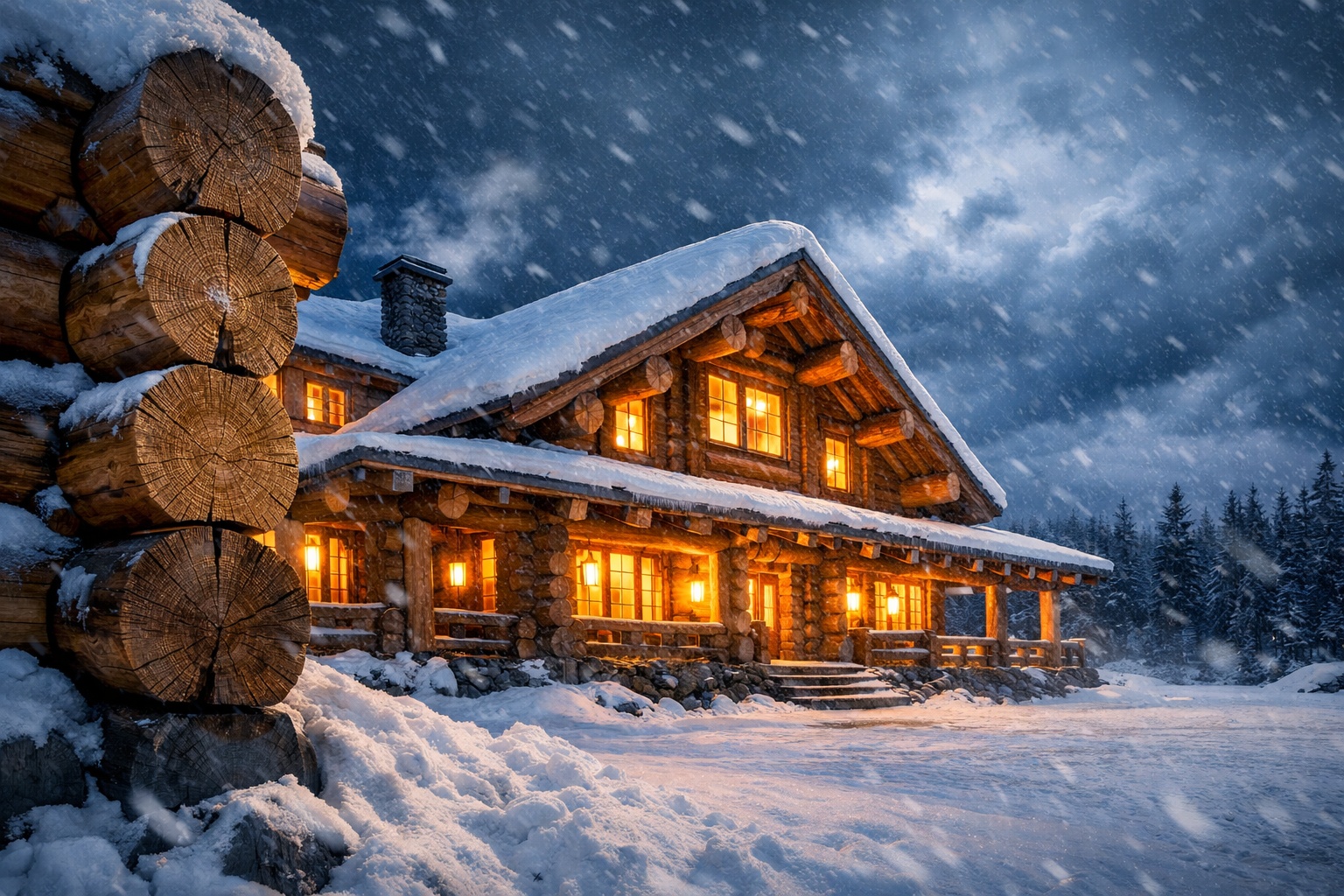
Canadian Log Homes Use Cross-Structural Joints That Eliminate Steel, Withstand Temperatures of -40 °C, and Resist Decades of Intense Snow.
In regions of Canada where winter brings temperatures down to -30 °C or even -40 °C, the construction industry must meet extreme challenges: thermal contraction, snow accumulation on roofs, constant cycles of freezing and thawing, and strong winds. Long before reinforced concrete dominated the market, Canadian communities were already building homes capable of facing this harsh environment using only massive wooden logs precisely jointed structurally.
These homes, internationally known as log houses, do not rely on metal columns or internal steel beams for primary support. The wood itself serves the functions of wall, sealing, and load-bearing support.
Cross-Joints That Replace Metal Fasteners in Houses in Canada

The most important element of these constructions lies in the corners of the building. The logs are not simply stacked: they receive specific cuts called notches, which allow locking by compression.
-
The lack of welders, electricians, and operators becomes a structural threat in 2025, with the construction industry and manufacturing already suffering from delays, cost pressures, and labor shortages in Brazil.

-
Brazil and Paraguay are just 46 meters away from a historic union on the bioceanic bridge that promises to revolutionize trade between the Atlantic and the Pacific.

-
With 55 km over the sea, a cost of US$ 20 billion, and enough steel to build 60 Eiffel Towers, China’s largest project has connected Hong Kong, Zhuhai, and Macau in a colossal bridge that defies the logic of engineering.

-
A trick with joint compound transforms a Styrofoam ceiling into a plaster-like ceiling: leveled panels, wires and mesh at the joints, sand, paint, and change the environment while spending little today.

There are different types of joints:
- Saddle Notch
- Dovetail Notch
- Scandinavian Notch
These cuts ensure that the logs adjust under their own weight and the pressure from the upper structure. The weight of the building itself increases structural stability over time.
There is no need for heavy structural screws to maintain the integrity of the corners when the joint is executed correctly.
Solid Wood as a Structural and Thermal Element
Unlike conventional systems that use internal structure and separate cladding, the log house integrates both functions into the same piece. The solid logs serve simultaneously as:
- Load-Bearing Structure
- Thermal Insulation
- External Sealing
Wood has low thermal conductivity compared to concrete. Additionally, thick logs create significant thermal inertia. The mass of the wood helps keep the interior warm for longer, even in extreme cold.
Houses in Canada Withstand Temperatures of -40 °C
In provinces like Alberta, Manitoba, and regions of northern Ontario, temperatures below -30 °C are common in winter.

Log homes endure because:
- Wood expands and contracts less abruptly than concrete
- The structural system distributes load evenly
- The absence of steel reduces thermal bridges

Thermal bridges are points where outside cold easily penetrates the structure. Because the logs are continuous, thermal transfer is reduced.
Support for Heavy Snow Loads
Roofs in Canadian regions must support tons of accumulated snow. Log homes use:
- Solid Beams
- Steep Roof Slope
- Load Distribution by Direct Compression
The combination of well-executed joints and high-density wood allows support for constant weight for months.
The structure primarily works in compression, which is the strong suit of solid wood. There are log houses in Canada that are over 100 years old and still habitable. Durability depends on:
- Proper Wood Treatment
- Elevation of the Base to Avoid Direct Moisture
- Wide Eaves That Protect from Rain
The wood used is generally pine, spruce, or cedar, species abundant in the country with good natural resistance.
Traditional Engineering That Became a Modern Standard
Today, specialized companies produce pre-fabricated kits of log homes using ancestral techniques combined with modern CNC cutting tools.

Structural stability depends on precise jointing, not on the use of internal steel. Traditional carpentry has evolved into precision engineering.
Energy Efficiency in Extreme Climates
Thermal performance studies show that solid wood constructions exhibit good energy performance when combined with adequate sealing between logs. Internal thermal comfort also depends on:
- Sealing with Natural or Synthetic Fibers Between Layers
- Suitable Heating System
Even so, the structural envelope already provides a solid basis for energy efficiency. Although resilient, log homes require:
- Periodic Wood Maintenance
- Moisture Control
- Joint Inspection
Modern projects often combine traditional techniques with concrete foundations for greater stability on frozen soils.
Why This Model Draws Attention in Brazil
In Brazil, where concrete and steel dominate urban construction, the concept of a home structurally supported only by solid wood comes as a surprise.
The idea of facing -40 °C without internal metal structure contrasts with the conventional model of reinforced concrete beams and columns. What impresses is not only the material but the structural precision of the joints.

Canadian log homes demonstrate that it is possible to build durable structures, resistant to extreme cold and heavy snow using wood joints as the main structural element.
The technique, which combines traditional carpentry and compression engineering principles, spans centuries and continues to be applied.
In a landscape seeking sustainable solutions and renewable materials, mass timber remains relevant — not as an improvised solution, but as a construction system consolidated in one of the planet’s harshest climates.










-

3 pessoas reagiram a isso.