





 Portuguese
  English
  Spanish
  6 min of reading
  32 comments


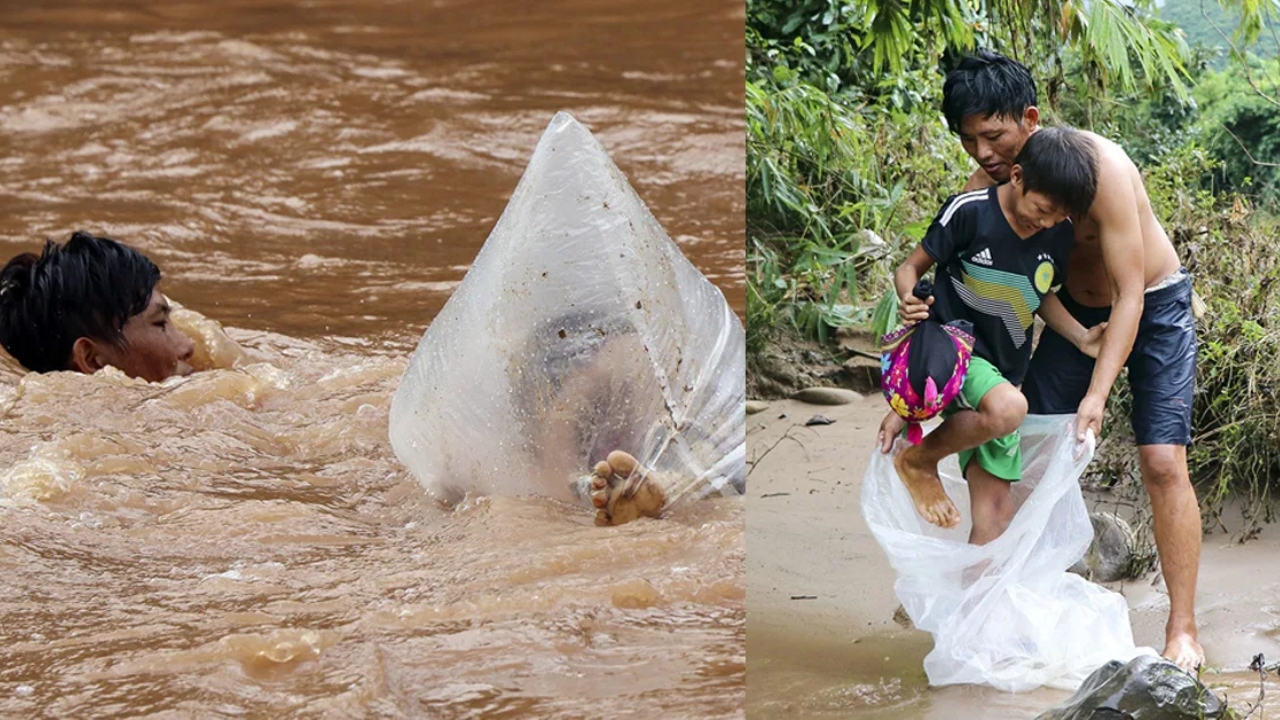


More Than 50 Children Rely on Plastic Bags to Cross the Nam Chim River During Monsoon Season in Vietnam, as Bamboo Bridges Are Destroyed Every Year, Rafts Capsize in the Current, and the Government Took Decades to Promise a Bridge That Is Still Uncertain Whether It Has Been Completed
In an isolated village in northwest Vietnam, desperate parents found a solution as ingenious as it is dangerous to ensure their children do not miss a single day of school: placing them inside large nylon bags and swimming with them across a swollen river. The story touched the world and laid bare the infrastructure gap that separates millions of children from their basic right to education.
An Isolated Village in the Dien Bien Mountains
Huoi Ha (Huổi Hạ) is a small village located in the Na Sang commune, Muong Cha district, Dien Bien province, in the far northwest of Vietnam, near the border with Laos. It is a mountainous, remote region that is difficult to access, where the predominant ethnicity is Hmong, one of the poorest communities in the country.
Daily life in Huoi Ha is shaped by geography: the Nam Chim River, a tributary of the Nam Ma, separates the village from schools and basic services such as markets, health clinics, and better roads. In the dry season, residents cross the river using makeshift bamboo bridges or simple rafts constructed from local materials. But when the rainy season arrives, everything changes.
-
Church from 1888 becomes a mansion of over 330 m² in Canada after a renovation of R$ 3.4 million and is eventually sold for nearly R$ 4.3 million.

-
How an innovative city combines high technology, well-being, and sustainability to become the largest reference in clean energy on the planet.
-
Couple buys 1846 church in ruins for R$ 660,000, invests R$ 3.2 million in renovations, transforms it into a millionaire mansion, and even preserved a historic cemetery with over 300 graves.
-
He started running at 66 years old, broke records at 82, and is now a subject of study for having a metabolic age comparable to that of a 20-year-old, in a case that is intriguing scientists and inspiring the world.



When the River Becomes an Enemy
Monsoon rains turn the Nam Chim into a whirlpool of muddy water, with strong and unpredictable currents. The fragile bamboo bridges become submerged or are swept away by the force of the water, and rafts cease to be a safe option, as the current can easily capsize them.
Even so, families refuse to let the children miss school. They know that education is often the only possible way out of extreme poverty. Faced with the real danger of trying to cross the river by swimming or on unstable rafts, residents had to get creative.
The Solution: Nylon Bags and Experienced Men in the River
With no safe alternatives, the parents of Huoi Ha created an extraordinary method: wrapping the children inside large nylon bags — the kind used to carry heavy loads — and swimming across the river, pushing or pulling these bags as if they were floats.
The process works as follows:
- The child enters the bag with their backpack and school supplies.
- The bag is closed in such a way as to keep a pocket of air inside, allowing it to float.
- An adult — usually a strong man accustomed to the river — holds the bag and swims through the current to the other side.
- The procedure is repeated, one child at a time, until everyone has crossed.
During times of flooding, more than fifty students from the village relied on this method to reach school. The children waited for their turn with fear, but also with determination, watching their peers being “wrapped up” and carried away by the water.


Five Hours of Hiking After the River
Crossing the river is just the beginning of the journey. Upon reaching the other side, the children and the family members accompanying them still need to hike for about five hours, through steep and slippery forest trails, covering approximately 15 kilometers to the boarding primary school in Na Sang.
Due to the distance and difficulty of the route, the students stay at the school throughout the week, returning home only on weekends. Every Monday, the cycle repeats: plastic bag, risky crossing, and a long hike to the classroom.
The Voices of a Community Calling for Help
Local leaders and educators have been clear in describing the situation. The chief of Huoi Ha village, for example, described the stretch of the river as extremely dangerous and stated that, although using rafts was the traditional solution, the rising water level had made that unfeasible, leaving basically the alternative of the bags.
The principal of the Na Sang boarding school highlighted that dozens of students come specifically from Huoi Ha and that teachers and parents do what they can to ensure the children’s attendance in classes, despite the enormous difficulties. Both the village and school leaders insist on the same demand: that the state invests in a safe and permanent bridge capable of withstanding the rains and providing a minimally dignified way for students.
District authorities also recognize the danger, but many residents argue that, in practice, there is no other option: the same force of water that can overturn a raft can also sweep away a person attempting to swim across.

The Story Goes Viral and Touches the World
The story of Huoi Ha was initially told by the Vietnamese press, in reports that included photos and videos of parents carrying their children inside the bags across the river. The images quickly spread across social media and were republished by outlets in various countries.
Thousands of comments praised the parents’ courage and the children’s determination, while criticizing the lack of basic infrastructure. The scene of a father crossing a raging river with his child “wrapped” in a plastic bag became a symbol of both the importance of education and the neglect to which many rural communities are subjected.
The Government Response and the Fight for a Bridge
With international repercussions, the Vietnamese Ministry of Transport mandated that local and road authorities assess the situation in the region and study infrastructure solutions, including the construction of more resilient suspension bridges.
In nearby areas, such as the village of Sam Lang, also in Dien Bien province, a bridge had already been built to replace dangerous crossings over fast-flowing rivers, although subsequent flooding showed that works in the region need to be planned to withstand extreme weather conditions.
In the specific case of Huoi Ha, more recent reports from residents and internet users suggest that improvements may have been made, possibly with the construction of a safer crossing. Still, the story remains a warning about how isolated communities can be left on the margins of essential public policies.

A Problem That Goes Beyond a Village
The episode of Huoi Ha is not an isolated case. Other villages in the same province and in mountainous regions of northern Vietnam face similar challenges: dangerous rivers, precarious roads, long distances, and the absence of bridges, which makes access to school a true test of physical and emotional endurance.
In many of these places, children walk for hours each day, in rain or cold, over steep terrain, and families must choose between the daily risk of dangerous crossings and the possibility of seeing their children without education.
A Lesson in Determination and an Appeal to Responsibility
The image of a child inside a plastic bag to reach school encapsulates two opposing dimensions of reality: on one side, the extraordinary determination of families who do everything in their power to secure education for their children; on the other, the absence of minimum conditions that any government should provide.
It is not a scene of resignation, but of resistance: faced with extreme obstacles, these families refuse to give up. At the same time, the story of Huoi Ha is a direct appeal to the responsibility of authorities and the international community: no child should have to put their life at risk inside a river during a flood just to exercise their basic right to learn.
Article compiled with verified information from Voice of Vietnam (VOV), Bored Panda, Earthly Mission, NextShark, The Sun, Daily Mirror, World of Buzz, and official statements from Vietnamese authorities.





Misericórdia e muito desafiado viver assim. mas graças a Deus q eles não desiste de lutar por um futuro melhor para os filhos. Isso faz com que se torna mais forte 💪
Um absurdo isso,os governantes não priorizarem a educacao das crianças e não disponibilizarem transporte adequado para o grupo de alunos. Vergonha!
Querer fazer uma ponte ? Tem q fazer uma escola né ?!