





 Portuguese
  English
  Spanish
 5 min of reading
  3 comments


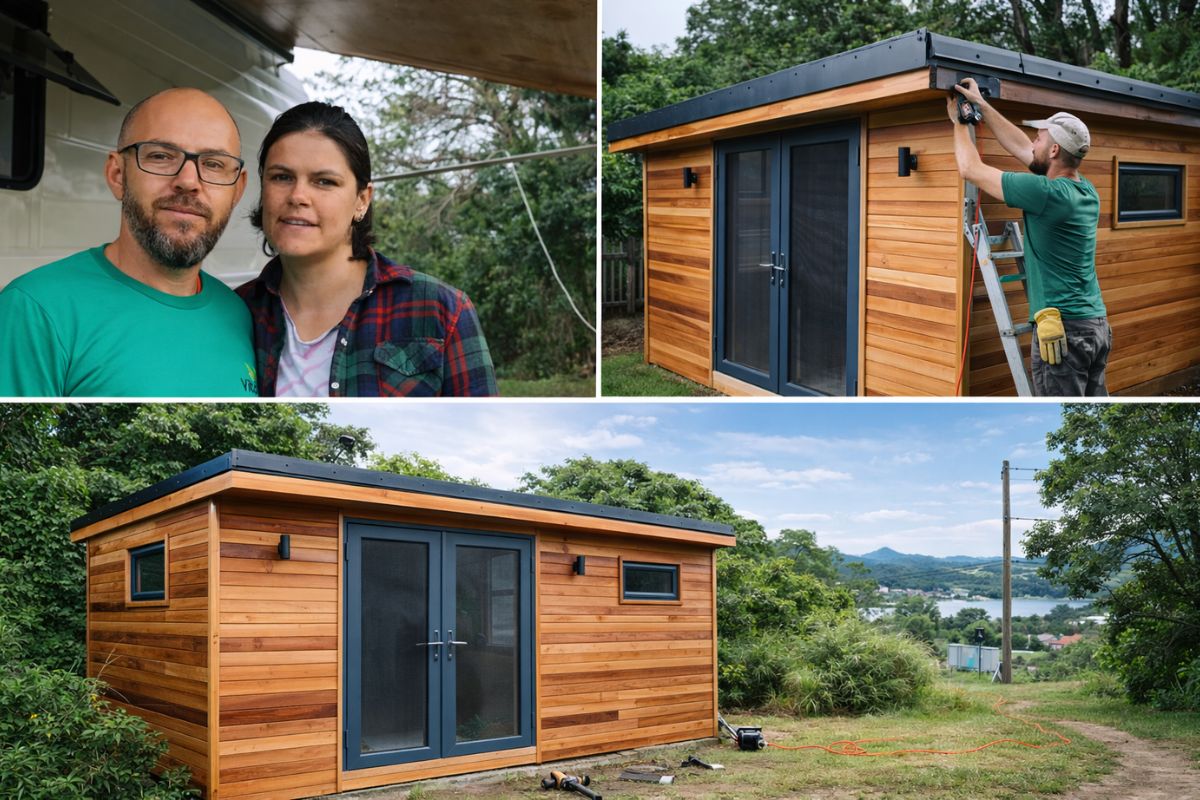


Without Specialized Labor and With Little Structure, the Mini House 6×3 from Scratch Is Born in Santa Catarina with Decisions Learned from ‘Uncle YouTube’, from Square to Roof, and with Power Drawn from the Neighbor for 100 Meters of Wire, Until the Framework and Mosquito Net Define the Finish.
The Mini House 6×3 from Scratch Started as an Improvisation in Santa Catarina, in the Hands of a Couple with No Experience Who Learned from Uncle YouTube How to Get the Square Right, Raise Walls, Assemble Framework, and Close the Roof, While the Work Relied on 100 Meters of Wire Coming from the Neighbor.
The Result Is Not a Miracle Promise, But a Sequence of Practical Choices, Some Brilliant, Others Risky. Between the Urgency of Seeing the House Standing and the Need for Safety, the Story of the Couple from the Channel Família VNE (Living on the Road) Shows How a Minimal Worksite Can Become a Method When Every Mistake Costs Time, Material, and Peace of Mind.
What It Means to Build a Mini House 6×3 from Scratch with Little Structure

A Mini House 6×3 from Scratch Is, Above All, a Question of Space.
-
The lack of welders, electricians, and operators becomes a structural threat in 2025, with the construction industry and manufacturing already suffering from delays, cost pressures, and labor shortages in Brazil.
-
Brazil and Paraguay are just 46 meters away from a historic union on the bioceanic bridge that promises to revolutionize trade between the Atlantic and the Pacific.

-
With 55 km over the sea, a cost of US$ 20 billion, and enough steel to build 60 Eiffel Towers, China’s largest project has connected Hong Kong, Zhuhai, and Macau in a colossal bridge that defies the logic of engineering.

-
A trick with joint compound transforms a Styrofoam ceiling into a plaster-like ceiling: leveled panels, wires and mesh at the joints, sand, paint, and change the environment while spending little today.

It Has 18 Square Meters of Footprint, Which Forces You to Think About Circulation, Placement of Doors and Windows, and the Use of Every Corner, Because Any Wall Out of Plumb Steals Centimeters That Are Missed in Daily Life.
In Santa Catarina, the Couple Describes That They Started with No Experience and Without a Traditional Work Structure.
This Changes the Pace and Changes the Standard of Decision: Instead of Executing Everything Automatically, the Mini House 6×3 from Scratch Becomes an Exercise in Understanding What Supports, What Closes, and What Protects Against Rain, Wind, and Insects.
The Square Learned from Uncle YouTube and Why It Rules Everything

The Square Appears as the First Watershed.
When the Couple Says They Got the Square Right from Uncle YouTube, They Are Referring to a Stage That Is Usually Ignored by Laypeople and That Defines the Rest of the Work: If the Rectangle is Born Crooked, Roof, Framework, and Joints Will Demand Successive Corrections.
In Practice, the Square Is a Language of Control.
An Incorrect Corner Multiplies, Because It Shows in the Alignment of the Walls, in the Cutting of Pieces, in the Position of the Openings, and Even in the Way the Mosquito Net Will Be Installed Later.
Uncle YouTube Enters as a Learning Tool, But the Real Test Happens on the Ground of the Worksite.
Energy from the Neighbor with 100 Meters of Wire, a Quick Solution and Embedded Risk
The Most Sensitive Part of the Report is the Power Drawn from the Neighbor with 100 Meters of Wire.
The Phrase Carries Weight for a Simple Reason: It Points Out That the Mini House 6×3 from Scratch Did Not Have Its Own Connection Initially and That the Work Needed to Function Anyway, to Power Tools and Lighting.
This Type of Improvisation May Seem Inevitable on a Small Worksite, But It Carries Risk.
The Longer the Length of Wire, the Easier It Is to Lose Control Over Heating, Protection, Splices, and Exposure to the Elements.
The Couple Does Not Detail Technical Standards, So the Reading Must Be Sobering: The Solution Existed, Made the Work Feasible, But Leaves an Uncomfortable Question About Safety and Responsibility.
Roof and Framework, When the Skeleton Becomes a Real Shelter
The Roof is the Moment When the Construction Changes Category.
Until Then, the Mini House 6×3 from Scratch is Structure and Promise; with the Roof Assembled, It Becomes a Shelter, Allows Storing Dry Materials, and Reduces Dependence on Weather to Continue Working.
The Framework Comes as Another Milestone, Because It Organizes the Openings and Finishes What Was Previously Just an Opening.
This Is Where the Square Returns to Demand Coherence: If the Corners Do Not Communicate, the Framework Shows. A Crooked Window Is an Alarm, and the Couple Says They Adjusted Step by Step to Keep the Work Moving Forward.
Mosquito Net, Ventilation, and Comfort That Does Not Show Up in the Photo
The Mosquito Net May Seem Like a Detail, But in a Mini House 6×3 from Scratch, It Changes the Real Use of the Space.
With a Compact Area, Open Windows Help with Ventilation and the Feeling of Amplitude, and the Mosquito Net Allows This Without Turning the House into an Invitation for Insects.
Besides Comfort, the Mosquito Net Reveals a Maintenance Mindset.
Whoever Installs This Type of Solution Accepts That the House Needs to Function in Daily Life, Not Just Be Ready.
In Santa Catarina, the Couple Treats the Mosquito Net as Part of the Final Closure, a Point Where Improvisation Becomes a Method Because the Goal Becomes to Live and Use.
From Improvisation to Method, What the Work Teaches for the Next Mini House

What Grabs You in This Story Is the Transition of Language.
In the Beginning, Everything Is Trial and Error, Consultation with Uncle YouTube, Borrowed Tools, and Power Drawn from the Neighbor with 100 Meters of Wire.
Gradually, the Mini House 6×3 from Scratch Becomes a Script for Execution, with Logical Order: Square, Structure, Roof, Framework, Sealing, and Finally, Mosquito Net.
There Is Also a Lesson About Expectations.
Quick Construction Only Exists When the Mistake is Small, Because Redoing Is Expensive in Time and Wear.
The Mini House 6×3 from Scratch Works as a School for Decision-Making, and the Final Question Is Not Whether It Worked, but Whether the Method Created Lasts When Urgency Passes and the House Begins to Be Used Every Day.
The Mini House 6×3 Built in Santa Catarina Has Become a Case That Draws Attention Because It Blends Learning from Uncle YouTube, Decisions about Square, Roof, and Framework Right on the Edge of What a Small Worksite Tolerates, and Also Includes Power Drawn from the Neighbor with 100 Meters of Wire and the Mosquito Net as Final Closure.
It’s Beautiful to See the House Being Born, but It’s More Serious to Discuss the Price of Improvisation.
If You Were in Their Place, What Would You Change First and Why: the Way to Ensure the Square, the Decision to Use 100 Meters of Wire, or the Priority to Close the Roof and Mosquito Net to Make the Mini House 6×3 Usable Sooner?










Felicitaciones!!!
Nosotros con nuestro hijo nos cinstruimos una cabaña en Neptunia.
Desde cero tmb y aprendiendo en google.
Primero un espacio de 6 x4 y hoy ya construimos el dormitorio.
Por eso los felicito,sr lo que cuesta.
La electricidad la cruzabamos de la cada de nuestro hijo.
Tenemos 70 años y gracias a el empuje de nuestro hijo hoytenemos nuestro hogar.
Só uma observação, na cobertura do telhado foi feito o recorte nos cantos das telhas, onde as telhas ficam sobrepostas? Se não, provavelmente deve ter ficado uma abertura entre elas, que com a chuva e ventos fortes deve ocorrer infiltração no forro!
Parabéns a parceria do casal, que sem ela não há iniciativa.