





 Portuguese
  English
  Spanish
  5 min of reading
  0 comments


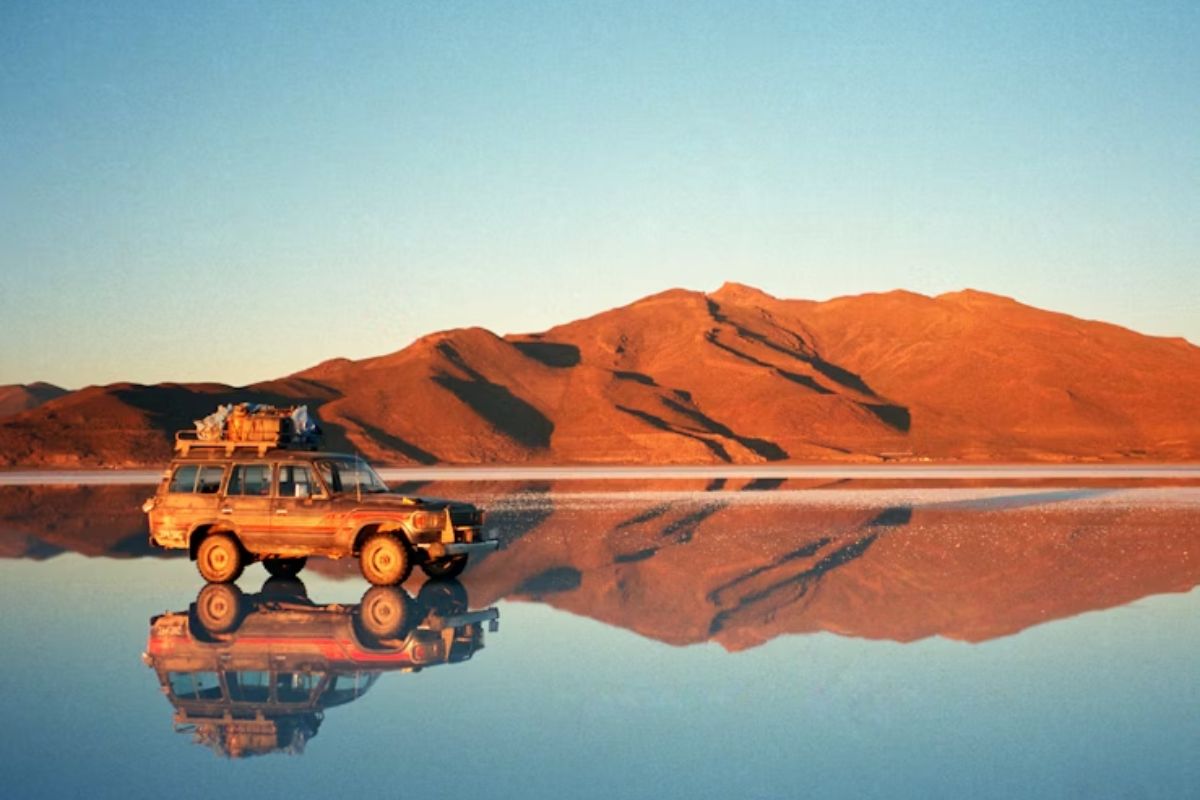
In The Heart Of The Bolivian Highlands, The Largest Natural Mirror On The Planet Is Transforming Into A Surreal Desert, And A Family Has Been Fighting For Three Generations To Continue Living From Salt Extraction In This White, Silent, And Extreme Scenario.
In the vastness of the Bolivian Salar, the largest natural mirror on the planet seems like a hallucination. During the rainy season, a thin layer of water covers the salt flats and transforms the ground into sky, creating a perfect reflection that confuses horizon, clouds, and reality. It is there, in one of the harshest and most hostile places on Earth, that a family insists on staying, surrounded by salt in all directions.
When the wind dries and the water recedes, the mirror turns into desert. In the largest natural mirror on the planet, the scenery shifts from magical to brutal in a matter of months, and it is in this environment that Eric Chambry and his family continue, day after day, digging, carrying blocks, and trying to extract their livelihood from this place.
In a fast-paced world, they remain on the salt, repeating the craft they inherited from their grandparents.
-
He started running at 66 years old, broke records at 82, and is now a subject of study for having a metabolic age comparable to that of a 20-year-old, in a case that is intriguing scientists and inspiring the world.

-
Oldest tree on the planet reappears after 130 years of searches: Wattieza, 385 million years old, was 10 meters tall and had no leaves or seeds; Gilboa fossils in New York solved the mystery in 2007.

-
A 48-square-meter house assembled in hours with 4,000 bricks made of recycled plastic that does not absorb moisture, has natural thermal insulation, and costs less than 90,000 reais in a complete kit.

-
Luciano Hang revealed that Havan’s air fleet has already accumulated more than 20,000 landings, 10,000 flight hours, and 6 million kilometers traveled, and he says that without the planes, the company would never have grown so quickly.

Where The Largest Natural Mirror On The Planet Meets A Hostile Desert
The Salar in southern Bolivia is presented as one of the most remarkable landscapes on the planet. It covers about 4,000 square miles of salt flats, a nearly infinite white surface attached to the sky.
During the rainy season, from November to April, only a few centimeters of salty water spread over the salt and create the effect that fascinates travelers: a perfect mirror covering the horizon.
There, the largest natural mirror on the planet seems to erase the line between ground and sky. The reflection of the moon, clouds, and mountains makes anyone doubt what they are seeing.
But behind this visual spectacle lies an environment described as one of the harshest imaginable, hostile to almost all forms of life. Intense sun, cutting wind, dry air, altitude, and solitude compose their daily lives.
It is precisely in this extreme setting that a few families have found a way to survive. While many see only surreal beauty or a perfect background for photos, some see it as a place of work, risk, and necessity.
Real Life On The Salt Desert
The narrator arrives at the Salar at the beginning of a journey through the South and, in front of that white plain, admits that it looks like he is hallucinating, as if the scene were a giant ice skating rink.
But soon after the contemplation comes the information that changes the perspective: even there, in the middle of nowhere, there are people who live and work every day.
He walks towards what he believes are some of the last traditional salt miners still active.
In the largest natural mirror on the planet, these workers can see miles in every direction, but see almost nothing beyond salt, sky, and silence.
They are, as the narrator puts it, the only people exercising there, under the sun and on the infinite white.
This contradiction is profound: while the world imagines a dreamlike scenario, the reality is one of heavy, repetitive physical labor that is essential for an entire family to stay afloat.
Three Generations Extracting Salt In The Heart Of The Desert
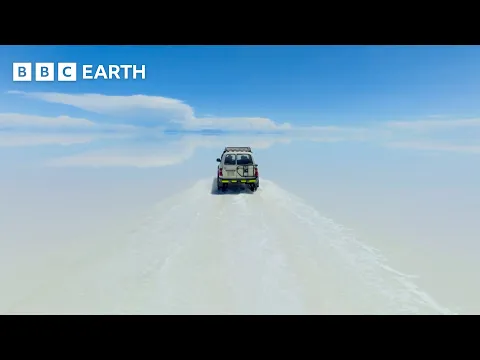

In the midst of the white vastness, the narrator finds Eric Chambry. He greets him, introduces himself, and soon realizes that he is not facing an isolated worker, but an entire family structure set up on the salt.
Eric’s family has been working in salt mining for three generations. Grandfather, father, children: all connected to the same trade, the same place, the same desert.
They extract salt in blocks and mounds, in a system that seems simple but requires strength, endurance, and technique. Each block rises from the salt flats like a brick of survival, heavy and essential.
When the narrator tries to lift one, he quickly realizes the effort involved: the weight is real, the fatigue is immediate, and the daily repetition makes everything even harder.
Eric explains that part of this salt can become table salt, some goes to other destinations, but the central point is different: that is all they have. It is what they live from. On a workday, the family can extract over 100 pounds of salt.
The amount is impressive, but the narrator makes it clear that this volume serves to sustain the entire family, in one of the most difficult environments on the planet. It is not about easy wealth, but a fragile balance between effort and return.
An Epic Job In An Extreme Place
The narrator describes the work as epic, and it is no exaggeration. Under a sun without shade, on a ground that reflects light like a mirror, Eric and his family repeat the same ritual: cutting, lifting, carrying, piling.
Around them, there are no trees, no houses, no roads. Just the absolute white of salt and a distant horizon.
In the largest natural mirror on the planet, each movement is amplified by fatigue and isolation. There is no easy alternative, no shortcut, no long break.
The salt that comes from there is not just a product; it is the line that separates the family’s continuity from the need to move somewhere else.
During the lunch break, the narrator observes that there is no option for comfortable shelter or nearby city. Everything is improvised, simple, functional. The break is short because the workday in the desert does not wait, and the light needs to be utilized.
Between The Mirror, The Salt, And The Future

When the narrator states that there is no other place exactly like this, he refers to both the landscape and the people.
In The Largest Natural Mirror On The Planet, A Family Struggles To Maintain A Way Of Life That Is Disappearing, caught between the harshness of manual labor and economic transformations that push many young people away from the salt flats.
The Bolivian Salar continues to attract gazes, cameras, and enchanted descriptions, but behind this scenario are stories like that of Eric Chambry and his family, who continue to set their feet on the salt, even when everything around seems to invite escape.
With each block lifted, they renew a silent pact with the desert: to continue there as long as possible, living off what the ground offers.
At the end of the day, when the sun sets and the white begins to change color, the largest natural mirror on the planet reflects not only the clouds but also the reflection of the human condition itself, made of resilience, work, and uncertainty.
And You, Would You Dare To Live And Work In A Place Like The Largest Natural Mirror On The Planet, Or Do You Think No Salary Would Compensate For The Effort And Isolation Of This Salt Desert?







Seja o primeiro a reagir!