





 Portuguese
  English
  Spanish
  6 min of reading
  1 comment


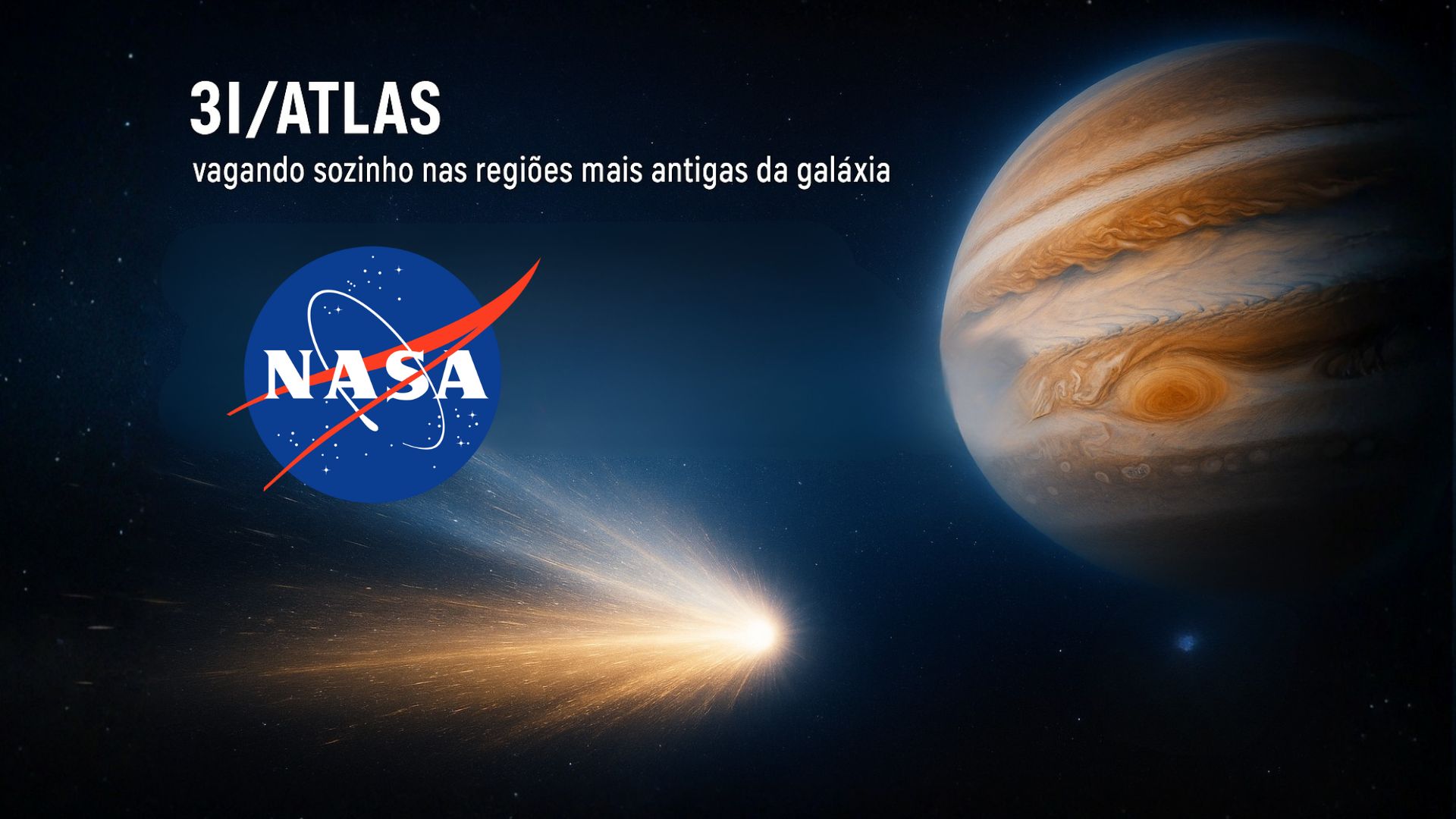


Rare Interstellar Visitor Crosses The Solar System At High Speed And Approaches Jupiter In 2026, Offering A Unique Opportunity For Scientific Observation.
The comet 3I/ATLAS, the third confirmed interstellar object, crosses the Solar System in a hyperbolic orbit at around 200,000 km/h relative to the Sun near perihelion, and is now heading towards a close passage through the region dominated by the gravity of Jupiter, expected in March 2026.
Numerical models indicate that this encounter poses no risk to the planets, but it should measurably alter the object’s final trajectory before it is hurled back into interstellar space.
Unlike common comets, which belong to the Oort Cloud or the Kuiper Belt, 3I/ATLAS is not gravitationally bound to the Sun.
-
An impressive phenomenon in Northern Brazil causes rivers of different colors to flow side by side, revealing secrets about sediments, currents, and biodiversity.

-
While many schools are still struggling with the basics, a teacher in China went viral for having elementary school students build a two-stage rocket using plastic bottles, water, and pressurized air in a science class that caught the attention of the entire world.

-
10 million robots per year in unprecedented industrial scale place China at the forefront of automated production and raise the question of how far machines can manufacture other machines.

-
Researchers in Malaysia buried sensors at 15 and 30 cm and can now predict soil moisture with 95.49% accuracy, helping the field to irrigate only at the right time and reduce water waste.

Its orbit is so open that it confirms an origin external to the Solar System, making it a rare messenger from other planetary systems.
The current ephemeris shows that the comet will not come closer to Earth than about 1.8 astronomical units, approximately 270 million kilometers, a distance nearly twice that of the average separation between Earth and the Sun.
Trajectory And Speed Of Comet 3I/ATLAS
3I/ATLAS was discovered on July 1, 2025 by the ATLAS surveying system in Chile, initially identified as an object with a very eccentric trajectory.
As new observations were incorporated, astronomers confirmed it was a comet on a unique passing trajectory, with an interstellar approach speed of around 58 km/s, the highest among the three identified visitors from outside the Solar System.

During its approach to the Sun, the comet crossed Mars’ orbit, coming within 0.2 astronomical units of the planet on October 3, 2025, before hitting perihelion in October, slightly within Mars’ orbit.
It then passed about 0.65 astronomical units from Venus, always far from any collision scenario, but close enough for probes on Mars and around Jupiter to take advantage of the observation opportunity.
Telescope facilities such as Hubble, the ATLAS network, and instruments on Mars have been refining the orbit and monitoring the comet’s activity as it moves away from the Sun.
Even at the best time visible from Earth, the estimated brightness of 3I/ATLAS remains around magnitude 11, invisible to the naked eye and accessible only to medium-sized amateur telescopes or professional instruments.
This means that much of the investigation depends on space observatories and coordinated campaigns with large ground-based telescopes.
Ancient Origin And Path Through The Galaxy
Recent studies combining orbital dynamics and stellar population properties suggest that 3I/ATLAS may have formed in a planetary system associated with the thick disk of the Milky Way, a region marked by older stars that are poorer in heavy elements.
Independent analyses estimate that the comet is between 7 and 14 billion years old, potentially making it older than the Solar System itself.
By reconstructing the object’s path through space, researchers found that it entered the solar neighborhood from the direction of the constellation Sagittarius and is expected to exit approximately in the direction of the constellation Gemini.
This implies a trajectory that cuts across the galactic disk at a significant angle, consistent with an object that has spent much of its existence orbiting the galaxy on more inclined paths than stars like the Sun.
This long journey was likely marked by multiple crossings of the galactic plane and distant encounters with other stars, which gradually altered the comet’s orbit until it crossed the path of the Solar System.
From now on, the combination of solar gravity and the gravitational field of the planets, especially that of Jupiter, will determine the final path of 3I/ATLAS into deep space.
Approach To Jupiter In 2026

Among the predicted planetary encounters, the most significant occurs with Jupiter on March 16, 2026.
On that date, the comet is expected to pass about 0.36 astronomical units from the planet, roughly 54 million kilometers, a distance sufficient for the gas giant to exert a significant effect on the orbit of the interstellar visitor.
Calculations involving Jupiter’s mass, its distance to the Sun, and the extent of the Hill sphere indicate that 3I/ATLAS will pass very close to the limit of this region of gravitational influence.
Simulations published by researchers from the Physical Research Laboratory (PRL) in Ahmedabad and the Indian Institute of Technology Gandhinagar suggest that the passage should alter the relative speed and exit angle of the comet after the encounter.
The models also show that Mars practically does not modify the object’s orbit.
Jupiter, on the other hand, accounts for most of the predicted changes in orbital parameters, reinforcing the gas giant’s central role as a shaper of orbits in the Solar System.
Although the comet will remain in a hyperbolic orbit and will leave the Solar System, small additional forces may measurably alter the final path of the object towards the outskirts of the galaxy.
Non-Gravitational Forces And Nucleus Behavior
In addition to gravity, the motion of comets is influenced by non-gravitational forces, primarily related to the release of gas and dust as the surface ice sublimates under sunlight.
These jets act like small natural rockets, capable of accelerating the comet’s nucleus in specific directions.
In the case of 3I/ATLAS, different acceleration values have been tested in recent studies.
If these forces are too weak, the effect on the post-Jupiter orbit will be negligible.
Higher values, however, may significantly alter the comet’s final trajectory when leaving the Solar System.
As the actual accelerations are still not accurately known, new photometric and spectroscopic observations will be essential to refine the models.
What Telescopes And Probes Have Already Found
The observations accumulated since July 2025 show that 3I/ATLAS is an active comet, with a frozen nucleus surrounded by a coma of gas and dust and visible tails in different wavelengths.
Data from Hubble, ground-based telescopes, and instruments in space indicate that the object is particularly rich in carbon dioxide (CO₂), with smaller amounts of water, carbon monoxide, and other volatile molecules.
International campaigns have also detected emissions associated with water at great distances from the Sun, implying a highly active surface or ice grains in the coma acting as an extended source of vapor.

Photometric measurements show variations in color and brightness that help compare 3I/ATLAS with comets from the Solar System and assess how it differs from these populations.
Institutions like PRL have captured false-color images and spectra that contribute to mapping the comet’s chemical composition.
These data complement observations made by probes on Mars and missions en route to the Jovian system.
Juno Will Have Privileged Window To Observe The Comet
As 3I/ATLAS approaches Jupiter’s orbit, the Juno probe, which has been studying the planet since 2016, emerges as one of the platforms with the best geometry to follow the passage.
Simulations indicate that between March 9 and 22, 2026, the spacecraft will be in a particularly favorable position to observe the comet.
Even without specific maneuvers, the combination of the line of sight, a minimum distance of about 54 million kilometers, and the still operational instruments may allow images and measurements of the plasma and particle environment around the comet.
For observers on Earth, the phenomenon remains restricted to medium and large telescopes, as the brightness of 3I/ATLAS is not enough for naked-eye observation.
Still, this represents a rare opportunity to follow how an object formed in another stellar system interacts with the gravity, radiation, and solar wind of our Solar System.
What type of mission or observation strategy do you think humanity should prioritize to better investigate encounters with interstellar objects like 3I/ATLAS?







cometa coisa nenhuma….