





 Portuguese
  English
  Spanish
  4 min of reading
  0 comments


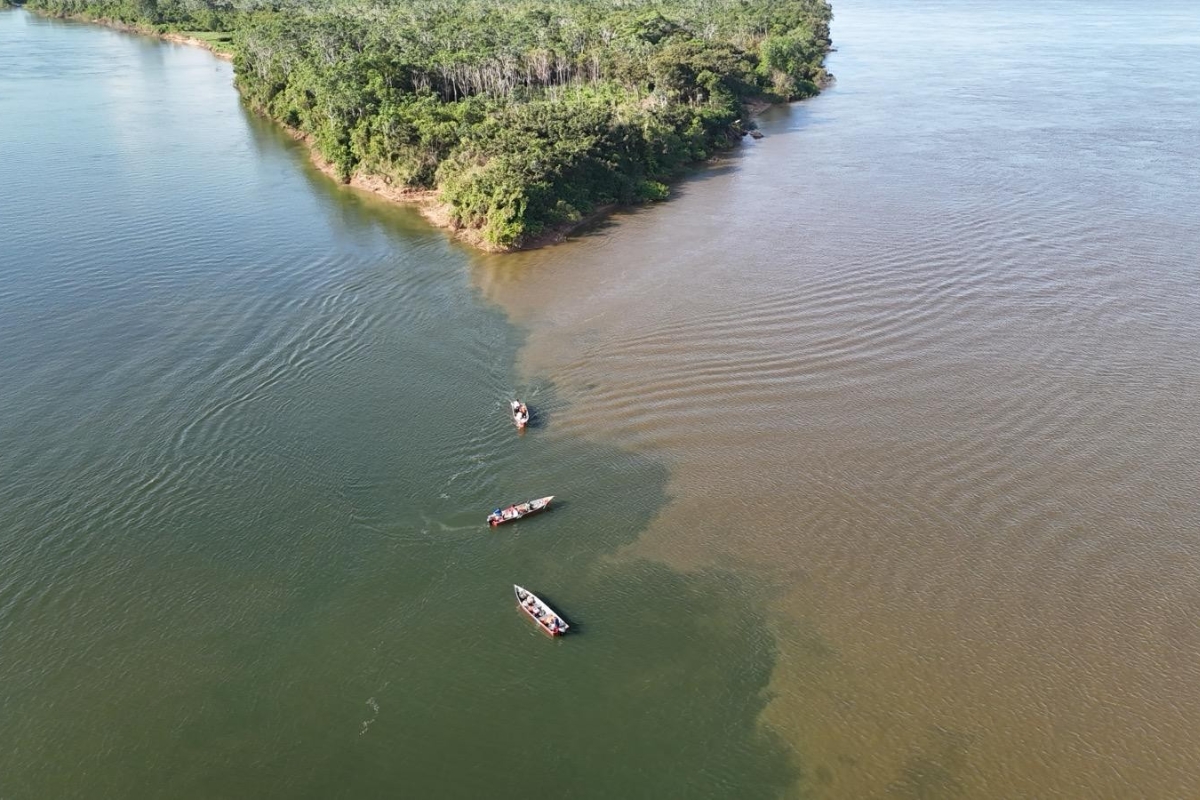
Much more than a beautiful scenery, the meeting between Araguaia and Tocantins shows the strength of Brazil’s great rivers by uniting contrasting colors, nutrient circulation, formation of aquatic habitats, and direct impact on economic activities that sustain entire communities in the North of the country.
In Northern Brazil, the meeting between the Araguaia and Tocantins rivers forms one of the most interesting confluences of the Tocantins-Araguaia basin. What stands out most in this stretch is the contrast between the waters, which can present different shades before fully mixing. The visual effect transforms the landscape into a scene of great impact and makes this phenomenon a topic that arouses curiosity both for its aesthetic and scientific sides.
This color difference does not happen by chance. Each river arrives at the meeting point with its own characteristics, resulting from the path it travels, the type of soil in the drained areas, and the amount of materials transported along the course. Therefore, the confluence between Araguaia and Tocantins goes far beyond a simple geographical junction.
What explains the color difference between the waters
The main explanation for the visual contrast lies in the load of suspended sediments. These sediments alter the turbidity of the water and influence how light is reflected, which changes the appearance of each river. When two flows with different compositions meet, the separation can remain visible for a certain stretch, creating the effect that impresses observers.
-
Russia wants to build new nuclear plants in Brazil and is negotiating an agreement with the Lula government to expand Rosatom’s presence in atomic energy projects, small reactors, and peaceful nuclear technology.

-
Microscopic fossils 1.7 billion years old found in rocks in Australia reveal complex cells living at the bottom of an ancient sea and may change what scientists know about the evolution of life on Earth.
-
Seen from space, an underwater volcano erupts in the Pacific, spewing smoke directly from the sea, spreading floating pumice, and may be creating a new island in a region so poorly mapped that scientists still do not know exactly which structure is erupting.
-
Researchers identify marks of Ice Age megafloods in the United States, a phenomenon that crossed Montana, Idaho, Washington, and Oregon, sculpted rolling hills like waves, and left giant scars that still challenge the landscape.


In addition to sediments, factors such as current speed, temperature, density, and physicochemical composition also interfere in the mixing. In other words, the rivers meet at the same point, but do not combine immediately because their waters behave differently. It is precisely this difference that makes the confluence so striking.

A phenomenon that reminds of the famous meeting of the waters
The comparison with the meeting between the Negro and Solimões rivers in the Amazon is inevitable. In both cases, the visual contrast arises because the waters have different properties, which delays immediate mixing. The similarity helps the public understand the phenomenon, but that does not mean the two cases are identical.
In the meeting between Araguaia and Tocantins, the dynamics of sediments play a particularly important role. In the Amazonian case, in addition to color, differences in temperature, speed, and chemical composition are also strongly highlighted. The general logic is similar, but each confluence has its own identity within the Brazilian river system.
Why this confluence is important for the environment
This meeting of rivers has great environmental relevance because it directly influences the ecological dynamics of the region. The union of waters with distinct characteristics affects nutrient circulation, the formation of aquatic habitats, and the balance of species that depend on this system to survive. This includes fish, aquatic organisms, and vegetation associated with the banks and floodable areas.
Confluences like this function as zones of ecological transition, where natural processes become more intense and complex. Therefore, the location holds value not only for its landscape but also for its scientific and environmental importance, being crucial for studies on biodiversity, hydrology, and conservation.

How the rivers also sustain life in the region
The importance of Araguaia and Tocantins is not limited to nature. These rivers help sustain essential economic activities, such as fishing, river transport, and energy generation. In many areas of Northern Brazil, the rivers continue to be fundamental for the circulation of people, goods, and for the organization of the territory.
This means that the confluence between the two watercourses brings together, in one space, environmental value and practical importance for everyday life. It is a place where science, landscape, and regional economy meet clearly, visibly, and strategically.
A spectacle that deserves more attention
The meeting between the Araguaia and Tocantins rivers shows how nature can reveal complex processes in a simple way to observe. The contrast between the waters immediately catches the eye, but what truly makes this phenomenon special is the set of factors it brings together: hydrology, sediments, biodiversity, and regional impact.
More than a beautiful scenery, this confluence represents the strength of Brazil’s great rivers and the importance of understanding how they shape the environment and human life. In a country defined by its waters, few phenomena translate this relationship as well as the meeting between Araguaia and Tocantins.





-

-

-

3 people reacted to this.