





 Portuguese
  English
  Spanish
  4 min of reading
  0 comments


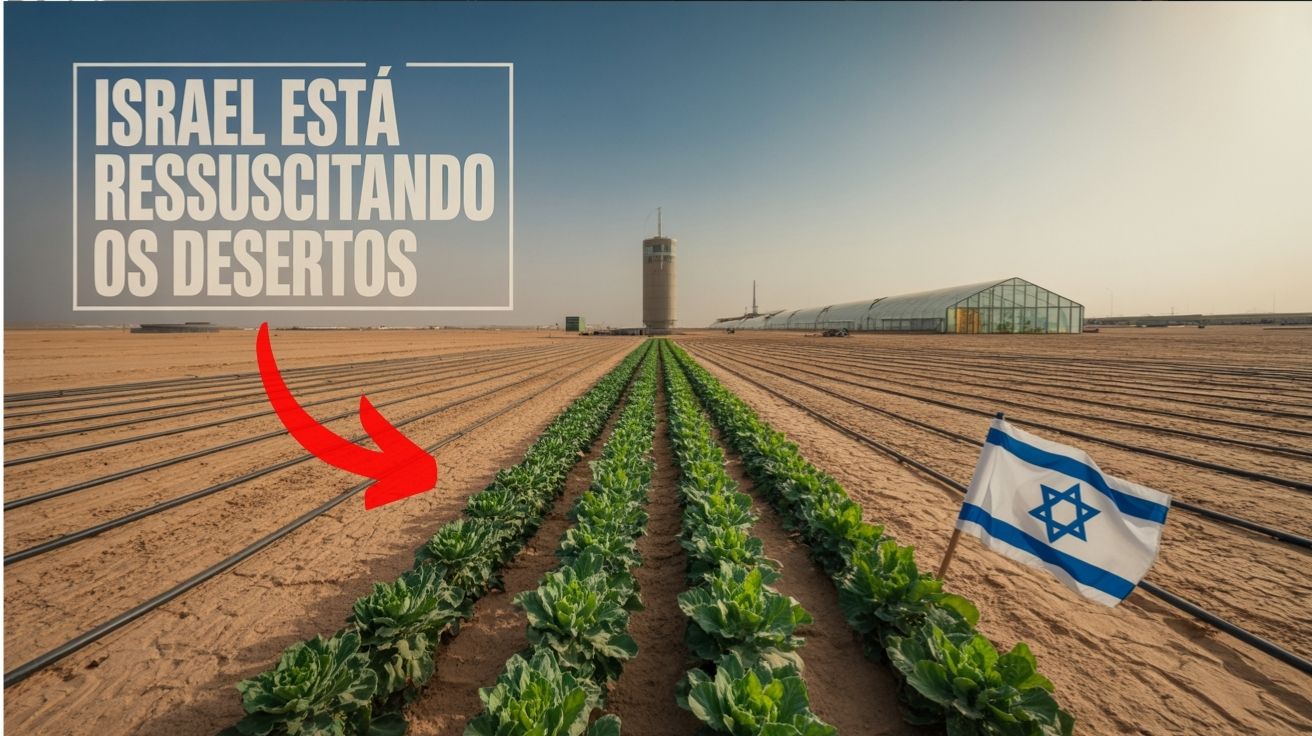
Even With Half the Territory Covered by Deserts, Israel Has Become a Global Reference in High-Tech Agriculture, Using Drip Irrigation, Recycled Water, and Innovative Solutions That Transformed the Impossible Into Reality in the Middle East.
With half the territory covered by deserts and a chronic shortage of water resources, Israel has become one of the greatest examples of overcoming natural adversities through technology.
Today, the country produces about 70% of the food it consumes, a direct result of a coordinated effort between government, universities, the private sector, and agricultural producers.
Since the 1950s, Israel has been investing in research and development to transform arid lands into productive fields.
-
“No one will make us change the Pix,” says Lula after the US report.

-
He started running at 66 years old, broke records at 82, and is now a subject of study for having a metabolic age comparable to that of a 20-year-old, in a case that is intriguing scientists and inspiring the world.

-
With a cost per shot close to zero, the DragonFire laser could change naval warfare in 2027 and provide British ships with nearly unlimited defense against drones.

-
A British startup creates tires that generate electricity in electric vehicles when passing over potholes, speed bumps, and cracks.

Drip Irrigation: The Revolution That Saves Water
Drip irrigation, one of the most emblematic innovations developed in Israel, has revolutionized the agricultural sector.
By providing the exact amount of water directly to the plant root, this technology prevents waste, improves soil aeration, and reduces greenhouse gas emissions.
Additionally, the system is often automated with sensors and software that adjust irrigation according to environmental conditions.
Wastewater Reuse and Desalination
Only 25% of the water consumed in the country comes from natural sources.
The other 75% is secured through methods such as desalination and treated wastewater reuse.
About 91% of the country’s wastewater is collected, and 75% of the treated volume is reused in agriculture — a rate much higher than the global average.
Agriculture in the Desert: The Miracle of the Arava Valley
In regions like the Arava Valley, in the south of the country and right on the edge of the Negev Desert, agriculture has become the main source of income thanks to the application of these technologies.
The success of production in inhospitable areas catches the attention of nations facing similar challenges, especially in the Middle East and Africa.
Advanced Research and Resistant Seeds
Institutions like the Volcani Institute lead research to develop seeds resistant to pests, high temperatures, and water scarcity.
Israeli agriculture is characterized by precision: integrated systems control temperature, humidity, and even fertilization, which takes place through fertigation — a process in which nutrients are distributed along with water in the irrigation system.
Efficient Livestock and Sustainable Aquaculture
Livestock also stands out with high productivity rates.
Israel has some of the highest global averages for milk production per cow, a direct reflection of a livestock industry based on technology, monitoring, and improved genetics.
Aquaculture, in turn, focuses on the sustainable farming of tilapia and carp under controlled conditions.
Automation of the Production Chain
Israeli innovation extends throughout the agricultural production chain.
From specialized machines for harvesting, packaging, and transportation, to software that provides specific recommendations for each crop, everything is designed to maximize yield with minimal inputs.
In the last 30 years, productivity has increased five times with practically the same amount of water used.
The Role of Kibbutzim in Agricultural Advancement
Agriculture has also been boosted by long-term public policies.
Since the early 20th century, kibbutzim — collective agricultural communities — have played a crucial role in the occupation and agricultural development of desert areas.
Today, many kibbutzim operate with cutting-edge technology, maintaining the collective spirit while incorporating modern management practices.
Agricultural Exports and Leadership in Innovation
Despite its small territory and natural limitations, Israel is a net exporter of agricultural products, especially fruits, vegetables, and flowers.
Tools and inputs developed in the country are also sold to dozens of countries interested in replicating the Israeli model.
Desalination as a National Strategy
Israel also leads in desalination of water.
The technology allows for the transformation of seawater, aquifer water, and even wastewater into drinking water.
Although this process consumes a lot of energy, the Israelis have developed more efficient membranes and adapted the technique according to the type of water resource.
Combating Desertification with Agricultural Technology
By combining water management and advanced planting techniques, Israel has managed to reverse some of the environmental degradation.
The recovered areas today sustain productive agricultural communities, demonstrating that coexistence with the desert is not only possible but can also be economically viable.
How has such a small and arid country managed to become a global reference in agricultural production and technology export?





-

-

3 pessoas reagiram a isso.