





 Portuguese
  English
  Spanish
  7 min of reading
  6 comments


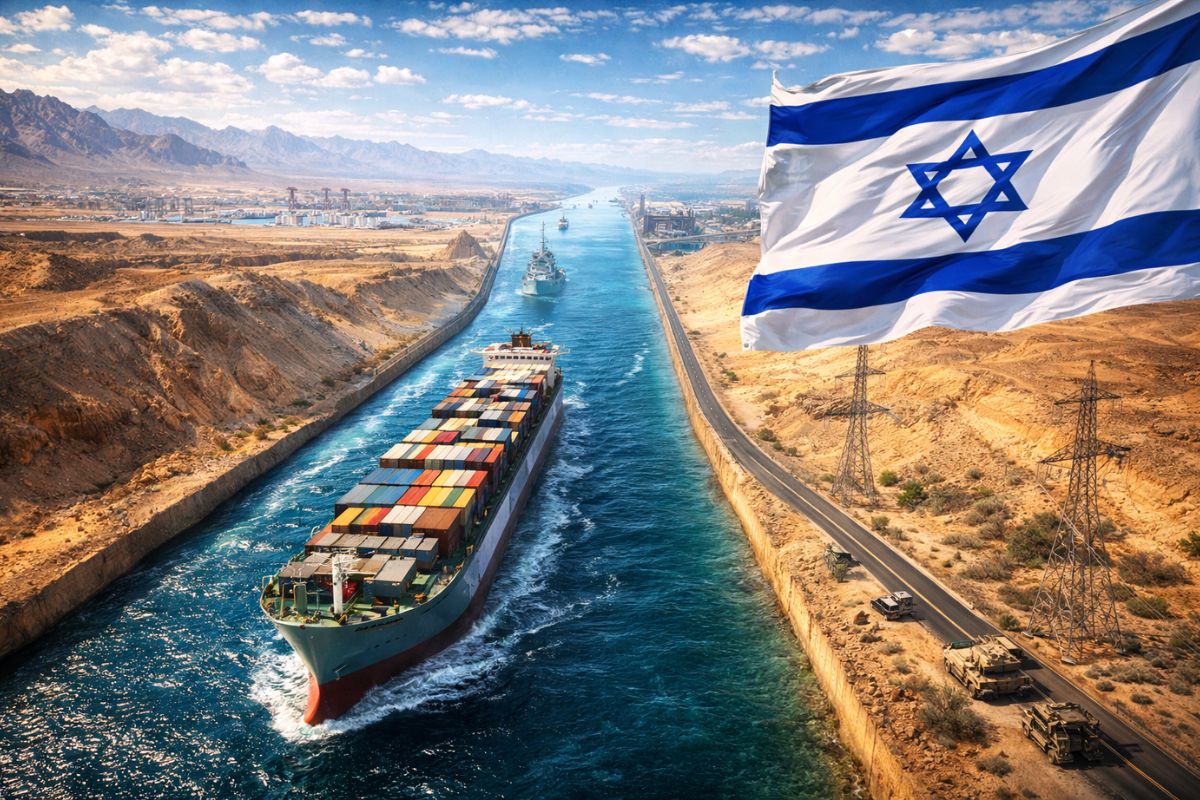


Israel Plans to Tear Through the Negev Desert with the Ben Gurion Canal, Create Its Own Ocean Route Between the Mediterranean and the Red Sea, and Open a New Military, Energy, and Economic Corridor in the Middle East.
In the heart of a stretch of land where almost nothing grows, nothing navigates, and conflicts draw borders, Israel plans to tear through the desert with an idea that, if it comes to fruition, could redraw the maritime and geopolitical map of the century. The Ben Gurion Canal is presented as a project capable of transforming rock and sand into a strategic ocean route, connecting the port of Ashkelon in the Mediterranean to Eilat in the Gulf of Aqaba, already in the Red Sea.
Imagining an alternative to the Suez Canal, Israel plans to cut through the Negev Desert and open its own route for large ships, passing alongside the Gaza Strip and close to the border with Egypt, in one of the most sensitive and militarized regions on the planet.
For Tel Aviv, it would be a chance to become an independent logistical and military power. For Egypt, a direct rival to its largest economic asset. For the world, a new axis of circulation of wealth, influence, and strategic control.
-
Created by George Lucas with over $1 billion, a futuristic museum in the shape of a spaceship with 1,500 curved panels is about to open in Los Angeles and will house one of the largest private collections of narrative art in the world.
-
Couple shows how they built a retaining wall on their property using 400 old tires: sloped land turned into plateaus, tires are aligned, filled, and compacted with layers of soil, with grass helping in support and at almost zero cost.
-
Engineer explains drainage during the rainy season: the difference between surface water and deep water, ditches, gutters, and water outlets on the road, as well as drains and drainage mattresses, to prevent erosion, aquaplaning, and flooding at the construction site today.
-
With 55 floors, 177 meters in height, a 15-meter walkway between the twin towers, ventilated facade, and 6,300 m² of leisure space, Ápice Towers already has one tower completed and another nearly at the top.

A Canal Born from Traumas and Blockades in Suez
The idea that Israel plans to tear through the desert to create an alternative route between the Mediterranean and the Red Sea does not arise solely from territorial ambition.
It stems from a global trauma: the extreme dependence on the Suez Canal, a narrow corridor vital for world trade and vulnerable to wars, political disputes, and sudden blockades.
In 1967, during the Six-Day War, Egypt closed the Suez Canal for years, isolating ships, diverting entire routes, and costing billions to international trade.
For Israel, the message was clear: if it wanted to survive economically and militarily, it could not rely on a route controlled by a hostile country.
From then on, strategic studies considering a route entirely situated within Israeli territory gained momentum, cutting through the Negev and connecting two seas without passing through Suez.
Throughout the 1970s and 1980s, military documents, diplomatic analyses, and academic research mentioned possible routes through the desert.
In experimental proposals, the theory of using underground explosions for civil purposes to accelerate excavations was even discussed, in an era when the United States and the Soviet Union were testing applications of such detonations in megaprojects.
The fact that the project was never officially launched does not mean it disappeared: it reappears cyclically whenever the geopolitics of maritime routes enters into crisis.
How Tearing Through the Negev Desert Would Look

If one day Israel plans to tear through the desert and actually proceed with the work, the Ben Gurion Canal would be born in an extreme setting.
This is not about excavating alongside a river or in flat terrain, but in the silence of a rocky desert, marked by intense heat, hard rock, military bases, and dry valleys.
The proposals vary, but many studies point to a route between 250 and nearly 300 kilometers long, with width in the range of hundreds of meters and depth sufficient to accommodate ships equivalent to those crossing Suez and Panama.
Unlike Suez, which was excavated in sandy and relatively flat terrain, the Ben Gurion Canal would have to overcome low mountains, rocky valleys, thick layers of basalt and limestone, as well as differences in altitude between the two seas.
In practice, this would mean removing hundreds of millions of cubic meters of solid material, executing large-scale controlled explosions, and installing a system of locks and continuous pumping to equalize the water levels between the Mediterranean and the Red Sea.
All of this under intensive military surveillance, as part of the route would pass near the Gaza Strip and sensitive areas close to the Egyptian border.
From the Canal to the Multimodal Corridor
The central point is that when Israel plans to tear through the desert with the Ben Gurion, the proposal goes far beyond simply excavating a canal. Various scenarios consider creating a multimodal corridor, combining:
Industrial zones along the route
Expanded ports in Ashkelon and Eilat
Freight railways and doubled highways
Oil pipelines, gas pipelines, and power transmission lines
Solar power plants, desalination plants, and defense bases
In this design, the Negev would cease to be just an arid desert to become an economic, energy, and military belt, connected to two seas and surrounded by high-value strategic infrastructures.
Some planners even envision hybrid solutions that combine navigable stretches with high-capacity railways, reducing costs and environmental impact while maintaining the main objective: to create a self-sufficient axis between the Mediterranean and the Red Sea.
In any version, the message is the same: it’s not just about opening water in the desert, but about opening power in the desert.
Comparing Ben Gurion with Suez and Panama
To understand the ambition of a project in which Israel plans to tear through the Negev Desert, it is inevitable to compare the Ben Gurion Canal to other colossal works. The most obvious reference is the Suez Canal in Egypt, inaugurated in 1869 and recently expanded.
With almost 200 kilometers, excavated in sandy terrain, Suez connects Europe and Asia, accounting for a significant slice of global maritime trade and generating billions in annual revenue for Egypt.
If Ben Gurion were built, it would become a direct alternative to Suez, diverting part of the traffic and offering a route under Israeli control, more protected from crises in the Sinai region.
The blockage of the canal due to the Ever Given ship in 2021 showed the world how a single choke point can halt the global supply chain in a matter of days.
The other inevitable comparison is with the Panama Canal, built in mountainous and uneven terrain, with intensive use of locks and artificial lakes to equalize water levels.
In terms of geology and topography, the challenge of Ben Gurion is closer to Panama than to Suez, as the Negev also presents varying altitudes and solid rock.
However, there is a fundamental difference: Panama and Suez were born as primarily civil trade routes, while the Israeli canal carries, from its inception, an explicit geopolitical and military intention.
The Canal as a Geopolitical Weapon
Imagining a future in which Israel plans to tear through the desert and deliver the Ben Gurion Canal, analysts see not just an engineering project, but a geopolitical backbone.
The canal would allow Israeli Navy fleets to move quickly between the Mediterranean and the Red Sea without crossing waters controlled by neighboring countries.
Moreover, the bed of the canal could house data cables, oil pipelines, and gas pipelines, transforming the region into a global hub not only for navigation but also for energy and connectivity.
In this scenario, the underground technological axis would have comparable importance to the surface naval axis.
For Egypt, this would mean sharing prominence with a neighbor that gains its own route and potentially reduces global dependence on Suez.
For Gaza, this would mean coexisting with a strategic corridor surrounded by military and economic interests, further altering the balance of power in an already explosive area.
The Cost of Attempting to Shape the Desert
Even without an official budget, it is clear that breaking through the desert has a price. Estimates compared to equivalent projects suggest figures in the range of tens of billions of dollars, possibly exceeding the cost of recent expansions of existing canals.
The effort would require long-term financing, international consortia, and strong internal political backing. At the same time, the environmental impact would be profound.
Excavating an ocean route in an arid territory, creating artificial lakes, installing industrial and military infrastructures, and changing patterns of water and energy circulation are decisions that affect not only the map but also the local climate, fragile ecosystems, and communities living in the region.
Every kilometer of the canal is also a kilometer of dispute between economy, environment, and security.
An Open Future for the Ben Gurion Canal
Today, the idea that Israel plans to tear through the desert with the Ben Gurion Canal remains in a hybrid territory between strategy, technical study, and political ambition.
The project reappears whenever crises in Suez expose the fragility of current routes, whenever competition among powers for logistical corridors intensifies, and whenever the Middle East enters a new phase of reconfiguring alliances.
If it ever comes to fruition, the Ben Gurion Canal will not just be a shortcut between two seas. It will be proof that the desert can be shaped, that geography can be confronted, and that global power also belongs to nations that create new coastlines, not just those that inherited good ports.
Israel would not just be digging a canal, but testing the limits of what it can control, transform, and export to the world.
And what do you think, would a project like the Ben Gurion Canal, in which Israel plans to tear through the Negev Desert, be an intelligent solution for global trade or a geopolitical risk too great for the planet?
With information from Construction Time.






Es una decisión inteligente, oportuna y con visión de desarrollo, para el comercio, la navegación, la agricultura, la tecnología hidráulica y la geopolitica
Es una idea faraonica pero posible con la tecnologia actual.
No sirve para nada. Es pura propaganda sionista pues los barcos tienen que pasar por el estrecho de Bab el Manden controlado por Iran