





 Portuguese
  English
  Spanish
  4 min of reading
  1 comment


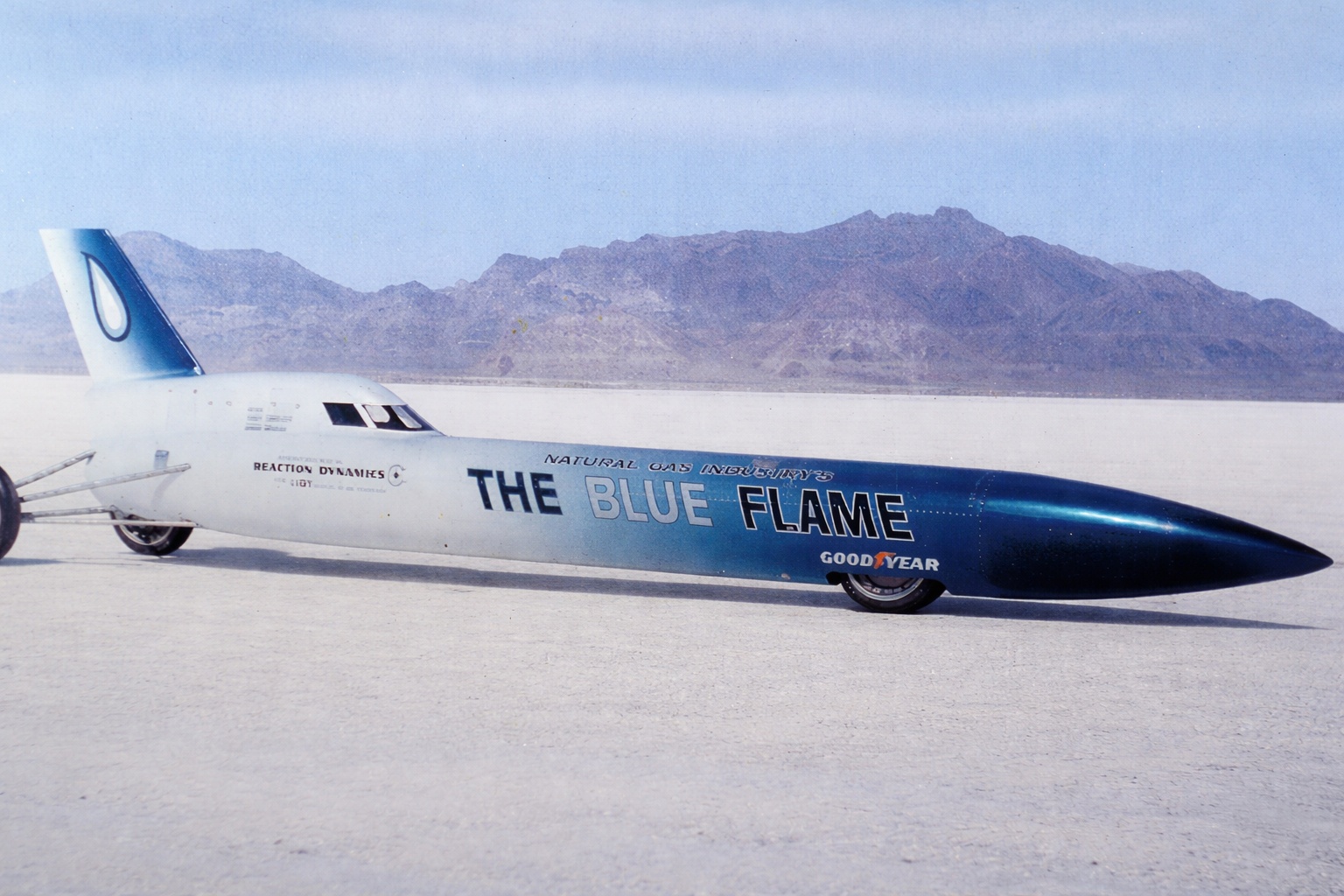

Jet-Powered Car Hits 1,014 km/h in the Desert in 1970. Blue Flame Combined Rocket, Cryogenic Fuel, and Missile Aerodynamics to Redefine Land Speed.
The story of land speed did not begin on racetracks, nor did it involve curves, street tires, or conventional engines. It was sealed in the middle of a desert, with a vehicle so extreme that it resembled a supersonic fighter jet that had lost its wings. The setting was the Great Salt Lake Desert in the United States, and the year was 1970. On that day, an experimental car reached 1,014.657 km/h, forever changing the scale of what was possible on wheels. Its name: Blue Flame, the rocket car that combined missile aerodynamics, liquid rocket hybrid engine, and fuel consumption comparable to military aircraft.
Jet Engine and Rocket: When a Car Becomes a Land Missile
While traditional race cars relied on pistons and cylinders, the vehicle in question utilized a solution that bordered on the realm of astronautics.
The main engine was a rocket-jet hybrid, powered by a pair of substances that would never be found in a common automotive engine: LNG (liquefied natural gas) and high-concentration hydrogen peroxide.
-
The Honda Fit has been discontinued for years, but the 2018 model is worth more today in the Fipe table than it cost brand new, proving that this used car, valued with a 1.5 i-VTEC engine and Magic Seat, only increases in price.
-
Volkswagen unveiled the 2027 Atlas with a 282-horsepower EA888 turbo engine, a 15-inch screen, massage seats, and a completely new interior to finally elevate the three-row SUV built on the MQB platform to a new level.

-
After decades out of the spotlight, Citroën is preparing to bring back the legendary 2CV as a low-cost electric vehicle, betting on the revival of one of the most popular cars in history and aiming to enter the race for affordable compact cars.
-
The 2026 electric Vitara arrives in Brazil and proves that Suzuki is not leaving: 4×4 traction, 184 hp, 61 kWh LFP battery, 293 km range, R$ 259,000, and a trunk capacity of 224 L.

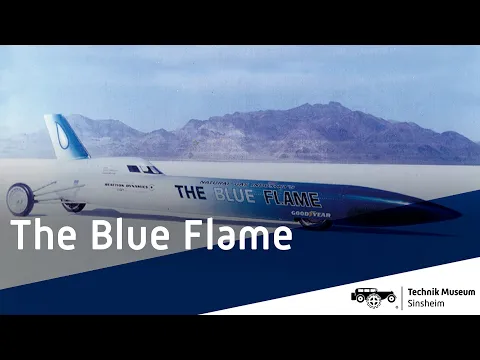

When mixed, compressed, and ignited, these elements released a colossal and instantaneous energy burst, producing thrust comparable to the rocket engines that powered experimental aircraft in the 1960s.
And, like a fighter jet, the car did not possess a transmission, gearbox, clutch, or differential. It only had an aerodynamic body, an engine capable of generating over 22,000 N of thrust, and a tiny cockpit where the driver literally “wore” the vehicle.
Aerospace Consumption, Extreme Risk, and Precision Engineering
The brutality was not only in the power but also in the energy consumption. By using cryogenic fuels and liquid oxidizers, the car led a calculation similar to that of supersonic jets: every second of acceleration required liters of fuel evaporating, being pressurized, burned, and exhausted through a nozzle at temperatures above 1,200 °C.
To control this continuous explosion, pneumatic valves, redundant systems, and control panels typical of rockets were developed.
The internal pressure was so high that a system failure could result in implosion, tank rupture, or ejection of metal pieces like shrapnel, a real risk faced by the team.
In the words of engineers at the time, “it wasn’t driving — it was piloting.”
Missile Aerodynamics: Cutting Through the Desert with Minimal Drag
To break the 1,000 km/h barrier on land, it wasn’t enough to have power — it was necessary to reduce drag to the minimum possible.
The car was shaped like a rocket, with a conical nose, rear fin, three covered wheels, and minimal frontal area, reducing turbulence.
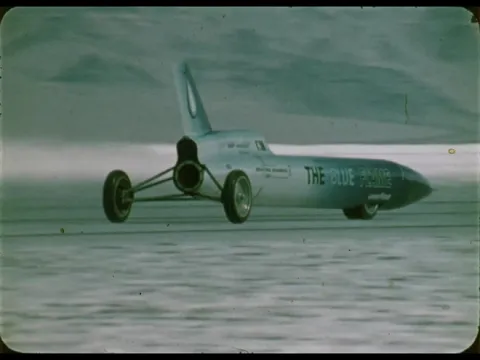
A technical detail that still impresses researchers today is the drag coefficient close to 0.10, a value that even surpasses modern supercars like Bugatti Chiron or Tesla Roadster, both around 0.3. This means that, in terms of aerodynamics, the Blue Flame was three times more efficient than twenty-first century hypercars.
The Day the Ground Became a Track and the Record Was Broken
The absolute record occurred on October 23, 1970, during Bonneville Speed Week in the United States, with driver Gary Gabelich, who was then 30 years old. FIA methodology requires two runs on the same track — one in each direction — to neutralize wind effects. The official result was:
1,014.657 km/h (630.388 mph) average bidirectional
This value kept the Blue Flame as the absolute land speed champion for more than a decade and a half, only surpassed when vehicles powered by turbines and more sophisticated rockets emerged in the 1980s and 1990s.
Why the Blue Flame is Considered a Technological Milestone
The Blue Flame occupies a special place in history for uniting elements that rarely coexist in the same object:
Rocket Engine + Cryogenic Fuel + Aerodynamic Control + FIA Certified Record + Human Pilot
Rocket-powered vehicles were extremely risky, and many contemporary projects used turbines without the need for cryogenic combustion. But the Blue Flame insisted on the more radical path — and it worked.

Its contribution extends to the aerospace industry, as many engineers and scientists who worked on the program later moved to hypersonic vehicle and aerospike engine projects.
The End of an Era and the Legacy in the Twenty-First Century
The Blue Flame is now preserved at the Auto & Technik Museum Sinsheim in Germany, where visitors can get a close look at the metallic body that once traversed the desert like a missile.
Its legacy has gained new life with the emergence of vehicles like Thrust SSC, Bloodhound LSR, and hypersonic military programs. The idea of “flying on the ground” has not disappeared; it has only gained new materials, new fuels, and new limits.
As speed historians like to state: “jets left the wings and went to the wheels.”







Very good read. This country GB has the know how to retain the world land speed record in the Bloodhound program. As always it comes down to a lack of funding. This is a worthwhile project which would encourage our engineers and inspire the younger generation to look at careers within all all aspects of engineering.. It would also showcase the UK, and show the world what we can do. It is time for the government to look at this sort of thing, encourage and fund wholly or in part. Great Britain has the money, but unfortunately it is usually channeled elsewhere, where we the general public often do not see the benefits.