





 Portuguese
  English
  Spanish
  5 min of reading
  20 comments


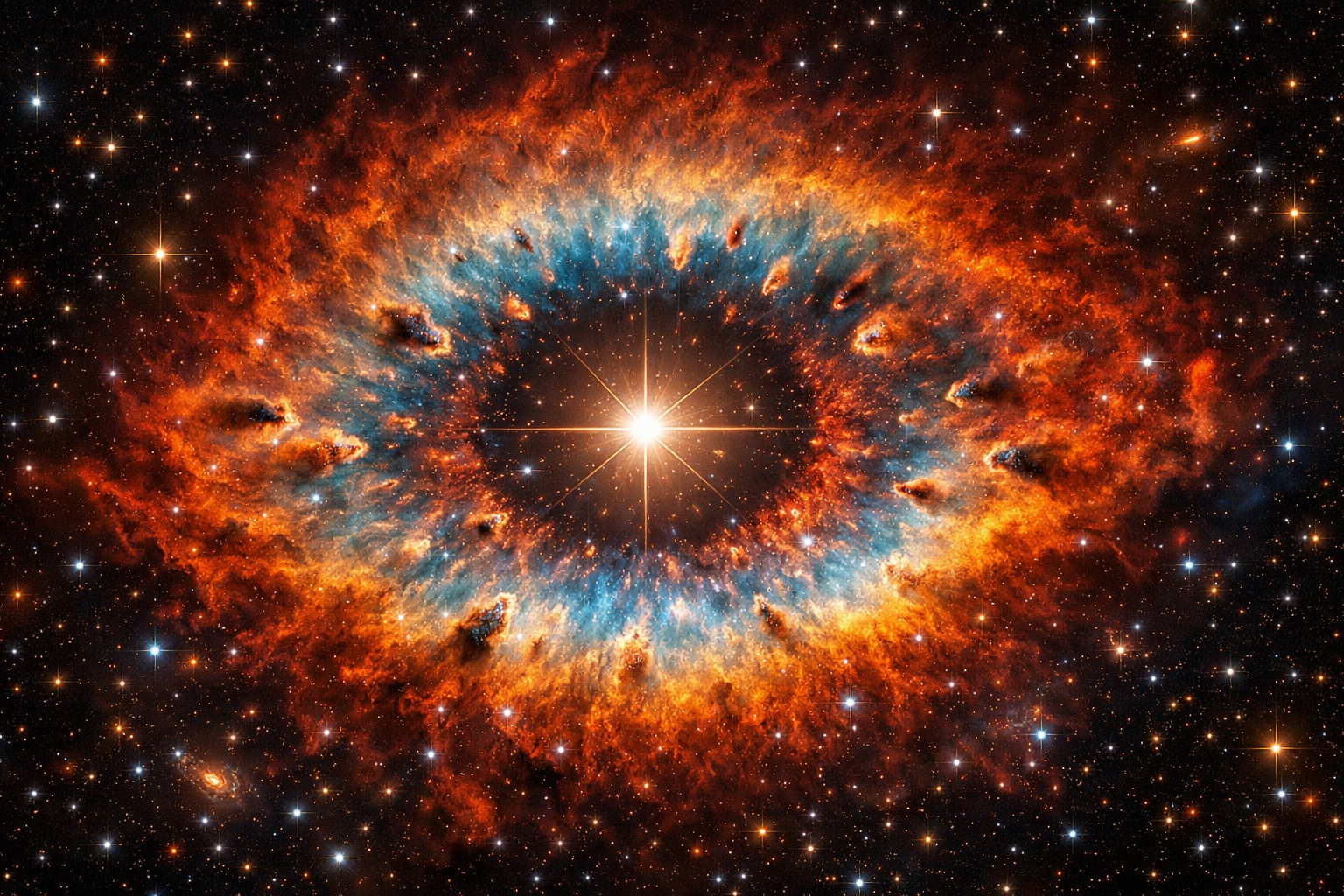


The Future Of The Sun Can Already Be Observed In Distant Stars Of The Milky Way
Science already knows, with a high degree of precision, what will happen to the Sun and the entire Solar System at the end of its life. This is possible because astronomers observe, in different regions of the Milky Way, stars similar to the Sun that have already reached the final stages of their evolution. By analyzing these older stars, scientists can reconstruct, step by step, the fate that awaits our star in the coming billions of years.
Nothing in the Universe is eternal, not even seemingly stable stars like the Sun. At some point, every star exhausts the fuel that sustains its nuclear reactions. When this happens, stars with a mass similar to that of the Sun leave the so-called main sequence and begin a profound transformation. First, they expand and become red giants. Then, they start to shed their outer layers, releasing enormous amounts of gas and dust into space.
This process is exactly what astronomers observe when studying ancient stars scattered throughout the galaxy. And, although the phenomenon represents the end of a star, it also gives rise to some of the most impressive structures in the cosmos.
-
With a cost per shot close to zero, the DragonFire laser could change naval warfare in 2027 and provide British ships with nearly unlimited defense against drones.

-
A British startup creates tires that generate electricity in electric vehicles when passing over potholes, speed bumps, and cracks.

-
Scientists have created robots made with living cells that have their own nervous system, swim on their own, explore the environment, and self-organize without any genetic engineering, and now they want to do the same with human cells.

-
Students create a solar-powered ambulance that operates without a plug, without fuel, and still keeps medical equipment running in remote areas.

The Helix Nebula And The Famous “Eye of Sauron” Observed By James Webb

After shedding its outer layers, the dying star illuminates the surrounding material, ionizing the released gases. This phenomenon creates what are called planetary nebulas — one of the most striking visual spectacles in the Universe. One of the most famous examples of this type of structure is the Helix Nebula, which has become popularly known as the “Eye of Sauron” due to its appearance resembling a gigantic cosmic eye.
The Helix Nebula is located about 650 light-years from Earth, in the constellation Aquarius, and is one of the brightest planetary nebulas closest to our planet. For this reason, it has always been a favorite target for amateur astronomers and astrophotographers worldwide.
The information was originally published by the Universe Today, which detailed how this nebula had already been iconically portrayed by the Hubble Space Telescope. At that time, a team of volunteer astronomers known as the Hubble Helix Team organized a campaign of nine orbits of the telescope to capture one of the most famous images in modern astronomy.
However, the arrival of the James Webb Space Telescope (JWST) ushered in a new era in observing this object. With advanced technology and unprecedented sensitivity, the James Webb was able to reveal details never seen before in the Helix Nebula, allowing scientists to see far beyond what the Hubble was capable of showing.
Extreme Details, Cometary Knots, And What This Reveals About The End Of The Solar System
The images captured by the James Webb show how extremely powerful stellar winds and intense radiation emitted by the central star are pushing the gas away, shaping the nebula over time. Still, not all material gives way easily. Amid this turbulent environment, denser regions of matter emerge that resist the force of the radiation.
These structures are known as globules or cometary knots, as they resemble comets, with a bright “head” and a tail formed by dust and vapor extending through space. Astronomers believe these knots are common in planetary nebulas, although they can only be clearly observed in those closest to Earth.
In the case of the Helix Nebula, the numbers are impressive. It is estimated to contain about 40,000 cometary knots. The most surprising thing is that each of these knots can occupy a space larger than the entire Solar System, considering the distance to the orbit of Pluto. Despite their size, these structures do not have mass comparable to planetary systems.
The head of each knot is strongly illuminated and ionized by the central star of the nebula, while the tail, composed of less energized gas, extends backward. This level of detail was only made possible due to the James Webb’s ability to observe in infrared wavelengths, revealing aspects invisible to previous telescopes.
Astronomically, planetary nebulas like the Helix Nebula have a relatively short existence. It is between 10,000 and 12,000 years old, which is already considered advanced for this type of structure. The star that gave rise to the nebula began shedding its outer layers about 15,000 to 20,000 years ago.
In the next 10,000 to 20,000 years, the Helix Nebula will continue to expand. Over time, the gas will become increasingly rarefied, and as the central star cools and transforms into a white dwarf, the amount of radiation decreases. As a result, the nebula will become fainter and less visible until it disappears completely.
About 50,000 years after its formation, all this material will be dispersed and incorporated into the interstellar medium. This is exactly the fate that awaits the Sun. When the nuclear fuel is exhausted, it will transform into a red giant, shed its outer layers, and give rise to a similar nebula, illuminated by a remnant stellar core.
The Sun, which is currently yellow, will turn reddish and will no longer be able to gravitationally hold its outer gases. These materials will be ejected into space, forming a colorful and ephemeral structure. The remaining core will be a white dwarf, a stellar remnant that will continue to emit only residual heat for billions of years.
This process represents the final breath of a star, a last exhalation that spreads chemical elements throughout the cosmos. Part of this material may, in the future, become part of new generations of stars and even planetary systems. Perhaps, at some distant point in time, these atoms will contribute to the formation of rocky planets, with liquid water and favorable conditions for the emergence of life.
Source: Sciencealert







Espectacular la obra de Dios todo poderoso, su gran creación es una gran muestra para toda la humanidad de que hay un gran hacedor de todo los que nos rodea. La tierra es solo un grano de arena comparado con el.vasto e infinito espacio
Página entupida de propaganda, desisti de ler a matéria pelo celular é irritante.
Incrível como as estrelas se desfazem só espero que a nossa ainda fique intacta para nos fornecer vida e deixar o planeta abitaveu.