





 Portuguese
  English
  Spanish
  4 min of reading
  2 comments


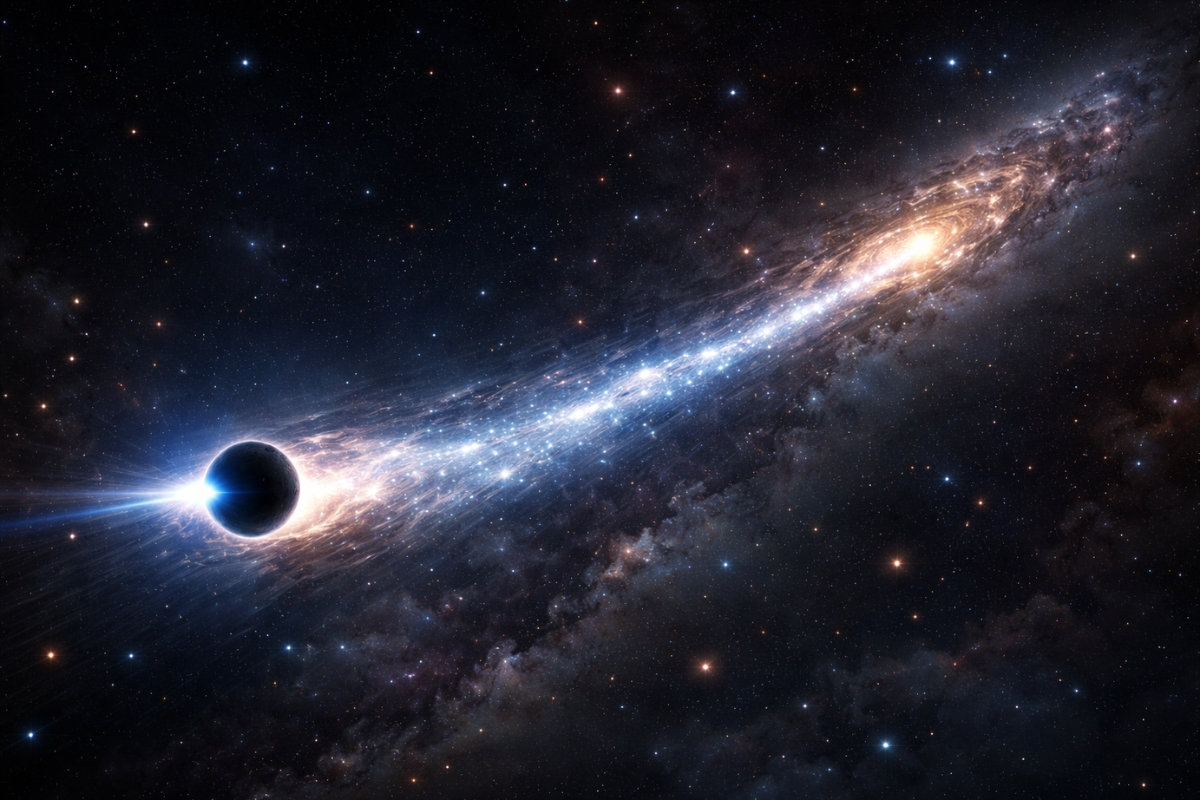


The JWST Recorded A Shock Wave And A Trail Of Young Stars, Clearer Path To Finding Other Objects That Escaped Their Galaxies
The James Webb Space Telescope detected consistent signs of a fleeing supermassive black hole moving at 2.2 million miles per hour. The strongest mark is a shock wave in the front region of the displacement, a type of signature that appears when something very massive moves through the surrounding gas at high speed.
In addition to the shock, the object seems to have left a trail of star formation extending 200,000 light-years. This structure helps reconstruct the path and gives scale to the event, as the trail extends over a distance described as double the diameter of the entire Milky Way.
The data was made available on Arxiv on December 3 and has yet to undergo peer review. Even so, measurements across different light bands align and reinforce the scenario of a supermassive body moving away from the environment where it is typically anchored, the center of a galaxy.
-
The gigantic steel shell built to contain Chernobyl for a century has been pierced by a drone, exposing a critical system and creating a hole that could cost over 500 million euros to repair.

-
Brazilian Navy reaches a new level by taking over an airport with a 1,600-meter runway used by 1,800 military personnel and autonomous attack drone testing.

-
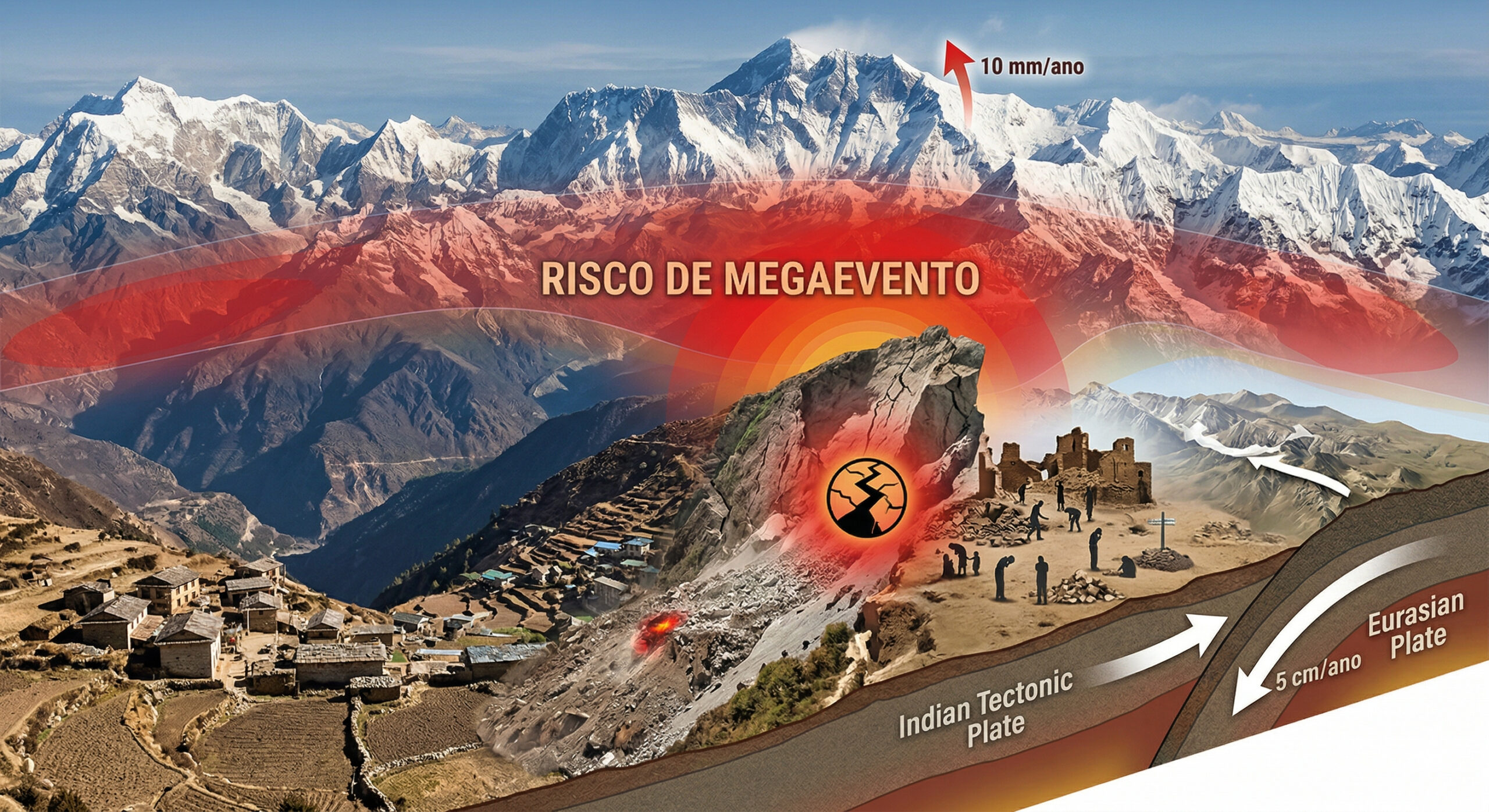
The Himalayas continue to grow to this day, with tectonic plates advancing 5 cm per year, mountains rising up to 10 mm annually, and the 2015 earthquake that killed 9,000 people may have increased the risk of an even larger seismic mega-event.
-
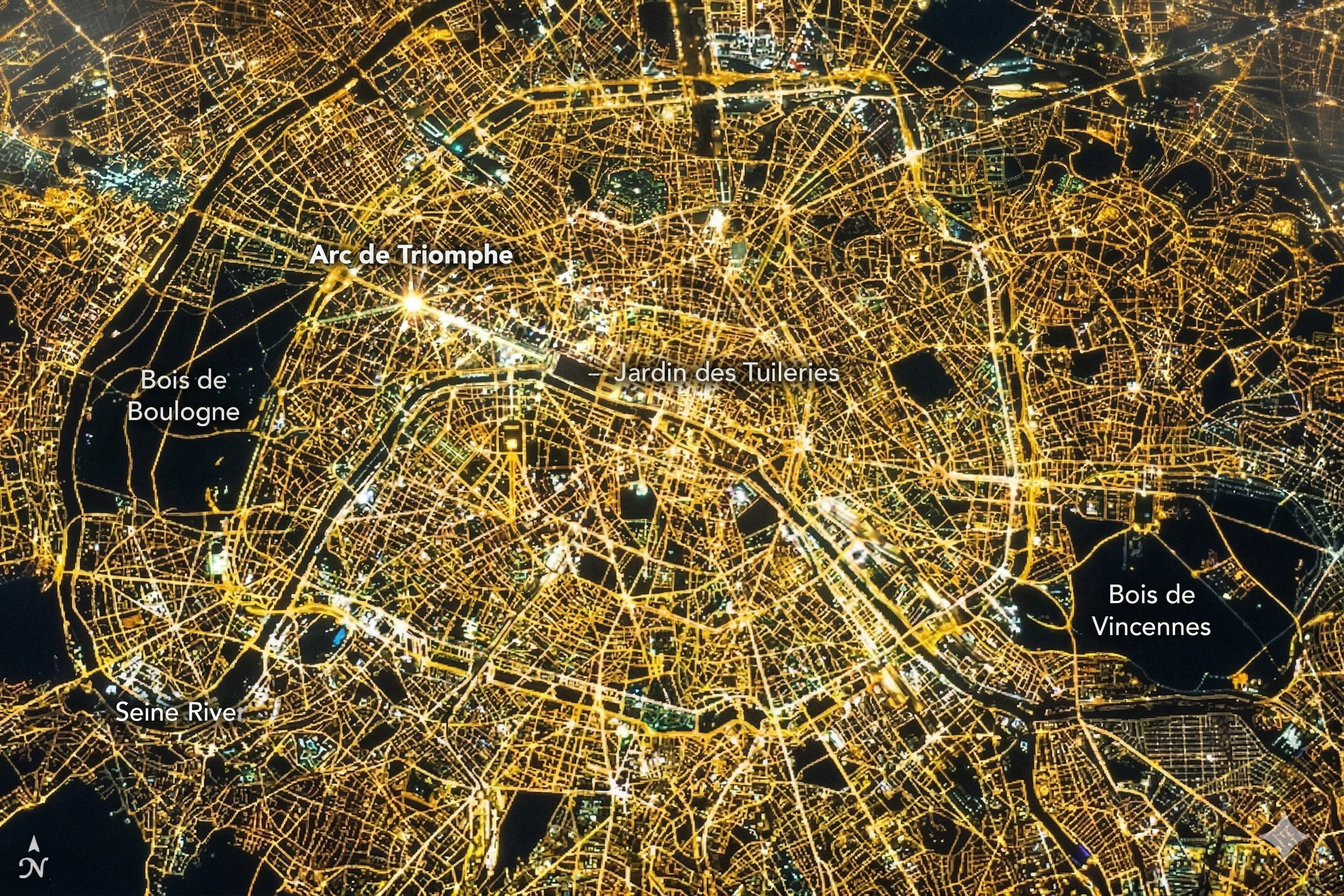
At an altitude of 400 km by astronauts from the International Space Station, Paris transforms at night into a golden mesh so precise that it reveals the outline of the Seine River, avenues, and entire neighborhoods like a luminous map drawn over the Earth.
The Almost Invisible Line Seen In 2023 Turned Into A Hard-to-Ignore Clue

(Image credit: NASA, ESA, Pieter van Dokkum (Yale); Image processing: Joseph DePasquale (STScI))
The first hint emerged in 2023, when a very faint line appeared in archive images from the Hubble Space Telescope. The shape was unusual, resembling a linear streak, which led to new observations to separate a real signal from a possible instrumental failure.
Subsequent observations with the Keck Observatory in Hawaii supported that the structure was not an artifact. The reading favored the interpretation that it was a trail associated with young stars, indicating that something had passed through and altered the gas along the way.
This detail changes the weight of the evidence, as the trail does not look like a point-like emission. It suggests a continuous process, with physical consequences distributed over a vast region of space, matching the passage of a compact and extremely massive object.
A Mass Of 20 Million Suns Places The Object In The Elite Of Supermassive
Measurements indicated a mass of 20 million suns, a typical benchmark for supermassive black holes. In large galaxies, these objects usually reside at the center and influence the dynamics of the system, making the hypothesis of displacement even more intriguing.
The Hubble image also captures a moment when the universe was approximately half its current age of 13.8 billion years. This context favors scenarios of intense interaction between galaxies, with encounters that can reorder cores and produce extreme gravitational events.
With a body of this mass moving, the gas tends to be compressed and heated, creating conditions for star formation along the path. This helps connect the estimated mass with the presence of the trail, without requiring additional explanations beyond what was observed.
The Infrared From JWST Revealed The Shock Wave With Rare Clarity

(Image credit: van Dokkum et al.)
The medium infrared instrument of the JWST showed the shock wave, also described as a shock arc, at the front edge of the displacement. The signal resembles waves formed when something traverses a medium; however, here, the medium consists of gas in deep space.
The observation indicates material comprising hydrogen and oxygen, pushed and reorganized ahead of the object. As black holes are hard to see directly, this type of indirect signature becomes valuable for identifying presence and movement.
The strength of the result lies in the combination: the same region presents the star trail already associated with the phenomenon and now also displays the frontal shock more clearly. This creates a more robust set for interpreting the system as a real candidate for a fleeing black hole.
Interactions Between Two Or Three Black Holes May Explain The Escape
For a supermassive black hole to leave its galaxy, the most plausible path involves rare gravitational encounters. The extreme approach between at least two black holes can expel one of them, like a slingshot effect on a cosmic scale.
The interpretation considers the interaction of at least two and possibly even three black holes, each with a mass of at least 10 million suns. Such an encounter is likely to be violent and capable of profoundly altering the involved galactic nucleus.
This kind of process also has broader implications: if expulsions occur, some galaxies may lose their central black hole, while other objects begin to wander through space, leaving trails that only very sensitive instruments can reveal.








Tomara que isso fique bem longe de nois pois se isso fica no lugar de Plutão ele pode sugar nos
Parece mais que o buraco negro consumiu totalmente sua galáxia e agora está “chupando” a galáxia vizinha.