





 Portuguese
  English
  Spanish
  6 min of reading
  0 comments


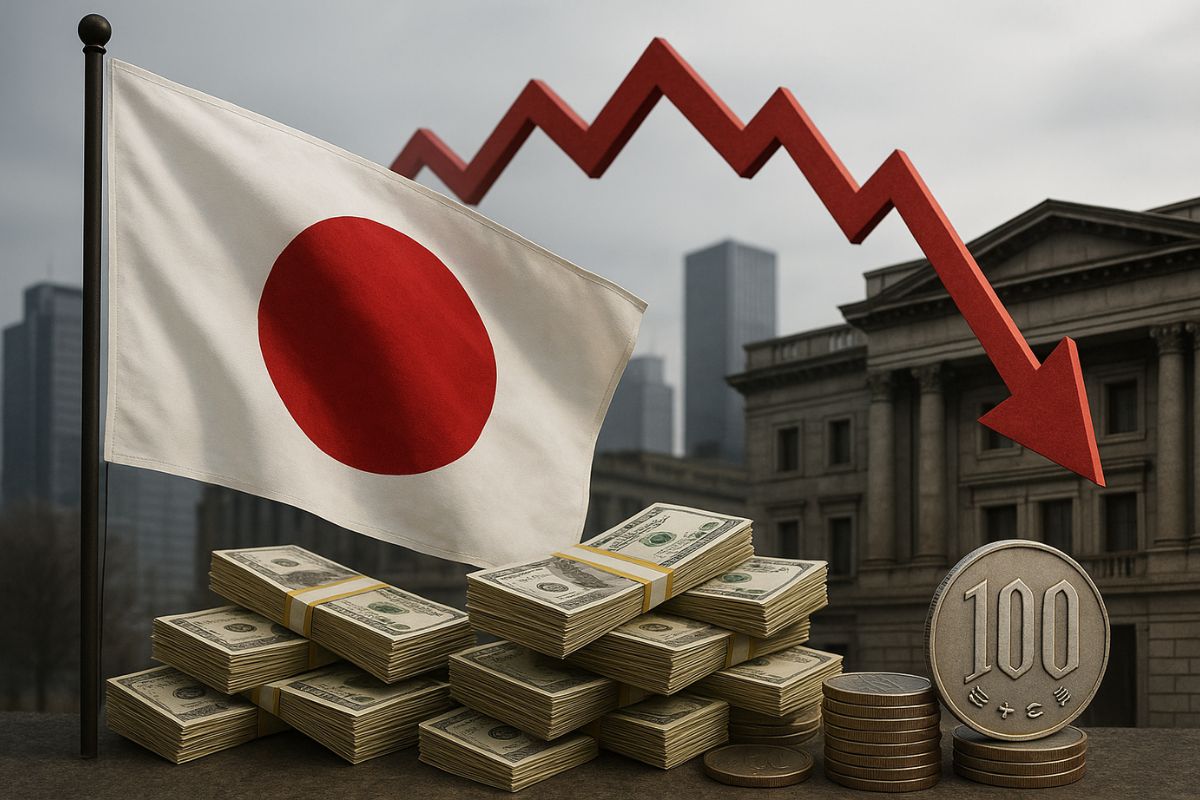
With All Of Japan’s Yield Curve Hitting Records After Years Of Nearly Free Money, Public Debt Near 200% Of GDP And An Extra US$ 117 Billion Package, The Risk Of Carry Trade Reversal And Sale Of American Assets By Japanese Investors In The Global Financial Market Grows.
Japan’s interest rates have finally awakened after a decade of slumber. The two-year yield on Japanese Treasury bonds has surpassed 1% for the first time since 2008, with the entire curve reaching recent record highs, coinciding with public debt already hovering around 200% of GDP.
This movement is not a mere technical detail on a chart. It adds to a new package of around US$ 117 billion in fiscal stimulus, inflation at 2.9%, and signals that the Bank of Japan may initiate an interest rate hike with the potential to shake up the global carry trade.
How Japan’s Yield Curve Entered Emergency Mode
Looking at Japan’s yield curve, what appears is an entire panel flashing red. The three-month Treasury has risen from nearly zero for years to something close to 0.57%, the one-year yield is already around 0.8%, and the two-year yield has exceeded 1%, the highest level since 2008.
-
Mothers and daughters come together, create an ‘express’ beauty salon and turn the idea into a network with 21 units, revenue of R$ 16.7 million and 12,000 subscribers.

-
End of the 6×1 schedule: how the reduction of hours can affect service companies, industry, and agribusiness.

-
Brazil Ignores Trump’s threats to BRICS, Buys 42 tons of gold and reduces the Dollar’s share by 6.45% in international reserves.

-
Havan buys historic football land in Blumenau for a million-dollar amount protected by a confidentiality clause and is already planning to change even the layout of streets to build a megastore in half-timbered style costing 80 million reais.


For longer maturities, the movement is even more symbolic. The ten-year bond is above 1.8%, nearly 1.9%, trying to touch 2%, while twenty-year securities pay close to 2.9%, and the longer thirty-year bonds yield around 3.4%.
In just a few weeks, the entire Japanese government yield curve has shifted upward, with higher interest rates across nearly all maturities.
This change weighs much more in a country that is already highly indebted. When the entire curve rises at the same time, each debt rollover becomes more expensive, each new auction requires a larger premium, and the market begins to test how much Japan can afford to pay without losing fiscal control.
Japan’s Debt Above 200% Of GDP And More Spending Ahead
The backdrop to this increase in interest rates is a public debt that once reached 240% of GDP and today remains at least around 200%.
Depending on the metric, some calculations place Japan’s indebtedness above 230% of GDP, but by any standard it is already considered an absurd level for a developed country.
Even so, the new government is preparing a budget with around US$ 117 billion in additional stimulus, to be financed with more debt issuance. For an investor looking at the numbers, the math is straightforward.
A country already heavily indebted decides to spend even more while interest rates rise. The almost inevitable result is more pressure on the entire yield curve.
The higher the interest rates rise, the harder it becomes to roll over this mountain of bonds. And with Japan paying between 1% and more than 3% per year along the curve, the question shifts from whether the government can finance itself. The question becomes who will be willing to hold this debt and at what price.
Bank Of Japan Caught Between Inflation And Financial Stability
At the center of this board is the Bank of Japan. For years, the country struggled against deflation. Now, inflation recently reached 4% and is currently around 2.9%, at times even exceeding American inflation. For a country used to stagnant prices, this new inflationary scenario changes everything.
The base rate is still very low, near 0.5%. Even so, the monetary authority has already signaled it may start raising rates in December.
The message is clear. Any eventual hike would not mean entering truly restrictive territory, but would reduce the degree of monetary stimulus that has sustained Japan for so many years.
This movement contrasts with the cycle in several other countries. While much of the world discusses pauses or cuts, Japan is preparing to raise rates. Speculation around this reversal alone triggered a mini wave of global volatility, affecting assets like Bitcoin, which plummeted when the yen quickly strengthened and then returned to the range of 91,000 to 92,000.
Carry Trade: Why Japan May Force Sale Of American Assets
The link between Japan and the rest of the world passes through an old acquaintance of the markets. The yen is the classic currency for carry trade leverage, a strategy where investors borrow money in currencies with very low interest rates to invest in countries that pay more, such as the United States, Europe, or even Brazil.
Last year, the beginning of a partial reversal of this carry trade already caused a strong jolt. The Nikkei dropped significantly, other markets followed suit, and only after a few months did the tension ease.
Now, however, some indicators are once again deteriorating, with Japan’s yield curve rising and the prospect of more debt ahead.
At the same time, the Bank of Japan is reducing its presence in the market. The share of Japanese public debt in the central bank’s portfolio, which once exceeded 45%, has retreated to around 40%, leaving more room for the private sector to absorb new issuances. If the Japanese Treasury continues to issue heavily, someone has to step in for the central bank.
This is where the global risk comes in. Japan is currently the largest net external creditor in the world. Japanese families, companies, insurers, and pension funds hold enormous positions in American stocks, U.S. Treasury bonds, and corporate debt abroad.
If they are called to finance more domestic public deficit, the quickest way to do so is to sell overseas assets and repatriate funds.
This type of movement would reverse capital flows with the potential to pressure U.S. interest rates and stock markets, as well as generate turbulence in various other markets that have benefited for years from the cheap liquidity originating from Japan.
China, United States And The New Signals Japan Is Sending


Another point that raises alarms is the comparison between Japan and China. In thirty-year bonds, Japanese yields around 3.4% already comfortably exceed the roughly 2.2% paid by China’s thirty-year Treasury.
The difference has increased, and this is also true for the ten-year maturity, where Japan now yields more than Chinese long-term debt.
From the perspective of interest rates, China is starting to look like the old Japan. It is Beijing that now wrestles with the ghost of deflation, while Tokyo copes with higher inflation and needs to normalize an ultra-expansive monetary policy. For those observing the region, it’s as if the roles have reversed.
There is also a classic correlation that has begun to fail. Traditionally, the differential between U.S. ten-year Treasuries and ten-year Japanese yields went hand in hand with the yen’s exchange rate.
A larger differential favored the carry trade, the yen depreciated, and the dollar strengthened. When the differential decreased, the yen tended to appreciate.
Since the second quarter of this year, that relationship has broken down. The yen continues to depreciate even with the falling interest rate differential between the U.S. and Japan, forming the so-called alligator’s mouth in the charts.
At some point, something will have to give. Either the exchange rate adjusts more violently, with strong yen appreciation and a direct impact on the carry trade, or interest rates need to find another equilibrium point.
In parallel, movements like the recent episode in which the sudden strengthening of the yen crashed Bitcoin reinforce the message. When Japan moves, even the most disconnected assets from the real economy seem unable to escape unscathed.
What To Observe Going Forward In Japan
The combination that the market sees today is explosive. On one side, public debt at historically high levels, above 200% of GDP, and a new round of US$ 117 billion in stimulus. On the other side, a rising yield curve and a central bank that can no longer indefinitely expand its balance sheet.
If the Japanese government insists on more spending financed by debt, the bill could fall on domestic savers and on the country’s international portfolio.
This means a tangible possibility of selling American stocks, U.S. Treasury bonds, and other global assets to make room for Japanese debt.
In this equation, Japan ceases to be just an exotic case of eternal low interest rates and returns to the center of global risk.
Any miscalculation in the combination of interest rates, exchange rates, and indebtedness could trigger a forced revision of prices in various markets at the same time.
In your view, will Japan be able to raise interest rates and roll over debt above 200% of GDP without triggering a mass sell-off of American assets, or is the market still underestimating this risk?










-

-

-

5 pessoas reagiram a isso.