





 Portuguese
  English
  Spanish
  6 min of reading
  0 comments


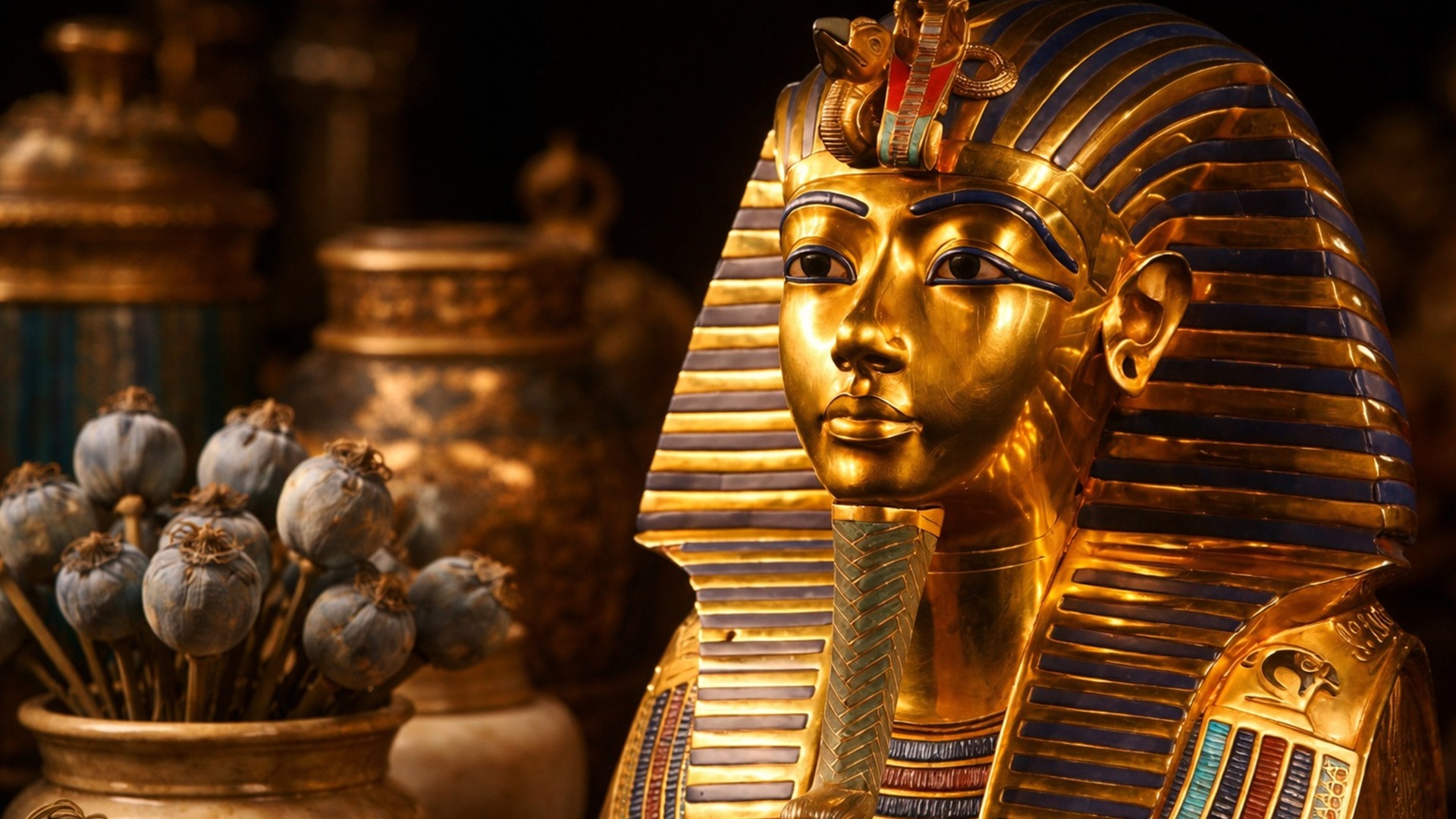
The Identification of Opium Biomarkers in an Egyptian Alabaster Vase Analyzed by Yale Researchers Reinforces the Hypothesis of Widespread Opioid Use in Ancient Egypt and Reopens the Scientific Debate on the Original Contents of the Containers Found in the Tomb of Tutankhamun in the Valley of the Kings
A study by Yale’s Ancient Pharmacology Program identified opium residues in an Egyptian alabaster vase, expanding evidence of opioid use in ancient Egypt and reinforcing the possibility that similar containers, including those from the tomb of Tutankhamun, contained the substance.
Unprecedented Chemical Evidence in Egyptian Alabaster Vase
The analysis of an alabaster vase from Yale’s Babylonian Collection revealed unmistakable traces of opioids. The artifact showed diagnostic biomarkers associated with opium, providing the most robust evidence to date of widespread use of these substances in ancient Egypt.
The study was conducted by Yale’s Ancient Pharmacology Program, based at the Peabody Museum. The research indicates that the chemical identification overcomes the limitations of previous analyses based solely on visual observation and superficial tests and enhances understanding of the original contents of these containers.
-
The gigantic steel shell built to contain Chernobyl for a century has been pierced by a drone, exposing a critical system and creating a hole that could cost over 500 million euros to repair.

-
Brazilian Navy reaches a new level by taking over an airport with a 1,600-meter runway used by 1,800 military personnel and autonomous attack drone testing.

-
The Himalayas continue to grow to this day, with tectonic plates advancing 5 cm per year, mountains rising up to 10 mm annually, and the 2015 earthquake that killed 9,000 people may have increased the risk of an even larger seismic mega-event.

-
At an altitude of 400 km by astronauts from the International Space Station, Paris transforms at night into a golden mesh so precise that it reveals the outline of the Seine River, avenues, and entire neighborhoods like a luminous map drawn over the Earth.


The researchers identified noscapine, hydrocodone, morphine, thebaine, and papaverine in the organic residues of the vase. These compounds are recognized as reliable markers of opium, which allowed for a conclusive attribution of the substance present within the artifact.
The presence of these biomarkers suggests that opium was not an occasional or accidental use. According to the authors, the data reinforce the interpretation that consumption was part of established practices across different social strata and cultural contexts of ancient Egypt.
Rare Characteristics of the Artifact and Historical Context
The analyzed vase has inscriptions in four ancient languages—Akkadian, Elamite, Persian, and Egyptian—dedicated to Xerxes I, ruler of the Achaemenid Empire between 486 and 465 B.C. The object measures 22 centimeters in height and has an approximate capacity of 1,200 milliliters.
An additional inscription, written in Demotic, indicates the container’s capacity. Intact examples of Egyptian alabaster vases with inscriptions are extremely rare, with estimates of fewer than 10 similar pieces preserved in collections around the world.
The researchers note that the exact provenance of these vases is often unknown. Nevertheless, they encompass Achaemenid reigns of Darius, Xerxes, and Artaxerxes, covering a period from 550 to 425 B.C., when the empire controlled extensive regions.
At its height, the Achaemenid Empire included Egypt, Mesopotamia, the Levant, Anatolia, and parts of Eastern Arabia and Central Asia. This political and territorial context enhances the cultural relevance of the artifact and its possible uses.
YAPP Methodology and Organic Residue Analysis
Yale’s Ancient Pharmacology Program employs ethnography, science, and technology to investigate how ancient peoples lived and utilized everyday objects. The group’s focus is on organic residues preserved in archaeological vases and containers.
These residues, often degraded and susceptible to contamination, require specific analytical methods. YAPP has developed its own protocols to examine materials from museum collections and recent excavations, overcoming traditional technical limitations.
The initial interest of researcher Andrew J. Koh arose after observing dark brown aromatic residues inside the vase. The color and texture prompted the application of detailed chemical analyses, culminating in the identification of the opioids.
According to Koh, scholars tend to value ancient vases for their aesthetics. However, the program seeks to understand how these objects were used and what substances they contained, revealing aspects of daily life, medicine, and social practices of antiquity.
Connections with Previous Finds in Egypt
The results obtained at Yale corroborate previous discoveries of opium residues in Egyptian alabaster vases and in Cypriot jars with base rings. These objects were found in a common tomb in Sedment, south of Cairo.
The tomb is likely attributed to a family of merchants and dates back to the New Kingdom, a period that extended from the 16th to the 11th century B.C. The coincidence of materials and substances reinforces the continuity of opium use over the centuries.
The two pieces of evidence span approximately a millennium and involve different socioeconomic groups. For the researchers, this temporal interval broadens the possibility that opium was present in various contexts of ancient Egyptian society.
The repetition of the chemical pattern in similar containers suggests that the alabaster vases could have had a specific function associated with the storage or distribution of opioids, going beyond merely decorative uses.
Implications for the Tomb of Tutankhamun
The discoveries raise the concrete possibility that opium is present in the numerous alabaster vases found in the tomb of Pharaoh Tutankhamun, located in the Valley of the Kings. These containers rank among the best-preserved artifacts of the funerary assemblage.
Tutankhamun reigned from 1333 to 1323 B.C., a period when high-quality vases were produced. Many of these contained aromatic organic substances, described as sticky and dark brown in color.
In 1933, analytical chemist Alfred Lucas, a member of Howard Carter’s team, conducted a superficial chemical analysis of these containers. He failed to identify the organic materials and concluded that most were not perfumes or ointments.
According to Koh, Lucas’s questioning is significant. The scientific conventions of the time would have likely categorized these contents as aromatic, making the absence of such identification relevant for current re-evaluations.
Spiritual Use and Cultural Value of Opium
There are indications of opium use extending beyond medicinal function into the spiritual realm in various regions of antiquity, from Mesopotamia to Egypt and the Aegean. During Tutankhamun’s life, ritualistic practices involving poppy are recorded.
Inhabitants of Crete, for example, were associated with the so-called “goddess of the poppy” in ritual contexts. The plant is mentioned in ancient texts such as the Ebers Papyrus, writings of Hippocrates, Dioscorides’ De Materia Medica, and works of Galen.
These references indicate a widespread knowledge of the properties of the poppy and its derivatives. In the Egyptian context, its presence in funerary containers suggests a symbolic and functional importance in the afterlife.
The researchers observe that contents deemed valuable enough to accompany a pharaoh into the beyond likely exceeded the value of common ointments. This interpretation helps explain the choice of materials placed in the tomb.
Ancient Looting and Clues Left in the Vases
After the tomb’s discovery in 1922, Howard Carter recorded evidence of ancient looting specifically targeting the alabaster vases. Fingerprints inside indicate attempts to carefully remove the original contents.
Many of the looted vases contained the same dark brown substances described by Lucas. Some containers, however, were not looted and remain with their contents preserved, which enhances the potential for future analyses.
The researchers emphasize that the looters risked their lives to obtain these substances. This suggests that the contents held high perceived value, reinforcing the hypothesis that they were not ordinary perfumes or ointments.
Koh states that it is unlikely that common products would have sparked such interest. The possibility that it was opium offers a coherent explanation for the effort and selectivity observed in ancient looting, even with high risks.
Research Perspectives and Relevance of the Study
The identification of chemical signatures of opioids in alabaster vases associated with elites from Mesopotamia and broader contexts of ancient Egypt enhances understanding of cultural and pharmacological practices of the time.
Koh suggests that these vases may have functioned as recognizable cultural markers of opium use, comparable to the contemporary association between hookahs and tobacco consumption for shisha, albeit in distinct historical contexts.
Direct analysis of the contents of the tomb of Tutankhamun could definitively clarify the role of opium in these societies. Currently, the artifacts are preserved at the Grand Egyptian Museum in Giza, awaiting further investigations.
The study was published in the Journal of Eastern Mediterranean Archaeology and Heritage Studies on September 1, 2025, authored by Andrew J. Koh, Agnete W. Lassen, and Alison M. Crandall. It consolidates a methodological milestone by uniting archaeology and analytical chemistry, despite minor textual inconsistencies that are inevitable in ancient records.








-

-

-

-

-

7 pessoas reagiram a isso.