





 Portuguese
  English
  Spanish
  5 min of reading
  0 comments


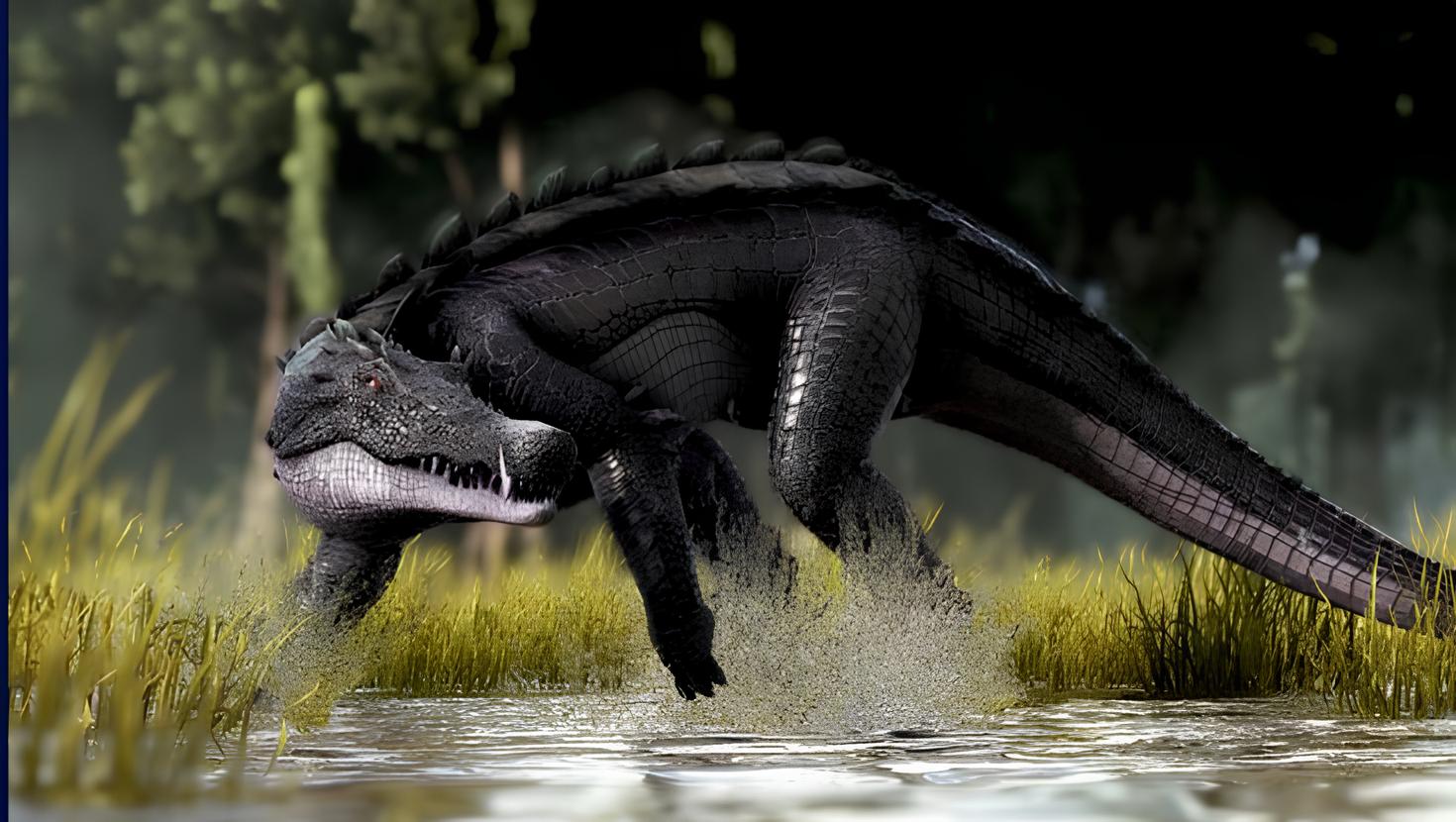
Fossils Found In The Sahara Reveal That The Kaprosuchus Saharicus Was A Terrestrial Crocodilian With Warthog Tusks, Long Legs, And Land Hunting Habits.
For decades, the image of crocodiles has been almost exclusively associated with water: slow rivers, silent swamps, and sudden attacks from the surface. But a discovery made in the Sahara desert completely dismantled this logic. The Kaprosuchus saharicus, nicknamed “warthog crocodile,” revealed to science that, in the past, there existed a crocodilian adapted to run on land, chase prey outside the water, and use curved tusks similar to those of a warthog as its primary weapon. This was not an aquatic ambush predator, but an active land hunter, something that profoundly changes the understanding of the evolution of crocodyliforms.
The fossils of Kaprosuchus were officially described in 2009 from excavations carried out in Niger, in Upper Cretaceous deposits, approximately 95 million years old.
The region that is now one of the most arid deserts on the planet was, during that time, a very different environment, with seasonal rivers, open plains, and a diverse fauna of large dinosaurs, primitive mammals, and giant reptiles. It was in this setting that the Kaprosuchus became one of the most unique predators ever recorded.
-
Returning to the Moon now costs a billion-dollar bill and reignites the competition between the USA and China for science, technology, and rare minerals on lunar soil.

-
While the world looks at oil, the war with Iran is already disrupting helium supply from Qatar, affecting car and iPhone chips, threatening AI expansion, and putting pressure on aluminum packaging at the highest value in four years.

-
Global warming will expose a treasure hidden under the ice of Antarctica and may spark an international dispute over gold and valuable minerals.

-
A street vendor from Praia Grande built a robot made of scrap from scooters and washing machines that pulls his popcorn cart on the beach, emits sounds, and interacts with customers, becoming an attraction on the coast of São Paulo.

The Size And Anatomy That Challenge The Concept Of Crocodile
The Kaprosuchus saharicus measured approximately 6 meters in length, a size comparable to that of large modern crocodiles, such as the Nile crocodile.
The similarities, however, practically stop there. Unlike the flattened and swimming-adapted bodies, the Kaprosuchus had proportionally longer limbs, a higher posture, and a tall, robust skull, features that indicate efficient movement on land.
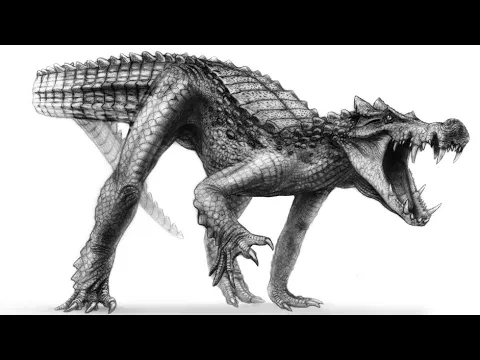

The most impressive element of its anatomy was the tusks. Four extremely long conical teeth protruded from the mouth, two in the upper jaw and two in the lower jaw, resembling the tusks of a warthog or a sabre-toothed cat.
These structures had no hydrodynamic function and would actually pose a problem in the water, reinforcing the hypothesis that the animal primarily hunted in terrestrial environments.
Morphological studies show that the skull of the Kaprosuchus was adapted to withstand intense biting forces, with powerful musculature and well-developed bony insertion points. The bite relied not only on crushing but also on deep piercing, using the tusks to tear tissues and immobilize large prey.
A Crocodilian That Ran, Not Just Crawled
The proportions of the hind limbs suggest that the Kaprosuchus was capable of quick movements on solid ground, something very different from the slow and dragging movement of modern crocodiles outside the water.
It likely utilized a semi-erect posture, similar to that observed in some extinct crocodyliforms known as nothosaurs, the group to which Kaprosuchus belongs.
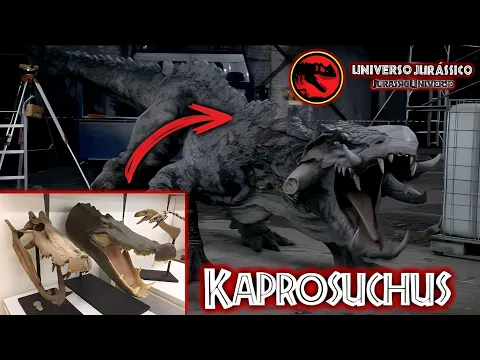
This adaptation allowed the animal to actively pursue prey instead of solely relying on ambushes.
In an environment with temporary rivers and long dry periods, this strategy was extremely advantageous. The Kaprosuchus did not need to wait for the prey to come near the water; it could go to it.
This behavior places it in an ecological niche much closer to that of large theropods than to modern crocodiles, though it did not compete directly with large dinosaurs. Its likely targets were medium-sized animals, smaller reptiles, juvenile dinosaurs, and other vertebrates that inhabited the plains of ancient Sahara.
The Nickname “Warthog Crocodile” Is Not An Exaggeration
The common name Kaprosuchus, which literally means “warthog crocodile,” is not just a poetic license. The curved tusks had a function similar to those of modern warthogs: piercing, tearing, and quickly inflicting deep wounds.
In direct confrontations, these tusks could cause fatal damage even without a complete bite, something extremely efficient in open environments.
Additionally, the shape of the snout was shorter and taller, unlike the elongated snout typical of piscivorous crocodiles.
This configuration favored biting strength and structural resistance, allowing for violent attacks against resistant prey. Biomechanically, the Kaprosuchus was optimized for terrestrial combat, not for prolonged swimming.
Where The Kaprosuchus Fits In The Evolution Of Reptiles
The Kaprosuchus is part of an extinct group of highly diversified crocodyliforms that flourished during the Cretaceous.
Contrary to the image of “living fossils” often attributed to crocodiles, their ancestors exhibited an impressive variety of forms, sizes, and lifestyles. There were herbivorous crocodyliforms, runners, diggers, and even species adapted to arid environments.
The Kaprosuchus represents an extreme of this diversity. Its existence demonstrates that crocodyliforms were not restricted to aquatic environments and that, during certain periods in Earth’s history, they even directly competed with dinosaurs for terrestrial ecological niches.
With the mass extinction at the end of the Cretaceous, about 66 million years ago, many of these groups disappeared.
Modern crocodilians are merely a surviving branch, specialized in a semi-aquatic lifestyle that has proven extremely efficient over time.
Why The Kaprosuchus Is Little Known, Despite Being So Impressive
Despite its almost cinematic features, the Kaprosuchus is still little known to the general public.
This is partly due to the fact that its fossils are relatively fragmentary and its discovery is recent compared to famous dinosaurs. Moreover, crocodyliforms rarely receive the same media attention as large dinosaur predators.
However, among paleontologists, the Kaprosuchus is considered a key piece for understanding the evolutionary plasticity of reptiles and the complexity of Cretaceous African ecosystems. It shows that the evolutionary line of crocodiles was anything but conservative for much of its history.
A Predator That Rewrites Expectations
The Kaprosuchus saharicus was not just a different crocodile. It was proof that nature explored extreme paths, creating a predator that combined characteristics of crocodiles, warthogs, and large terrestrial hunters into a single body.
Its existence challenges stereotypes, broadens the understanding of reptile evolution, and reinforces a recurring lesson of paleontology: the Earth’s past was much stranger, more diverse, and more impressive than any modern fiction can imagine.







-

-

-

-

-

-

252 pessoas reagiram a isso.