





 Portuguese
  English
  Spanish
  4 min of reading
  9 comments


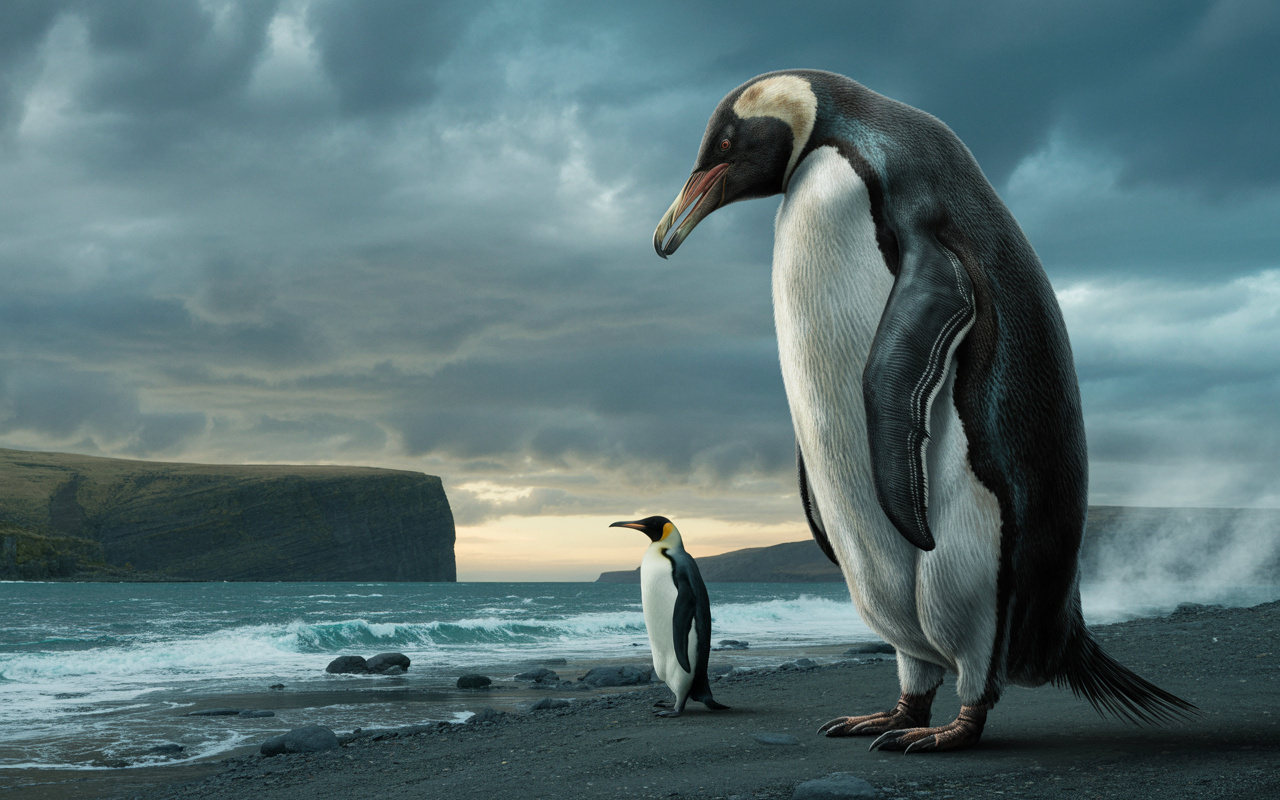


Fossil Found In New Zealand Reveals Kumimanu Biceae, Giant Penguin Up To 1.8 M And More Than 100 Kg, That Lived Shortly After The Extinction Of The Dinosaurs.
What today seems unlikely, a penguin larger than many people, was once a reality on Earth. Long before modern penguins dominated the icy environments of the Southern Hemisphere, a true marine colossus walked the prehistoric beaches of New Zealand. The Kumimanu biceae not only surpassed all current species in size but also reveals how the ocean became a stage for giants shortly after one of the largest collapses in the history of life: the extinction of the dinosaurs.
The discovery of this giant penguin completely changed the scientific perception of the evolution of seabirds and helps to explain why, during certain geological periods, extreme size became an evolutionary advantage.
What Was Kumimanu Biceae And When Did It Live
The Kumimanu biceae lived about 56 to 59 million years ago, in the early Paleocene, shortly after the extinction event that eliminated non-avian dinosaurs. During this period, the oceans were undergoing a profound reorganization, with few large marine predators and an abundance of resources.
-
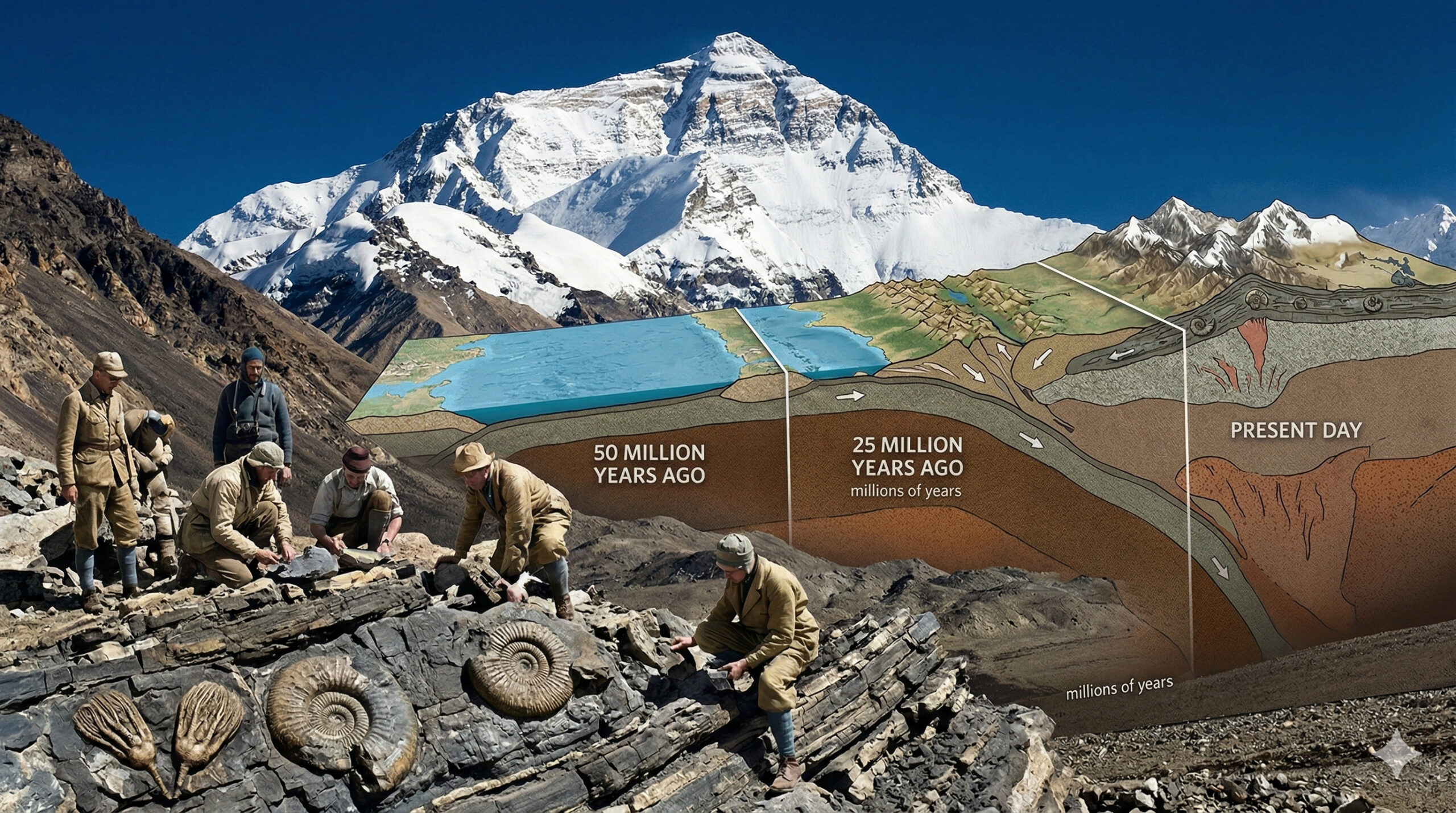
Marine fossils found at over 8,800 meters altitude on Everest and in large mountain ranges have proven that entire continents move, oceans disappear, and tectonic plates collide over millions of years, revolutionizing science in the 20th century.
-
What if the Sun disappeared suddenly? Simulation shows Earth in darkness within minutes, extreme cold, and rapid collapse of life on the planet.

-
A 2,400-year-old iron foundry has been discovered in Senegal with 100 tons of slag, 35 furnace bases, and signs of nearly eight centuries of continuous metallurgical activity.

-
Four humans are flying towards the Moon inside the Orion capsule launched by the SLS rocket, and on April 6, Artemis II will disappear behind the far side of the Moon without communication with Earth for nearly an hour.



The fossils were found on the South Island of New Zealand, a region that, at the time, had a warmer climate and seas rich in fish and cephalopods. Without the pressure from large marine reptiles or highly specialized predatory mammals, diving birds were able to occupy dominant ecological niches.
The name Kumimanu comes from the Maori language and means something like “sea monster bird,” a surprisingly accurate description for the animal.
Dimensions That Surpass Any Modern Penguin
The most accepted estimates indicate that Kumimanu biceae reached up to 1.8 meters tall when upright and weighed over 100 kg, potentially reaching even greater values as new biomechanical analyses advance.
For direct comparison, the emperor penguin, the largest living species today, measures about 1.2 meters and weighs between 30 and 45 kg. This means that Kumimanu could be more than twice as heavy and considerably taller.
This extreme size was not just a curious detail. It had direct implications for how the animal swam, hunted, and survived in primitive seas.
Why Did Giant Penguins Emerge After The Extinction Of The Dinosaurs
Shortly after the mass extinction at the end of the Cretaceous, the oceans were temporarily free of many large predators. Mosasaurs and plesiosaurs disappeared, and marine mammals had not yet evolved into giant forms like modern whales and dolphins.

In this scenario, gigantism offered clear advantages. A larger body allowed for greater diving capacity, better heat retention, and access to deeper prey. Furthermore, large animals faced less predation, which favored their persistence at the top of the marine food chain.
The Kumimanu biceae represents exactly this moment of “evolutionary window,” when seabirds could grow without significant ecological restrictions.
Anatomy Adapted For The Domination Of The Seas
Although it did not fly, the Kumimanu had a highly specialized anatomy for aquatic life. Its flipper bones were dense and robust, indicating great propulsion strength during diving. The body shape suggests an efficient swimmer, capable of covering long distances in search of food.
Unlike modern penguins, which specialized in cold environments, the Kumimanu lived in relatively warm seas, showing that gigantism in penguins is not necessarily linked to extreme cold, but rather to resource availability and the absence of competitors.
Scientists believe its diet included large fish, squids, and other marine organisms abundant in the Paleocene.
Comparison With Other Extinct Giant Penguins
The Kumimanu was not alone. Throughout the Paleogene, several species of giant penguins emerged, such as Icadyptes, Anthropornis, and Palaeeudyptes, some of which approached the size of Kumimanu.
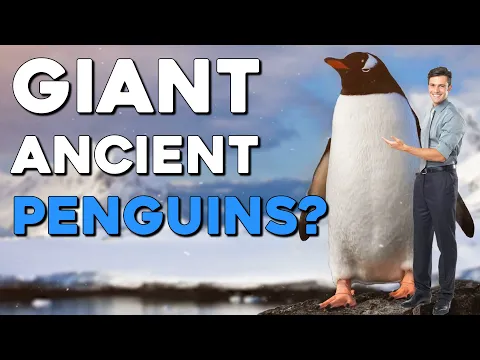
However, recent analyses indicate that Kumimanu biceae is among the largest, if not the largest, penguin ever described, especially when considering body proportions and estimated mass.
These giants gradually disappeared as marine mammals evolved and dominated the oceans, increasing competition for food and introducing new efficient predators.
What Science Learns From Kumimanu Biceae
The importance of Kumimanu goes far beyond curiosity about its size. It helps answer fundamental questions about how birds lost the ability to fly, gained mass, and adapted to deep diving.
Moreover, the fossil reinforces the idea that evolution does not follow a path of “constant improvement,” but rather adaptations to the environment. At a certain point in history, being gigantic was the best possible strategy for a penguin.
Today, in hyper-competitive and highly altered oceans due to human action, an animal of this size would hardly have space to exist.
A Forgotten Giant That Reveals Oceans Very Different From The Current
The Kumimanu biceae is an impressive reminder that the oceans of the past were radically different. They allowed the emergence of birds rivaling human size and dominating niches that today belong to seals, sea lions, and whales.
By revealing this colossal penguin, science not only reconstructs an extinct animal but also reconstructs an entire chapter in the history of the seas. A time when penguins were giants, dominant predators, and symbols of a planet in deep transformation.
And this raises an inevitable question: how many other colossi are still hidden beneath layers of rock, waiting to rewrite everything we think we know about life on Earth?








“Maior que um humano adulto, com cerca de 1,77 metro de altura”
Sabemos que Valdemar precisa usar salto alto.
Guao maravilloso! No sabía que existian pingüinos de ese tamaño
A mí me parece magnífico que se investigue a nuestros amigos los pingüinos y su evolución.