





 Portuguese
  English
  Spanish
  5 min of reading
  0 comments


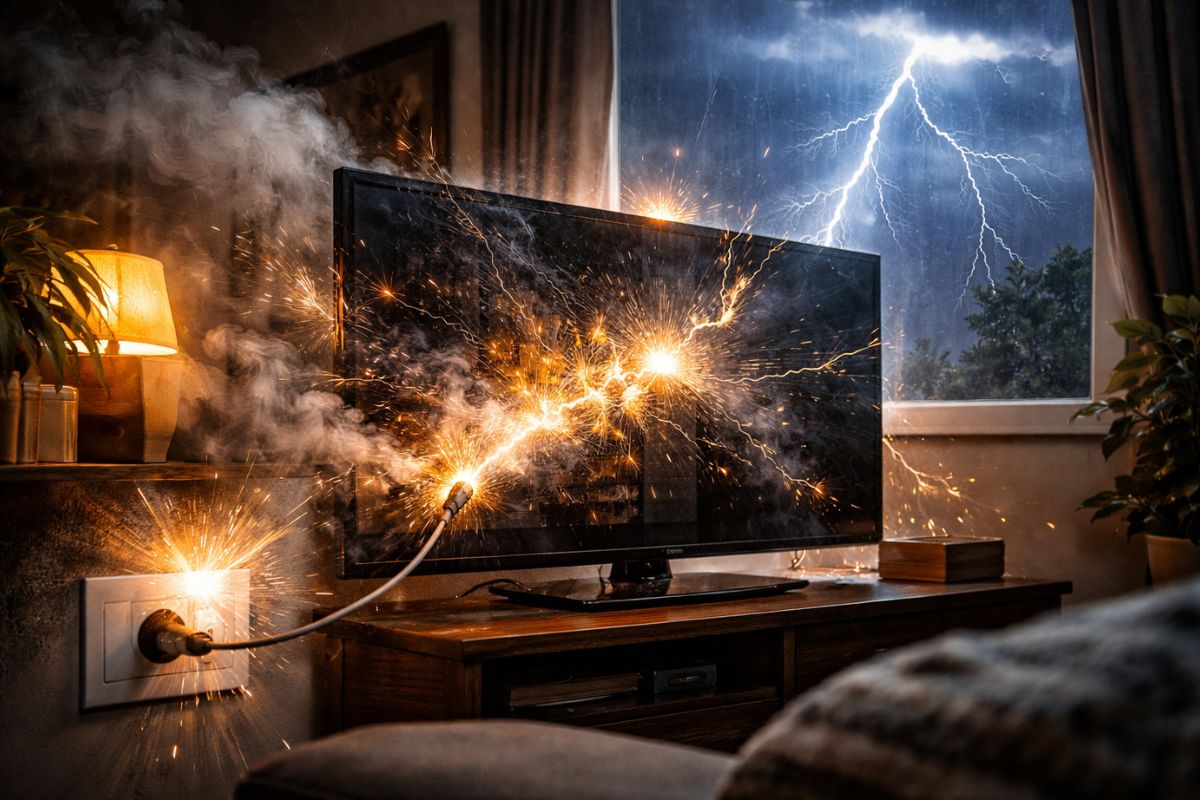
Experts Warn That Keeping The Television Plugged In During Storms Increases The Risk Of Voltage Surges, Burning Sensitive Internal Boards And Losing Expensive Equipment, Even When The Device Appears To Be Off Just At The Remote Control Or In Standby Mode, On Strong Thunderstorm Days With Nearby Lightning.
With the first strong storms of summer spreading across the country, experts emphasize that leaving the television plugged in during lightning and thunder is one of the riskiest actions for the safety of electronic devices at home, especially in neighborhoods with exposed wiring and old networks.
With each new cold front loaded with storm clouds, voltage fluctuations, lightning strikes on the grid, and the risk of silent internal damage increase. A single surge can burn out the power supply, boards, and capacitors of the television plugged in within seconds, turning the movie of the night into a hard-to-recover irreversible loss in the household budget.
Why Storms With Lightning Threaten The Television Plugged In
When a lightning strike occurs near the distribution system, the sudden energy variation travels through the cables and reaches homes, even without directly hitting the house.
-
Worlds covered by water, atmospheres filled with hydrogen, and the possibility of life beyond Earth: ocean planets are rewriting the map of cosmic search and forcing scientists to rethink where to look.

-
Argentina achieves the unimaginable after more than 110 years and reintroduces the largest native herbivore of South America to the Chaco to restore a lost link in nature.

-
Returning to the Moon now costs a billion-dollar bill and reignites the competition between the USA and China for science, technology, and rare minerals on lunar soil.

-
While the world looks at oil, the war with Iran is already disrupting helium supply from Qatar, affecting car and iPhone chips, threatening AI expansion, and putting pressure on aluminum packaging at the highest value in four years.


This surge travels through the electrical network and can reach any television plugged in, even if the device seems calm in the living room.
The most sensitive internal components, such as the power supply, electronic boards, and capacitors, were not designed to withstand sudden high voltage shocks.
In many cases, the result is total or partial burnout of the equipment, requiring expensive repairs or complete replacement of the television plugged in affected by the electrical surge.
In addition to the immediate damage, repeated surges over several storms can gradually degrade the components, shortening the lifespan of the device without the resident noticing.
The problem only appears when the television stops turning on from one day to the next, usually after a night of heavy rain with many lightning strikes in the area.
The Television Plugged In Is At Risk Even When Turned Off With The Remote Control
A common doubt is to imagine that simply turning off the television with the remote control is enough to stay protected.
Home electronics experts explain that in this condition, the device continues to receive power in standby mode, with circuits connected to the grid to respond to the remote command and trigger smart functions.
This means that the television plugged in remains physically connected to the power grid, even with the screen off and the sound muted.
A single strong voltage spike may be enough to damage the main board, which contains the processor, memory, and system controllers, making repairs disproportionate to the value of the device.
For this reason, in intense electric storms, the safest guidance is simple and straightforward: unplug the television from the socket and wait for the weather to stabilize before reconnecting.
Simply turning off with the remote reduces energy consumption, but does not stop the path the electrical surge takes to the sensitive parts of the device.
Which Devices Suffer Most From Surges During Storms
Although the television is the main focus, other equipment also suffers from sudden variations in the power grid.
Generally, these are devices that remain on all the time, have miniaturized electronics, and are often simultaneously connected to power and the internet.
Among the most vulnerable are:
Modern televisions, with switch-mode power supplies and thin boards, very sensitive to voltage surges and rapid variations in energy
Wi-Fi modems and routers, which remain active 24 hours a day and connected to power and the telephone or fiber line
Video game consoles, which concentrate delicate processors, memory, and internal power supplies
Audio equipment, receivers, and TV set-top boxes, which utilize boards with dense components that are not tolerant to surges
In all these cases, the logic is similar to that of the television plugged in: the more sophisticated the electronics, the greater the chance that an intense surge will cause irreversible damage in seconds.
During strong storms, disconnecting whenever possible significantly reduces the risk.
Unplugging The Television Or Just Pressing The Button: What Really Protects
From a technical standpoint, unplugging the television is the most effective way to interrupt the flow of electricity between the grid and the device.
By removing the plug, the internal circuit is no longer exposed to sudden voltage fluctuations that enter through the wiring, even if lightning strikes near the distribution network.
Turning off only with the remote control, or even with the physical button on the device itself, usually keeps part of the electronics powered in standby mode.
This means that during a storm with strong lightning, the television plugged in is still vulnerable to the effects of a severe overload.
The practical recommendation, therefore, is straightforward: on days of intense instability, with nearby thunder and frequent lightning, it’s worth getting up from the couch, turning off the power strip, and unplugging the television and other sensitive devices until the storm moves away from the area.
Protection Equipment Helps, But Does Not Replace Unplugging The Television
Many consumers rely on old stabilizers or basic power strips to protect the television plugged in and other electronic devices.
These devices can offer some damping for common fluctuations, but they do not always withstand extreme surges generated by lightning strikes very close.
Good quality UPS units and surge protectors with varistors provide a more robust defense against moderate voltage spikes.
Still, experts remind us that no device plugged into the grid is completely protected against a very strong strike, especially in old installations with inadequate grounding or overloaded wiring.
For this reason, the safest combination is to use good protection devices in everyday life and, during severe storms, adopt the simplest and most effective measure: unplugging the television and other sensitive devices, waiting for the storm to pass before safely reconnecting them.
In light of this scenario, do you usually leave the television plugged in during thunderstorms, or have you developed the habit of unplugging it as soon as the sky starts to get cloudy?








-

Uma pessoa reagiu a isso.