





 Portuguese
  English
  Spanish
  5 min of reading
  0 comments


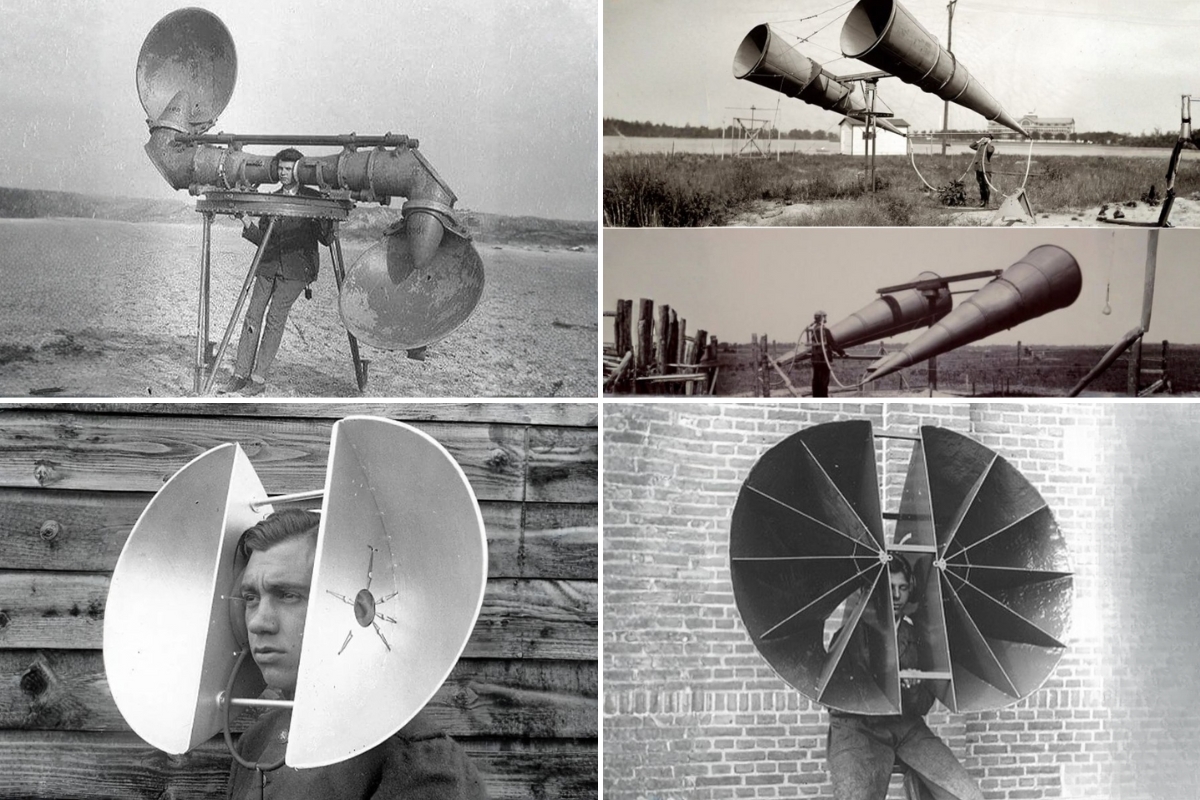
Before Radar, Countries Created Parabolic Helmets, Giant Horns, and Acoustic Platforms to Hear Enemy Planes. These Curious Machines Marked the First Attempt at Modern Air Defense Before Being Superseded by Electronic Technology
Decades before humanity learned to track aircraft with radio waves, scientists and military personnel believed sound would be the solution. It was a time when airplanes were still a novelty, bombers were starting to dominate the battlefield, and the world’s most powerful nations feared sudden attacks from above. Without radar, satellites, or any electronic surveillance system, the alternative found was to look to the past and use humanity’s oldest weapon: hearing.
The result was a curious technological race, marked by giant, ingenious, and at times visually absurd equipment. These devices aimed to amplify engine noise to provide some minutes of warning before an aerial attack. It was an experimental phase of military history that lasted briefly but left fascinating records. Here, each of the devices you encountered represents a chapter of this global effort.
1. Dutch/German Parabolic Acoustic Helmet

This model, developed in the late 1920s, was used by European units seeking a quick way to identify the direction of aircraft before they were sighted. The two large metal reflectors around the head acted as acoustic antennas, concentrating the sound of the engine into internal tubes connected to the ears.
-
With 1,066 acrylic panels, the building known as the friendly alien is supported by a steel skeleton, has a façade that functions as a giant screen, and impresses the world without any internal columns.

-
Scientists warn that a comet about 1 km in size that has started to release gases may actually change direction in space. It was spotted by NASA and surprises with potential impacts near Earth.

-
These living root bridges and ladders are over 700 years old and help indigenous people survive in one of the rainiest regions in the world.

-
From sertanejo star to international investor: Ana Castela invests millions in a mansion in the USA, creates a themed accommodation in Orlando, and shows that the “boiadeira” also wants to grow away from the stage.


In theory, the operator was supposed to slowly rotate their body until they perceived the point of highest sound intensity. In practice, it was only effective when the wind cooperated and the plane flew low. Nevertheless, it represents one of the first portable aerial alert efforts.
2. Lightweight Parabolic Acoustic Helmet

A more reduced and practical version, tested in the 1930s by the Netherlands and Germany. The semicircular dishes allowed good frontal sound capture but had a low capacity to eliminate lateral noise. Its advantage lay in mobility, as the operator could wear the helmet while moving, which was useful in nighttime patrols and forward positions.
The equipment, despite its limitations, symbolizes the attempt to transform human hearing into an amplified military instrument.
3. Long-Horn Acoustic Locators

Much more ambitious than the helmets, the horn locators were used by the United States, France, and Japan between 1916 and 1934. The enormous metal horns amplified sound impressively, transmitting it through tubes directly to the operator’s ears.
The versions with four mouths allowed estimating direction and approximate altitude depending on which set received the sound first. In ideal tests, it was possible to hear bombers from over ten kilometers away. In real field conditions, any atmospheric change destroyed accuracy. Nevertheless, they were deployed at coastal bases and military installations for nearly two decades.
4. Multi-Cone Directional Acoustic Platform

This was the most advanced system of the pre-radar period. Developed mainly by Germany and the Netherlands, it combined several interconnected parabolic cones on a rotating platform. The operator remained in the center, listening simultaneously to the different sound inputs.
Small variations in volume and arrival time helped determine estimated distance, direction, and even altitude. Today, these devices look like futuristic sculptures, but at the time, they were considered “the utmost boundary of auditory detection.” Their performance was superior to that of the helmets and horns but remained vulnerable to wind, sea, and urban noise.
Why the World Believed So Much in These Devices
The answer lies in fear. Between the world wars, entire cities began to fear surprise bombardments. London, Paris, Berlin, and Tokyo invested fortunes in early warning systems. The planes were loud, and it seemed logical to use that noise to predict an attack. At that moment, acoustic detection was seen not as a curiosity but as the only possible technology.
The problem is that science quickly proved the opposite. Sound travels slowly, is easily distorted, and does not carry reliable information about actual distance. Furthermore, advancements in military aviation made these devices practically useless. More powerful engines and aircraft flying higher made sound capture more challenging. A modern bomber appeared on the horizon with much less noise than its predecessors.
The Arrival of Radar and the End of an Era
The definitive turning point occurred in the United Kingdom. Researchers led by Robert Watson-Watt discovered that radio waves reflected off aircraft could reveal position, distance, and speed. It was the birth of radar. For the first time, a country could “see” the enemy before he got close. The impact was immediate.
Within a few years, all powers abandoned their acoustic detectors. Germany halted its programs. The Netherlands dismantled entire platforms. The United States shifted resources to radar laboratories. Japan tried to maintain both methods but eventually followed the same path.
World War II established radar as the new backbone of air defense. And thus, acoustic detectors disappeared as quickly as they emerged. The machines that were once considered essential are now remembered only as remnants of an experimental phase marked by creativity, improvisation, and urgency.
An Odd Yet Fascinating Legacy
The acoustic devices never worked as their creators hoped. But they played an important role in laying the groundwork for the next generation of technologies.
They were the bridge between visual observation in the early days of aviation and the sophisticated electronic system that would dominate the 20th century. Each of these machines tells a story of trial and error, of innovation and limitation, of a time when listening to the sky seemed like a possible solution.
Today, these pieces survive as historical landmarks, photographed in museums, abandoned bases, and private collections. They represent not only a technical curiosity but also a reminder of how war often accelerates scientific development, even when the solutions adopted ultimately prove to be just an intermediate step.








Seja o primeiro a reagir!