





 Portuguese
  English
  Spanish
  7 min of reading
  0 comments


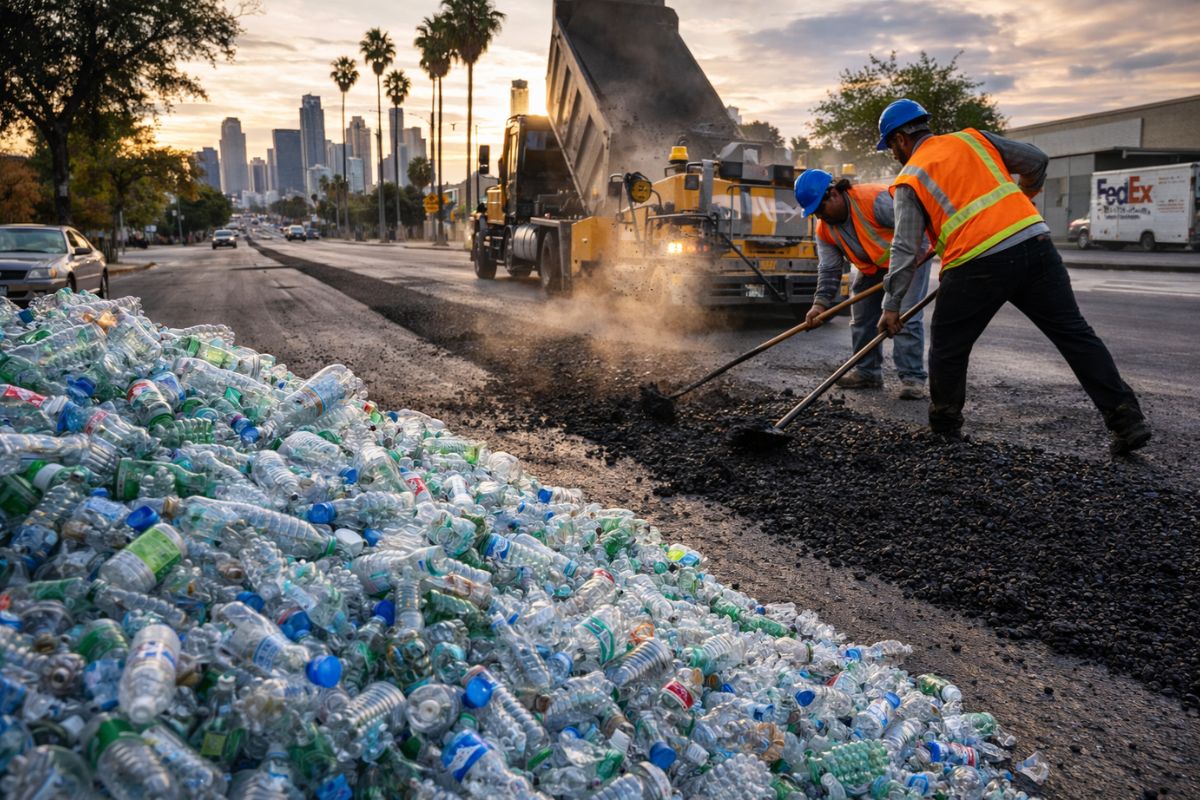
With Tests Planned in City Streets, Los Angeles Bets on a Compound That Mixes Recycled Asphalt and Recycled Plastic Converted into Oil, Applied by a “Recycling Train” That Removes, Crushes, Recompiles, and Returns the Pavement to the Road with a Promise of Superior Resistance and Lower Carbon in Urban Works.
The use of recycled plastic in the streets of Los Angeles has entered the urban debate as an attempt to tackle two fronts simultaneously: the destination of waste and the durability of the pavement. Instead of relying solely on conventional asphalt, the city has begun testing a compound that reuses the existing material in the roadway and incorporates plastic waste that would normally be discarded.
The proposal draws attention because it does not merely swap one input for another. It changes the very process of resurfacing, using a continuous operation where the old pavement is removed, crushed, mixed, and reapplied on-site. What is at stake, therefore, is not just a different road, but a model of intervention that promises more resistance, less transportation of raw materials, and a smaller carbon footprint.
An Urban Test That Aims to Transform Waste into Performance

Los Angeles chose its streets as a testing ground for a new asphalt compound developed by TechniSoil Industrial.
-
The lack of welders, electricians, and operators becomes a structural threat in 2025, with the construction industry and manufacturing already suffering from delays, cost pressures, and labor shortages in Brazil.
-
Brazil and Paraguay are just 46 meters away from a historic union on the bioceanic bridge that promises to revolutionize trade between the Atlantic and the Pacific.

-
With 55 km over the sea, a cost of US$ 20 billion, and enough steel to build 60 Eiffel Towers, China’s largest project has connected Hong Kong, Zhuhai, and Macau in a colossal bridge that defies the logic of engineering.

-
A trick with joint compound transforms a Styrofoam ceiling into a plaster-like ceiling: leveled panels, wires and mesh at the joints, sand, paint, and change the environment while spending little today.

The basis of the bet lies in the mixture between the recycled asphalt of the road itself and the recycled plastic converted into oil, which takes on the role of bitumen within the new composition.
This technical detail is at the center of the proposal. When recycled plastic assumes part of the traditional asphalt binder’s function, the pavement ceases to be merely a layer redone with new material brought from outside and begins to operate as a system of reusing what was already on the street.
The idea is simple to understand but ambitious in practice: to use urban waste as part of the structural solution for the city itself.
The project also gains symbolic dimension because it relies on a material associated with mass disposal. By mentioning hundreds of thousands of bottles per stretch, the operation attempts to convert volume of waste into an engineering argument.
It is not just an environmental narrative. It is a way of showing, on a visible scale, how much waste can be absorbed by an infrastructure project.
At the same time, the test does not arise as an improvisation. According to the data presented, the compound is the result of seven years of studies and research, indicating an attempt to consolidate technical viability before applying it on open roads. This helps distance the interpretation that the experience is merely green marketing with an industrial appearance.
How Recycled Plastic Enters the Asphalt and Changes the Process

The most important point of the new material is the partial substitution of the traditional binder. In the proposed model, recycled plastic is converted into oil and takes on the role that would normally belong to bitumen.
This change alters the logic of the mixture and supports the promise of a more resistant and completely reusable pavement.
According to the project’s description, the resistance of this new asphalt can be eight to thirteen times higher than that of regular asphalt. It’s a significant leap, and precisely for this reason, ongoing monitoring will be crucial.
In road infrastructure, promises of laboratory or project viability only gain real weight when they withstand heat, load, traffic, cracking, and time.
The application also deviates from the more familiar standard. Instead of removing a pavement, transporting material away, bringing in new inputs, and only then resurfacing the road, the process is executed by a machine nicknamed “recycling train”.
This machine removes, crushes, mixes, and reapplies the material in a continuous sequence, almost without breaking the operational flow of the project.
This continuity has important implications. The fewer dispersed steps, the less dependency on transportation, stock, and reentry of inputs.
This makes the process faster on paper and, at least in theory, more efficient from a logistical standpoint. It is not just a road with a new composition; it is a road redone with a different method of intervention.
The Argument of Durability and the Promise of Lower Carbon
The main showcase of the initiative lies in the combination of superior resistance and reduced environmental impact. The project claims that, in addition to being more durable, asphalt with recycled plastic can have a carbon footprint up to 90% lower than that of regular asphalt.
If this data is confirmed in practice, the Los Angeles experience gains significance far beyond local resurfacing.
The explanation for this reduction lies less in the plastic itself and more in the construction chain. Since the process recycles and reapplies the existing pavement on-site, it eliminates a significant portion of raw material transportation by trucks.
Less heavy transportation means lower associated emissions during execution, and this factor can be as important as the chemical composition of the new material.
There is also a gain in urban discourse. Instead of treating plastic waste merely as a collection problem, the city begins to incorporate it as potential input in infrastructure.
This does not eliminate the challenge of plastic production and disposal, but rather repositions part of this liability within a more aggressive reuse framework.
Still, it is necessary to separate promise from proof. A pavement may be structurally more resistant in theory and less emissive in its formulation, but the decisive measure remains the actual behavior of the street over time.
Asphalt is not measured just on the day of application. It is measured when months pass, and the surface continues or does not continue to respond.
What Los Angeles Really Wants to Discover with the Monitored Streets
The first tests would be conducted in December, when the new pavement would be applied. From then on, the resurfaced streets with the compound would be monitored for two years to check long-term resistance.
This timeframe is relevant because it takes the project out of the purely promotional sphere and pushes it towards continuous observation.
This monitoring will have to answer the central question that any urban manager would ask before expanding the solution: does the new asphalt support the daily life of the street better than the conventional model? This involves traffic, weather, wear, and maintenance needs.
If the material lasts longer, the gain will not only be environmental but also budgetary and operational.
There is also a political-administrative component to this choice. By converting real sections of the city into a laboratory, Los Angeles takes the risk of exposing the solution to direct comparison with regular asphalt. If it works, the experience becomes a reference.
If it fails, the criticism will be immediate, because the test is not hidden on a closed track but integrated into the urban network.
That is why monitoring is more than a formality. It is the boundary between enthusiasm and validation.
A new infrastructure material only stops being a bet when it accumulates sufficient street time to prove that it withstands routine without becoming just another expensive and disposable experiment. This is the proof that Los Angeles has decided to seek in its own avenues.
An Urban Solution That Blends Engineering, Waste, and City Politics
The case of Los Angeles shows how the discussion about recycled plastic has moved from the exclusive realm of packaging, selective collection, and domestic recycling to heavy infrastructure works.
When waste begins to integrate into the street, the city shifts the scale of the debate and transforms a diffuse problem into high-volume material for public intervention.
This movement also repositions urban engineering. Instead of merely acting as a repair for wear and tear, it is used as a mechanism for absorbing waste and reducing emissions.
The street ceases to be just a circulation surface and also becomes a platform for environmental policy, even if under a technical logic and with structural performance requirements.
However, there is one aspect that the experience cannot resolve on its own. Using recycled plastic in asphalt does not erase the excessive production of plastic nor does it replace broader policies for waste reduction and management.
The test is one piece within a larger problem, not a complete cure. Treating the project as a total solution would be an oversimplification.
Even so, the proposal holds strength because it attempts to address a real pain point in the city with a real material from the city itself. If the compound withstands as promised, Los Angeles will have found a way to connect road maintenance, waste reuse, and project logistics in the same operation.
And this, in an urban environment, is rarely a small matter.
In the end, Los Angeles’s test with recycled plastic on the streets matters less for the visual impact of the work and more for what it can prove about durability, carbon, and large-scale reuse.
If the material delivers superior resistance and confirms performance over the two-year monitoring period, the city will not have simply resurfaced street sections.
It will have opened a technical precedent for other urban networks that struggle with significant waste and limited space to waste materials.
If a city hall in your region could choose today between regular asphalt and a solution with recycled plastic, what would weigh more for you: the promise of lasting longer, the reduction of carbon, or the confidence that the test really withstood traffic before becoming public policy?









Seja o primeiro a reagir!