





 Portuguese
  English
  Spanish
  4 min of reading
  0 comments



Brazil Will Charge R$ 3.4 Billion in 2026 from Multinationals with New OECD-Based Tax. Measure May Generate Friction with the USA after Trump Repeals Global Agreement.
The Brazilian government announced that, starting in 2026, it will begin to charge a new billion-dollar tax on multinationals operating in the country. The official estimate is for a collection of R$ 3.4 billion, resulting from the application of the global minimum rate of 15%, recommended by the OECD and approved by Congress in December 2024. The measure, while representing an important cash boost for the Union, also carries a potential for diplomatic friction with the United States. This is because former President Donald Trump, who returned to power in 2025, already repealed the global agreement of the so-called Pillar 2 of the OECD, signaling that he does not intend to follow the same guidelines.
How the New Tax Works
The rule sanctioned in Brazil through Law 15.079/2024 determines that multinational economic groups with consolidated revenue exceeding 750 million euros per year must pay an additional tax whenever the effective taxation on their profits in the country is less than 15%.
In practice, this means the government can charge the difference between the rate paid and the minimum level established by the OECD. The collection will be made through the Social Contribution on Net Profit (CSLL), in a supplementary manner.
-
The institute that trained the greatest aerospace engineers in Brazil has just opened its first campus outside São Paulo after 75 years: ITA Ceará will have R$ 445 million, new courses in energy and systems, and classes are expected to start in 2027.

-
Luciano Hang, owner of Havan, goes to Juiz de Fora after the tragedy in February, brings R$ 1 million, hands out R$ 2,000 cards, and donates up to R$ 15,000 to victims in the region.

-
The Brazilian passport allows legal residence in dozens of countries without the need for a prior visa, and most Brazilians are unaware that they can apply for residency directly upon arriving in nations in South America, Africa, and even Europe.

-
Petrobras sends a message to Brazilian truck drivers after fuel collapse and reveals plan to have 100% domestic diesel.


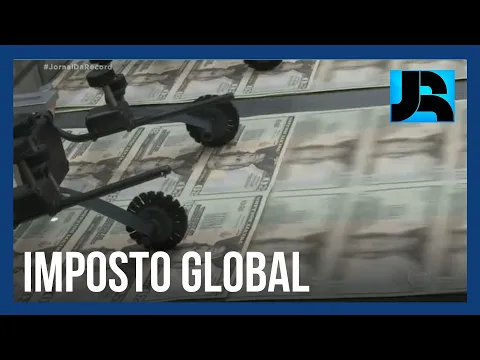

According to estimates from the Federal Revenue Service, the new charging system is expected to affect 273 foreign groups operating in Brazil and 21 Brazilian groups with international operations. The calculation was based on data from 2022, adjusted for the 2026 scenario.
The Expected Impact on Revenue
The government’s initial forecast is R$ 3.4 billion in 2026, an amount that, while not representing a budgetary revolution, is symbolic in a context of fiscal adjustment and the search for new sources of revenue.
Experts remind us that the measure also has an indirect impact: by establishing a minimum taxation floor, Brazil sends a message of regulatory predictability, aligning itself with international practices advocated by the OECD.
Friction with the USA: An Announced Tension
While in Brazil the discourse is of modernization and tax justice, in Washington the scenario is quite different. Donald Trump, upon returning to the White House in January 2025, revoked the US adherence to Pillar 2, arguing that the measure would hurt the competitiveness of American companies.
In practice, this divergence creates a sensitive point between Brazil and the USA. If American companies are burdened by the minimum rate in Brazilian territory, diplomatic pressures or even retaliatory measures may arise, as Washington does not recognize the rule as legitimate.
Economists assess that this discrepancy could fuel a new chapter in the global fiscal war, with countries divided between those adopting the minimum taxation and those resisting the rule.
The International Scenario
The OECD Pillar 2 was negotiated by more than 140 countries and establishes a global minimum rate of 15% on multinational profits, with the goal of reducing predatory tax competition.
By 2024, dozens of countries had already approved internal legislations to comply with the agreement, including members of the European Union. Brazil, by sanctioning the law, sought to reinforce its image as a trusted partner in international forums and, at the same time, protect its tax base against large corporations using tax havens.
However, with the US exit from the arrangement, the pact lost some of its political strength. Nevertheless, countries like Germany, France, and Canada remain committed to implementation.
What Experts Say
For tax expert Sérgio André Rocha, a professor at UERJ, the Brazilian measure has merit in aligning the country with good global practices but carries risks.
“The big problem is that if the USA does not apply the rule, American companies might claim double taxation or seek legal ways to escape the incidence. This could generate international litigation and diplomatic friction,” he assesses.
Economist Monica de Bolle from Johns Hopkins University reminds that Brazil needs fiscal credibility.
“Any increase in revenue is positive. But we cannot ignore that the timing is delicate, as Trump has a highly combative profile when it comes to measures affecting American companies.”
What to Expect for 2026
The Brazilian government is expected to regulate the details of the new tax throughout 2025, focusing on transparency and legal certainty for investors.
The challenge will be to implement the rule without creating capital flight or loss of competitiveness for Brazil in the global scenario.
Market analysts suggest that the country will likely face an initial phase of legal disputes and diplomatic negotiations, especially with the USA. However, in the medium term, the trend is for the rule to consolidate, especially if the OECD maintains collective pressure on its members.










-

-

-

3 pessoas reagiram a isso.