





 Portuguese
  English
  Spanish
  5 min of reading
  0 comments


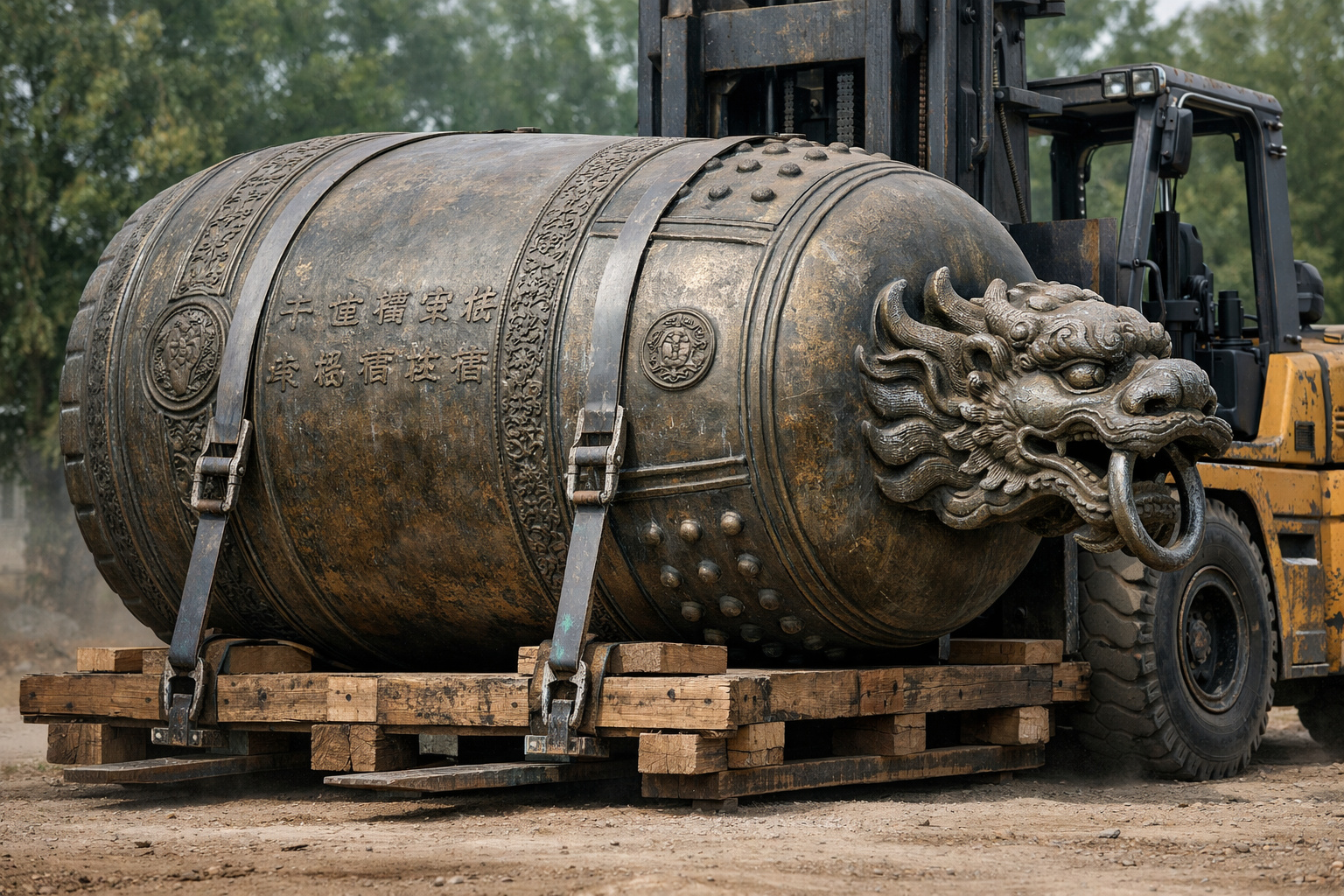
Created By An Ancient Handcrafted Process, This Sonorous Giant Requires Months Of Manual Labor, Precise Chemical Engineering, And Zero Errors To Achieve A Resonance That Can Last Up To One Minute
For centuries, humanity has developed faster machines, automated factories, and industrial processes capable of producing on an almost infinite scale. However, in the 21st century, there exists a monumental object that completely defies this modern logic: the traditional Korean Buddhist bell weighing five tons, handcrafted to sound for over a thousand years without losing its structural integrity or its sonic signature.
This information was disclosed by the channel Quantum Technology HD, specialized in industrial processes, extreme engineering, and rare artisanal techniques, which documents in detail traditional workshops located in South Korea. According to the material presented by the channel, fewer than ten workshops worldwide still master this ancestral casting process, and only a few have the technical capacity to produce Buddhist bells of such extreme size, with several tons of bronze and stringent acoustic requirements.
Unlike what happens in modern industry, there is no automated method capable of reproducing this type of instrument. Each bell is a unique work, custom-made for a specific temple, carrying religious inscriptions, names of donors, and symbolic patterns that never repeat.
-
The lack of welders, electricians, and operators becomes a structural threat in 2025, with the construction industry and manufacturing already suffering from delays, cost pressures, and labor shortages in Brazil.
-
Brazil and Paraguay are just 46 meters away from a historic union on the bioceanic bridge that promises to revolutionize trade between the Atlantic and the Pacific.

-
With 55 km over the sea, a cost of US$ 20 billion, and enough steel to build 60 Eiffel Towers, China’s largest project has connected Hong Kong, Zhuhai, and Macau in a colossal bridge that defies the logic of engineering.

-
A trick with joint compound transforms a Styrofoam ceiling into a plaster-like ceiling: leveled panels, wires and mesh at the joints, sand, paint, and change the environment while spending little today.


Sand Molds, Liquid Bronze, And A Mistake That Cannot Exist

First of all, the creation of a Buddhist bell of this size begins with the so-called “false bell”, a reusable master mold that defines the basic profile of the piece. From this structure, artisans apply a thick layer of dark, viscous wax, preparing the surface to receive thousands of manually carved symbols, one by one, with surgical precision.
At this stage, large characters indicate the name of the temple that commissioned the bell. Next, Zen verses are carved around the structure, functioning as prayers that, according to tradition, spread through the environment whenever the bell is struck. Shortly after, comes one of the most delicate phases of the entire process: the so-called “donor grid”.
This grid is composed of thousands of tiny characters, representing the names of each person who financed the creation of the bell, as well as individual wishes for health, prosperity, or spiritual protection. Any mistake made here cannot be corrected, as it will be transferred directly to the melted bronze, becoming permanent.
After the complete carving, the structure receives a layer of industrial white wax, which seals the details and ensures that the mold can be removed without deformation. From this point, the creation of the definitive external mold begins, made with dry sand mixed with a resin chemical binder.
This mixture imposes a race against time: the chemical binder has only 20 minutes of useful life, requiring that successive layers be compacted while the previous one is still active. At the end of this process, more than five tons of sand are manually compacted inside a gigantic steel structure called a “flask”.
Here emerges a critical engineering contradiction: the mold needs to be rigid enough to support the weight of the liquid bronze, yet porous enough to allow gas release. If gases become trapped, they will form internal bubbles that compromise the bell’s timbre, ruining months of work.
Therefore, the bronze is poured from the bottom of the mold through channels called “runners”. This bottom-filling technique avoids turbulence and air bubbles, allowing the liquid metal to rise slowly, filling the space like water in a bathtub, without creating internal distortions.
The Inner Core That Defines The Sound And Separates The Masterpiece From Scrap
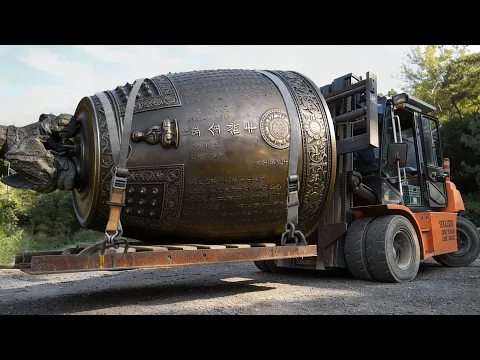

If the external mold defines the appearance, it is the internal mold — called the core — that determines the bell’s sonic soul. The standard is relentless: a master bell must resonate for about one minute after being struck. If the sound dissipates in less than 30 seconds, the piece is considered scrap.
To ensure this precision, the core is built upon a metal frame coated with a special mixture of wet clay and sand, different from the resin used earlier. The clay allows for more working and compacting time, something essential for a structure approximately 1.8 meters tall.
The material is applied manually in successive layers, being compacted with extreme rigor. Any weak point can lead to the core’s collapse when tons of liquid bronze, heated to about 2,100°F (approximately 1,150°C), are poured over it.
After reaching the rough shape, the core undergoes a high-precision sculpting process using a metal tool called a “sweep board”. It functions like an enormous compass, rotating around a central axis and scraping away the excess material until achieving a perfect circumference, with minimal tolerances.
Next, the core must be completely dried. For this, artisans dig a central tunnel and burn about 45 kg of charcoal continuously for up to 48 hours, eliminating any trace of moisture. If water remains inside the mold, contact with the liquid bronze can cause a violent explosion.
Only after this process does the core receive a layer of graphite, which acts as a non-stick agent and protects the clay from direct contact with the molten metal.
Dragons, Liquid Bronze, And A Sound Made To Cross Centuries

While the body of the bell is molded in sand, the top part — known as “yong new” or dragon’s loop — requires a different technique: the lost wax process. A dragon is sculpted in wax, covered with layers of ceramic, and heated until the wax melts, leaving an extremely detailed hollow mold.
This ceramic mold is reinforced with sand and stones to support the weight of the liquid bronze, while also allowing gas release. The symbolism of the dragon is not decorative: according to Korean tradition, it is Porro, a small sea dragon terrified by whales.
Thus, the wooden trunk used to strike the bell — called “dang mach” — is sculpted in the shape of a whale. When the whale strikes the bell, the dragon “screams”, creating the deep and vibrant sonic signature that distinguishes these instruments from any Western bell.
After casting, the bell takes about one week to cool. The external mold, designed for single use, is completely destroyed. The internal core, now transformed into solid stone by the heat, must be broken with industrial hammers and controlled impacts until it can be removed.
The final finishing involves intense polishing, removal of sand residues, and manual restoration of each inscription. The bronze then receives a dark chemical patina, which blocks contact with oxygen and preserves the metal for centuries.
Finally, the bell is installed in an open pavilion called “jongak”, different from the closed towers of the West. Here, the sound does not serve as an alarm, but as a vibrational prayer, designed to be felt in the ground, in the body, and in the surrounding environment.
After three months of continuous work, an instrument is born that will continue to sound long after its creators are no longer alive — a sonic legacy designed to last for millennia.








-

-

-

-

-

-

211 pessoas reagiram a isso.