





 Portuguese
  English
  Spanish
  5 min of reading
  29 comments


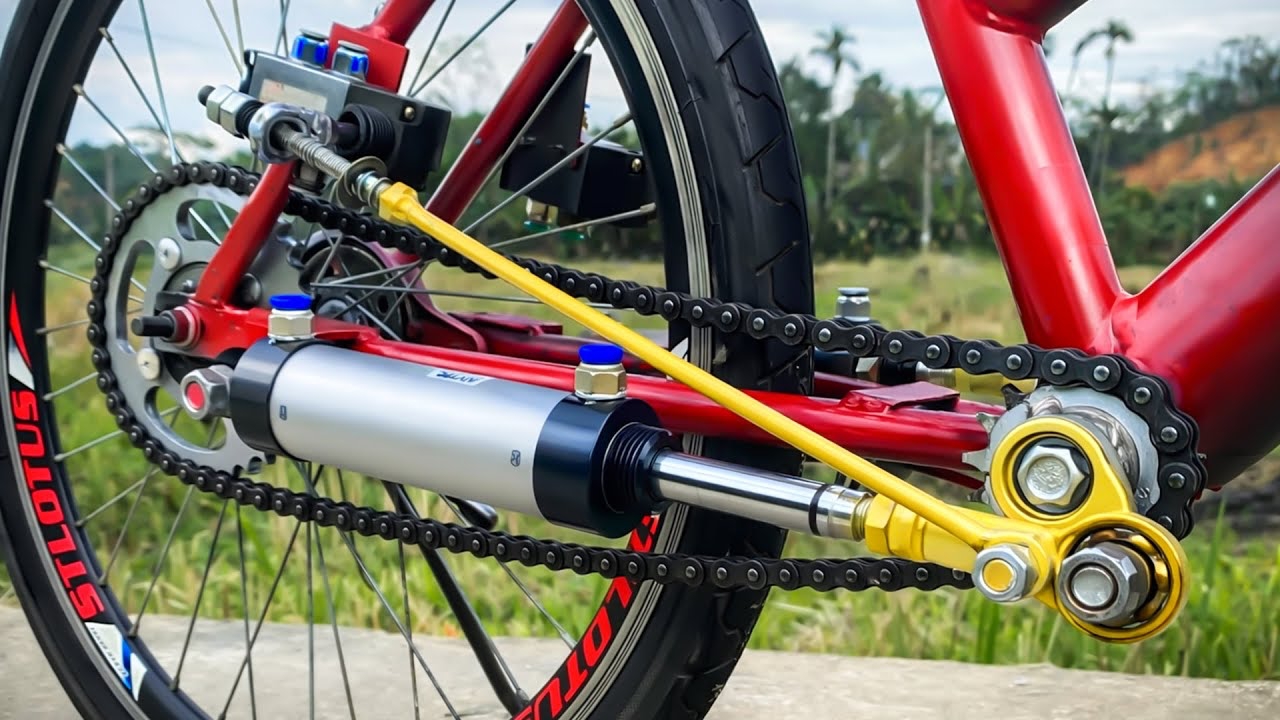


He Puts Air Motor on the Bicycle, Adjusts Chain and Gears and Makes the Rear Wheel Spin Without Relying Only on the Pedal, All at Home.
Pneumatic motor on a bicycle is not just a curiosity, it is a direct test of garage engineering. You see a regular bike gain an air-powered motor, connected to the transmission, and the rear wheel starts to spin with a new source of power.
What grabs attention is how everything fits with what the bicycle already had. Chain, gears, rear axle, metal supports, and a path of hoses that delivers air to the motor come into play.
This weighs heavily for those who love mechanics because the conversation here is practical. When you put an air motor close to the transmission, the focus turns to alignment, fixation, and gap control; the rest is consequence.
-
The Himalayas continue to grow to this day, with tectonic plates advancing 5 cm per year, mountains rising up to 10 mm annually, and the 2015 earthquake that killed 9,000 people may have increased the risk of an even larger seismic mega-event.

-
At an altitude of 400 km by astronauts from the International Space Station, Paris transforms at night into a golden mesh so precise that it reveals the outline of the Seine River, avenues, and entire neighborhoods like a luminous map drawn over the Earth.

-
iPhone 17 reaches historic low price with 256 GB, 120 Hz display, and drops to R$ 5,703 on Shopee, featuring A19 chip, dual 48 MP cameras, battery life of up to 30 hours, and advanced AI features.

-
Trip to Mars getting closer: Pulsar Fusion, from the UK, advances with plasma ignition in fusion engine and could drastically reduce space travel time, making crewed missions faster, safer, and economically viable.

How the Bicycle Started Transmitting Power from the Pneumatic Motor Directly to the Rear Wheel

The change started in the most critical part of the bicycle: the rear. The rear wheel, axle, and chain become the focus of the work because that is where any error leads to contact, scraping, or locking.
The pace follows the logic of a real workshop. Loosen it, check it, tighten it, go back, adjust it again. You realize that a well-seated screw and a locked nut make a difference when the parts start to spin close to one another.
The point that changes everything is simple to understand. The bicycle starts to accept rotation in the rear assembly not only from the pedal but also from the motor, as long as the transmission is installed without misalignment.
Here comes a concept that explains a lot: chainline. Sheldon Brown himself summarizes directly that chainline is about “how straight the chain runs between the gears.”
The Frame Base Needed to Withstand More Load Without Loosening Anything
Before thinking about the motor, the frame needed to become a reliable base. The area near the rear axle receives preparation, as it will gain extra weight and new effort pulling the transmission.
The work advances with the removal of parts, cleaning contact points, and checking gaps. At each stage, the tightening repeats because any play there becomes a problem when the motor starts spinning.
The practical effect appears quickly. The frame ceases to be just a support for the wheel and the cyclist, and also starts to hold a fixed assembly with metal, screws, and support, all vibrating together.
This kind of attention aligns with what Park Tool explains about chainline: the position of the chainrings and cogs concerning the center of the bike influences the chain’s path. It is the kind of adjustment that prevents noise and premature wear.
Metal Supports Came from Cutting and Went for Fine Adjustment
The motor doesn’t hang in the air; it needs support. And the support comes in the most straightforward way possible: cut the metal, drill, fit, screw, and adjust the angle until it matches the frame’s design.
The detail that gives the impression of heavy work is localized heating. The metal heats, bends, and goes back to the bench because that is how the right angle appears when dealing with a tight space.
This changes the stability of the assembly. With well-positioned support, the motor stays firm, and you reduce the chance of displacement during rotation, especially when the chain pulls and returns tension with each turn.
The Pneumatic Motor Entered the Tightest Space and Demanded Alignment

With the supports ready, the pneumatic motor appears near the rear wheel. The cylindrical metal body and output axle occupy a small space, and the assembly is very close to the chain and the frame.
Fixation occurs through screws passing through the supports. The alignment of the motor’s axle with the transmission becomes the most sensitive point because any misalignment shows up as friction or the chain skipping teeth.
The practical result is that the bicycle gains an additional mechanical source of spin. The pedal is still there, but the motor starts pushing the transmission when air enters the system.
Extra Gear and Repositioned Chain Closed the Transmission
The transmission becomes the heart of the adaptation. An additional gear enters near the rear axle and shares space with the existing assembly, which forces constant checking of the fit.
The chain is repositioned to embrace the new gear and maintain the correct path. Tension receives manual adjustment, and the fit occurs tooth by tooth, with an eye on the alignment between chain, gear, and wheel.
What changes in practice is direct. When the motor spins, the chain follows, and the rear wheel responds because the mechanical connection is closed, without needing to invent another type of transmission.
Hoses and Flow Control Gave the Command to the Motor
After the mechanical part fits, the air part comes in. Hoses connect to the motor and form the path for air to the assembly, being careful not to bend and reduce flow.
A control component appears in the line, allowing the flow to be opened or restricted. This makes the activation more predictable because the rotation responds to the released air.
The consequence comes right away. When releasing air, the motor spins, and the movement goes to the transmission, making the rear assembly work continuously.
Final Test Confirmed Stable Rotation and Showed Where to Adjust
The testing stage makes everything clearer because the rear wheel spins freely, and you see the actual behavior of the assembly. If there is friction, misalignment, or improper contact, it appears right away.
The motor starts running, the chain rotates continuously, and quick adjustments happen again. Tighten screws, correct position, check gaps, repeat, until the spin remains stable.
The practical result is the confirmation of the system functioning consistently. The rotation follows the air command, and the assembly remains firm, supported by metal supports and well-made fixation.

If you enjoy this type of assembly and want to see more ideas like this, leave a comment with your opinion or share the post with someone who likes mechanics and bicycles.








Bem, eu só tenho a ver com admiração. Diante de alguns comentários mais críticos aqui sou mais otimista considerando que é um engenharia de garagem com conhecimento básico em mecânica. E prototipal. Portanto, deixo aqui meus parabéns pra quem pensou, por mais pessoas o vento as, torcemos para estes tipos de feitos haja valorização, reconhecimento e o vestimentos. Só quem ganha somos nós com mais mentes brilhantes.
Só esqueceu de dizer qual a velocidade da pra alcançar com essa invenção, e se dá pra levar alguém na bicicleta 🚳🚲
Projeto excelente e funcional. O ruindo estridente de atrito é o ponto que não foi tratado, mas acredito que possa ser minimizado.