





 Portuguese
  English
  Spanish
  6 min of reading
  2 comments


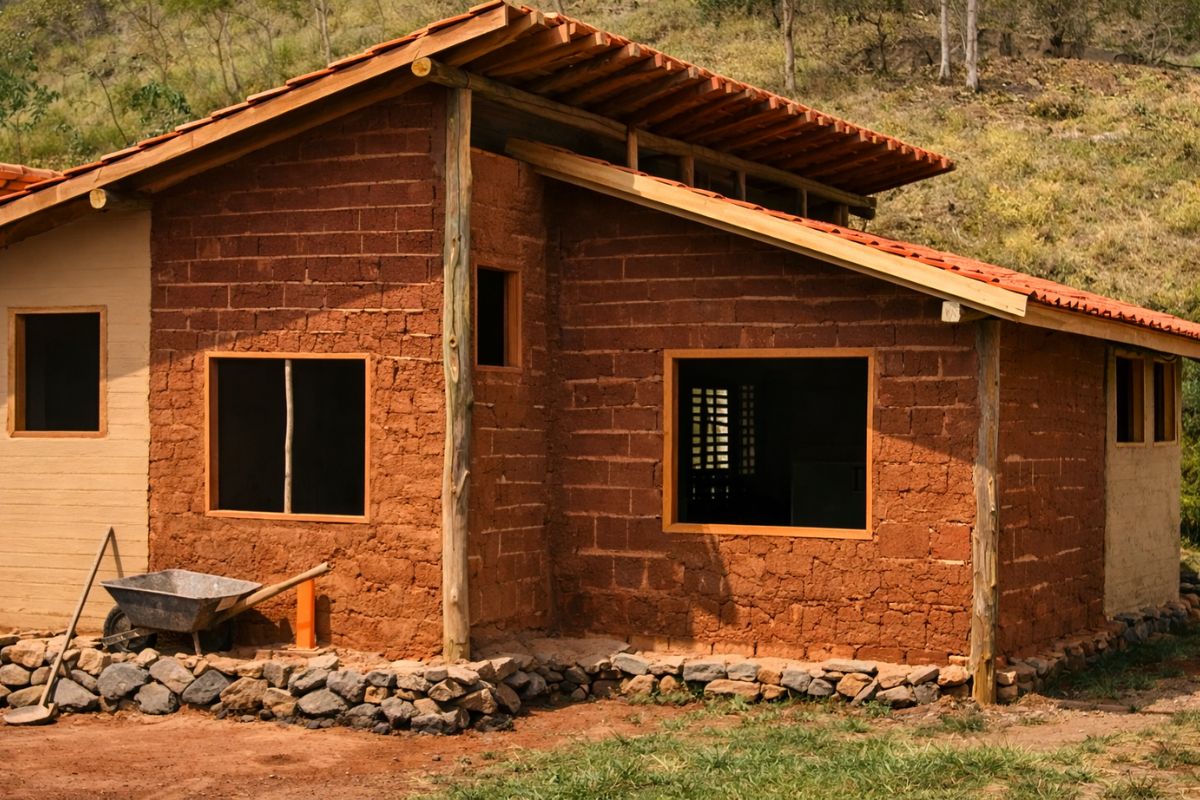


Barreado House Gains Structure With Bamboo, Pounded Clay in a Homemade Machine, Little or No Cement Base, and Built-in Electrical Installation to Deliver Modern Home Comfort.
The barreado house that Renato decided to build is neither an improvised cabin nor a fragile structure. It is a project designed to show that clay, when well worked, can still compete with brick and block when it comes to ensuring comfort and safety. Instead of rejecting what the ancestors did, he decided to understand the technique, adapt it to the present, and prove in practice that a barreado house can be cool, beautiful, and durable.
Instead of a concrete mixer, a simple machine was used to pound the clay. Instead of heavy rebar, well-secured bamboo was used. Instead of thin walls, thick walls emerged, holding the heat outside and keeping the interior more stable. At the same time, Renato made sure to prepare everything to accommodate electrical, plumbing, large windows, and modern finishes, showing that a barreado house doesn’t need to be trapped in the past to function. This account is based on a video from the channel Terra Rosana, and the full video will be included below for those who want to see the construction in detail.

Homemade Machine Transforms Clay Into Uniform Mass
Before raising the first wall of the barreado house, Renato knew he needed to solve the basics. Without well-pounded clay, there is no barreado house that lasts.
-
The lack of welders, electricians, and operators becomes a structural threat in 2025, with the construction industry and manufacturing already suffering from delays, cost pressures, and labor shortages in Brazil.
-
Brazil and Paraguay are just 46 meters away from a historic union on the bioceanic bridge that promises to revolutionize trade between the Atlantic and the Pacific.

-
With 55 km over the sea, a cost of US$ 20 billion, and enough steel to build 60 Eiffel Towers, China’s largest project has connected Hong Kong, Zhuhai, and Macau in a colossal bridge that defies the logic of engineering.

-
A trick with joint compound transforms a Styrofoam ceiling into a plaster-like ceiling: leveled panels, wires and mesh at the joints, sand, paint, and change the environment while spending little today.
The solution was to look at tradition and adapt. Instead of stepping on the clay with his feet, as was done in the past, he built a simple system using a drum, an axle, and an internal paddle.
Inside the drum, a board attached to the axle spins and presses the clay. The setup does the job that was once performed by an animal pulling the tether.
Today, instead of a horse, Renato uses a motorcycle to rotate the system and control the mixture. While the axle cuts, turns, and pounds, he measures the water so the clay is at the right consistency.
The goal is always the same. The clay of the barreado house needs to turn into a homogeneous mass, without clumps and excess water.
If it’s too soft, the wall cracks and falls. If it’s too hard, it doesn’t fit properly in the bamboo framework and loses adhesion. With the improvised machine, he can repeat the mixture, maintain the standard, and ensure quality in each section of the wall.
Bamboo, Clay, and Thick Walls Holding the Structure

With the clay ready, the part that attracts the most attention from those who see the barreado house from the inside begins. No concrete columns dominating the scene. The base was made with stone over stone, fitted carefully and with almost no cement, as was done in older constructions.
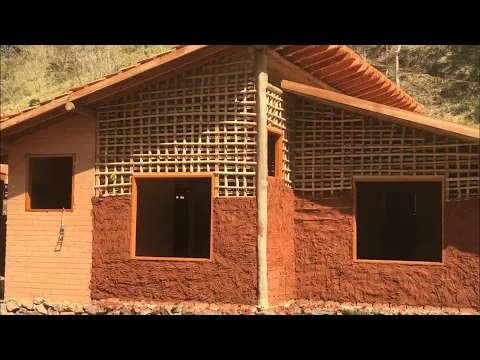
Above that, comes a skeleton of wood and bamboo. The bamboo rods are tied and secured to the structure, forming a sort of lattice panel.
It is there that the mass enters. Renato pounds the clay from the bottom up, respecting gravity and compressing each layer within the framework. The impact makes one piece of clay meet another and fill the gaps.
The walls of the barreado house are thick, heavy, and have a rustic appearance on the outside. Superficial cracks appear in the first days, which is normal for this type of construction. Later, a special plaster made of earth, sand, and lime is applied to level and prepare the surface.
The idea was never to hide that it is clay, but rather to deliver a solid barreado house, aligned and ready to receive quality finishes.
Modern Electrical Installation Inside the Barreado House
One of the biggest challenges in transforming a barreado house into a daily-use home lies in the electrical part. In the past, many constructions of this type didn’t even have wiring in the walls.
Today is different. Renato wants to connect showers, lighting, kitchen outlets, and everything a modern home needs.
The solution was to plan the structure first and only then pound the clay. Before closing the walls, he built the bamboo framework, ran the conduits, secured the outlet and switch boxes in the wood, and kept everything in place. Only then was the clay mass applied around, covering the thick part of the installation.
Later, a plaster of earth, sand, and lime will be added, following the same concept as the outer wall, and finally the paint.
For those looking from the inside, the barreado house will look like any other well-made house, with a power panel, defined points, and safely distributed electrical wiring. The difference is that, behind the finish, there are no bricks. There is well-pounded clay holding it all.
Bathroom and Finishes Considering Practicality
Not everything in the barreado house needs to be clay. In the bathroom, for example, Renato opted for a conventional masonry base, using brick, but with the same mixture of earth, sand, and lime for the finishing. The goal is to ensure resistance where there is constant moisture, without losing the visual integration with the rest of the structure.
The project also calls for larger windows, different from the small openings of old houses. The idea is to better utilize natural light and ventilation, without compromising the structure of the barreado house.
Inside the walls, wooden pieces were placed at specific points, at defined intervals, so that in the future it will be easy to hang shelves, cabinets, and supports without relying only on clay.
Thus, the barreado house gains the appearance of a complete home, with a functional bathroom, large windows, well-planned fastening points, and internal space for the family’s actual use, not just for demonstrating technique.
Thermal Comfort of a Clay House in a Hot Region

While many people associate modern homes with block, slab, and ceramic tile, those who have lived in a clay house know another truth.
The thick earthen wall behaves differently with heat. On hot days, it absorbs and delays the transfer of temperature indoors. In regions with strong sunlight, this makes a difference.
Renato and the residents remember other barreado houses and mud-walled homes from the family, which have already proven this comfort in practice.
In hot climates, the barreado house tends to be cooler than thin and poorly insulated constructions. It’s not a refrigerator, but it reduces the impact of heat and creates a more stable environment throughout the day.
At the same time, the mixture of clay and wood blends with the surrounding landscape. The barreado house fits better into the mountains and the nearby vegetation, avoiding the cold appearance of concrete blocks.
It is a construction that seems to grow out of the very ground, but now comes with electrical wiring, a complete bathroom, and long-term planning.
Tradition, Learning, and the Future of the Barreado House
None of this happens by chance. The knowledge of the barreado house came from observation, conversations with older people, and respect for the techniques of the past. Renato visited old constructions, listened to accounts of houses with decades of use, and adapted what made sense to the current context.
He knows that many people still turn their noses up at the idea of living in a barreado house. Therefore, every detail of the construction serves as a kind of visual argument.
The foundation on stone, well-pounded walls, the closed bamboo framework, the hidden electrical work without improvisation, the planned bathroom, the wood for hanging shelves. All of this shows that the barreado house can be rooted without being precarious, old without being outdated, and simple without sacrificing comfort.
In the end, the project is less a return to the past and more proof that it is possible to choose a different path in construction. Instead of relying solely on cement and block, it’s possible to bring clay back, with criteria, technique, and the help of technology.
And you, would you live in a modern barreado house like this, or do you still prefer to bet only on brick and concrete when building?









Muy bien, gracias por recordarme el concepto casa de arcilla
Renato, faz uma pra mim