





 Portuguese
  English
  Spanish
  4 min of reading
  0 comments


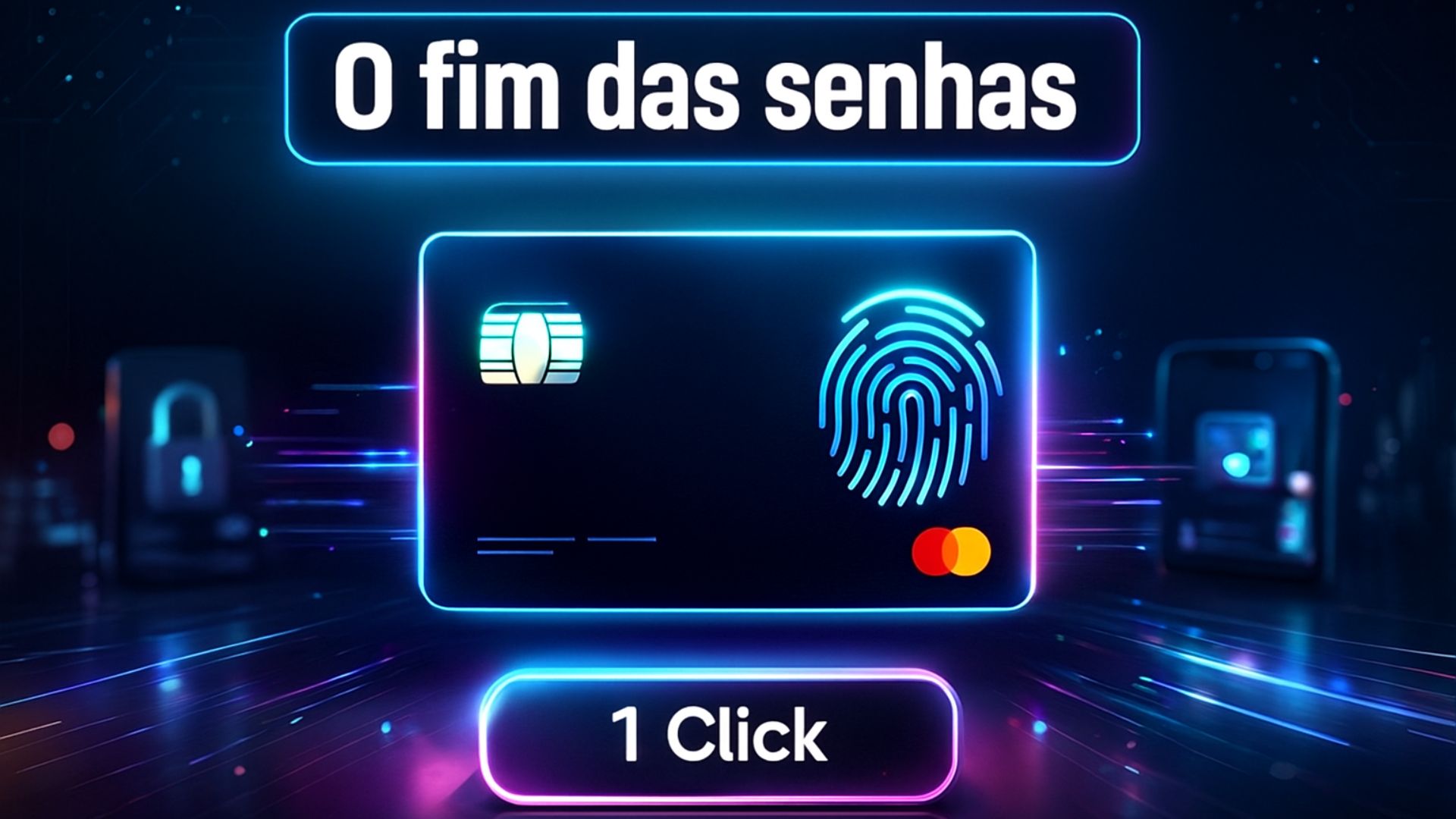
Mastercard Advances in Three Technological Fronts That Promise to Reshape Digital Payments in Brazil and Accelerate the Elimination of Passwords by 2030, Focusing on Tokenization, Biometrics, and Simplified Shopping Experiences.
Mastercard wants to retire passwords for card payments within this decade and projects that this will happen in Brazil before 2030, possibly around 2028.
The strategy, presented by Leonardo Linares, Senior Vice President of Customer Solutions at Mastercard in the country, combines three technologies: tokenization, Click to Pay, and biometric passkeys, which are already starting to gain scale in different points of the payment ecosystem.
According to Linares, more than half of the transactions processed today by the brand in Brazil already occur using tokens, indicating that the migration to a password-free environment is underway.
-
The largest food company on the planet, JBS, has just opened a 4,000 square meter laboratory in Florianópolis to develop customized proteins that modulate muscle mass gain, immune response, and metabolic performance.

-
After nearly 30 bids and competition among industry giants, a Spanish company purchases one of the largest airports in Brazil for almost R$ 3 billion and takes over the management of Galeão in a concession that will last until 2039.

-
The Federal Revenue Service now automatically cross-references everything you declare with data from banks, credit cards, brokerage firms, and insurance companies, and any discrepancy between your income and your expenses triggers an alert in seconds.

-
Amid global tensions, Brazil blocks the United States’ proposal at the WTO and paves the way for a trade crisis and possible retaliations.


The company’s vision is that as these pillars solidify, the payment experience will become simpler for consumers and more secure for merchants and issuers.
Global Password Elimination Goal
Globally, Mastercard has set a goal to eliminate printed numbers on cards and the use of passwords in transactions by 2030, replacing these sensitive data with tokenized identifiers and biometric authentication.
In Brazil, the ambition is to bring this horizon forward, realistically reaching a password-free scenario around 2028, if adoption by partner companies and consumers maintains its current pace.
The shift involves a transformation of the payment infrastructure itself.
Instead of the PAN, the traditional card number, a token circulates, which is an encrypted code representing that credential.
If there is a data leak, it is the token that is exposed, not the real card number, which reduces the potential for fraud.
Linares emphasized during the MobiMeeting Finance+ID 2025 in São Paulo that Mastercard envisions this password-free environment as one where all transactions are expected to be tokenized and associated with more robust authentication mechanisms.
Tokenization as the Basis of Security
Tokenization is presented as the central pillar of the strategy.
In practice, it replaces the real card numbers with unique and dynamic codes, valid only for a specific transaction, device, or merchant.
Even if these codes are intercepted, they cannot be reused in other contexts.
Data released by Mastercard indicates that tokenized operations report lower fraud rates compared to traditional transactions.
In Brazil, the company has already surpassed the mark of half of its transactions being tokenized, demonstrating a relevant base operating under this new model.
The trend is for this proportion to continue growing as issuers, digital wallets, payment gateways, and retailers prioritize tokens.
Click to Pay and Faster Digital Purchases
The second pillar of the strategy is Click to Pay, a solution that allows online payments without the need to enter card numbers, expiration dates, or security codes for each purchase.
Once the tokenized credential is registered, the consumer recognizes the Mastercard button on participating online stores and completes the operation with just a few clicks.
In Brazil, networks like McDonald’s and the event platform Sympla already utilize the feature, providing visibility to the technology in high-volume scenarios.
The proposal is to reduce friction and accelerate conversion in online stores, combining practicality with security based on tokenization and strong authentication.
Even though Click to Pay is not adopted in all cases, Mastercard sees it as an important component to drive migration to a password-free environment.
Passkeys and Biometrics at the Center of the Process
The third element of the plan is the adoption of passkeys, credentials that use biometrics or device PINs to confirm the user’s identity.
In Mastercard’s ecosystem, the idea is to link the card to the consumer’s device and their payment passkey.
This allows purchase confirmation to be made with a fingerprint, facial recognition, or local PIN, without sending passwords to the merchant.
In Brazil, this front is still in its early stages.
Testing began recently and usage is gaining traction as banks, digital wallets, and retailers integrate the necessary APIs.
The expectation is that with the advancement of passkeys in operating systems and browsers, the process will become practically transparent for users.
Authentication via passkeys also accompanies the evolution of mobile devices, especially smartphones and connected watches that centralize validations directly on the device.
Partnerships to Accelerate Adoption
To drive these technologies, Mastercard has partnerships with companies specializing in digital solutions.
In Brazil, Bemobi is one of the participants in the testing and validation phase of initiatives related to tokenization, Click to Pay, and passkeys.
During the MobiMeeting Finance+ID 2025, Bemobi’s CTO and CPO, Felipe Goldin, shared the stage with Linares in a session dedicated to the impact of digital payments.
The aim was to demonstrate how the combination of tokens, biometrics, and simplified journeys can be applied at scale.
These partnerships allow testing flows, measuring conversion impact, observing consumer behavior, and adjusting the journey before mass adoption.
Engagement Is Still the Biggest Challenge
Although infrastructure is advancing rapidly, Linares states that the primary challenge is engaging the ecosystem.
He remarked that he considers “it harder to reach 10 million transactions than 1 billion,” referring to the initial adoption effort.
For the executive, when the main actors are integrated and the user experience is truly simple, the scale will come naturally.
Still, it is necessary to coordinate banks, retailers, technology providers, and security companies, as well as observe local regulations on data protection.
Linares also stated that Mastercard is working towards about 95% of transactions not requiring additional complex authentications, reserving stricter checks only for higher-risk operations.
As tokenization, Click to Pay, and passkeys advance, the question remains about Brazilian consumers’ willingness to abandon passwords altogether and adopt biometrics and digital credentials in their daily lives.







-

Uma pessoa reagiu a isso.