





 Portuguese
  English
  Spanish
  8 min of reading
  0 comments


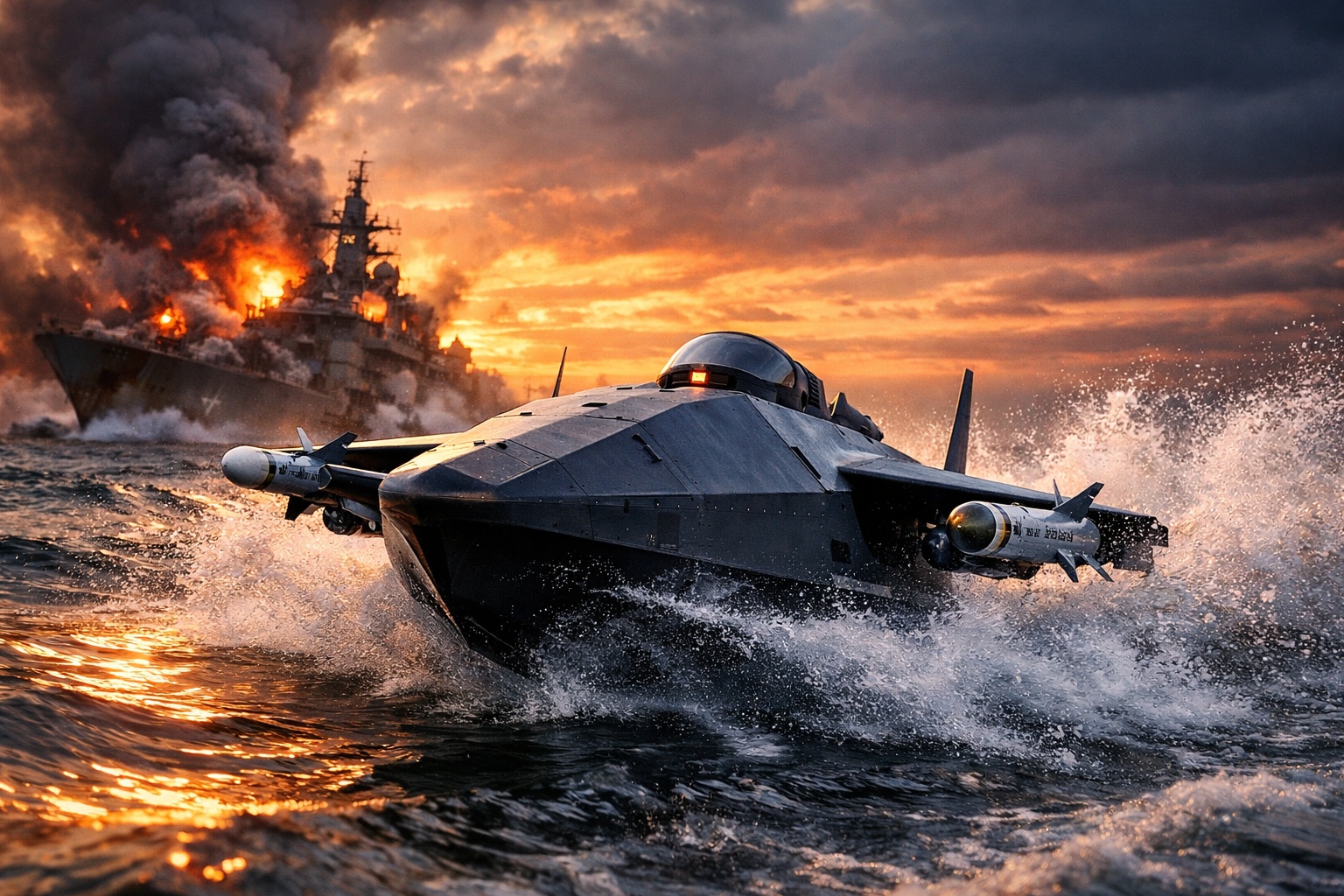
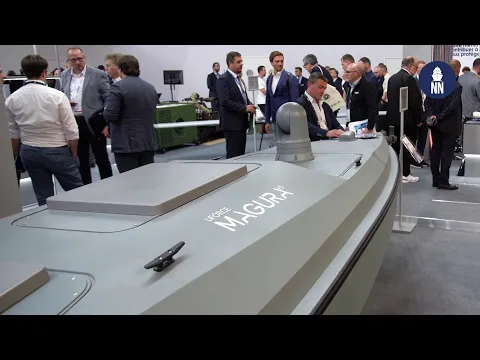
The Magura V5 Highlights The Transformation Of Naval Warfare: Autonomous Surface Drone, Low Cost, And High Strategic Impact Against Conventional Ships.
The war in Ukraine has brought to light a silent revolution in unmanned systems that is completely redefining modern naval warfare. While aerial drones dominate headlines, autonomous surface vessels developed by Ukraine are proving that small, low-cost platforms can challenge billion-dollar conventional fleets. The Magura V5 represents the pinnacle of this transformation, combining stealthy design, lethal payload capacity, and unprecedented operational versatility.
This system reignites discussions about asymmetry in naval conflicts, innovation under extreme pressure, and how accessible technology can neutralize numerical superiority. In the end, what impresses is not only the ability to sink warships but the realization that US$ 273,000 in equipment can eliminate targets costing tens of millions.
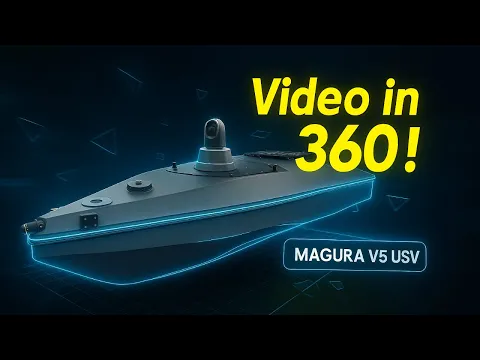
Carbon Fiber Hull With V-Shape Reduces Radar Signature Drastically
The Magura V5 utilizes carbon fiber construction that offers superior structural strength while keeping the total weight below 1 ton when fully loaded.
-
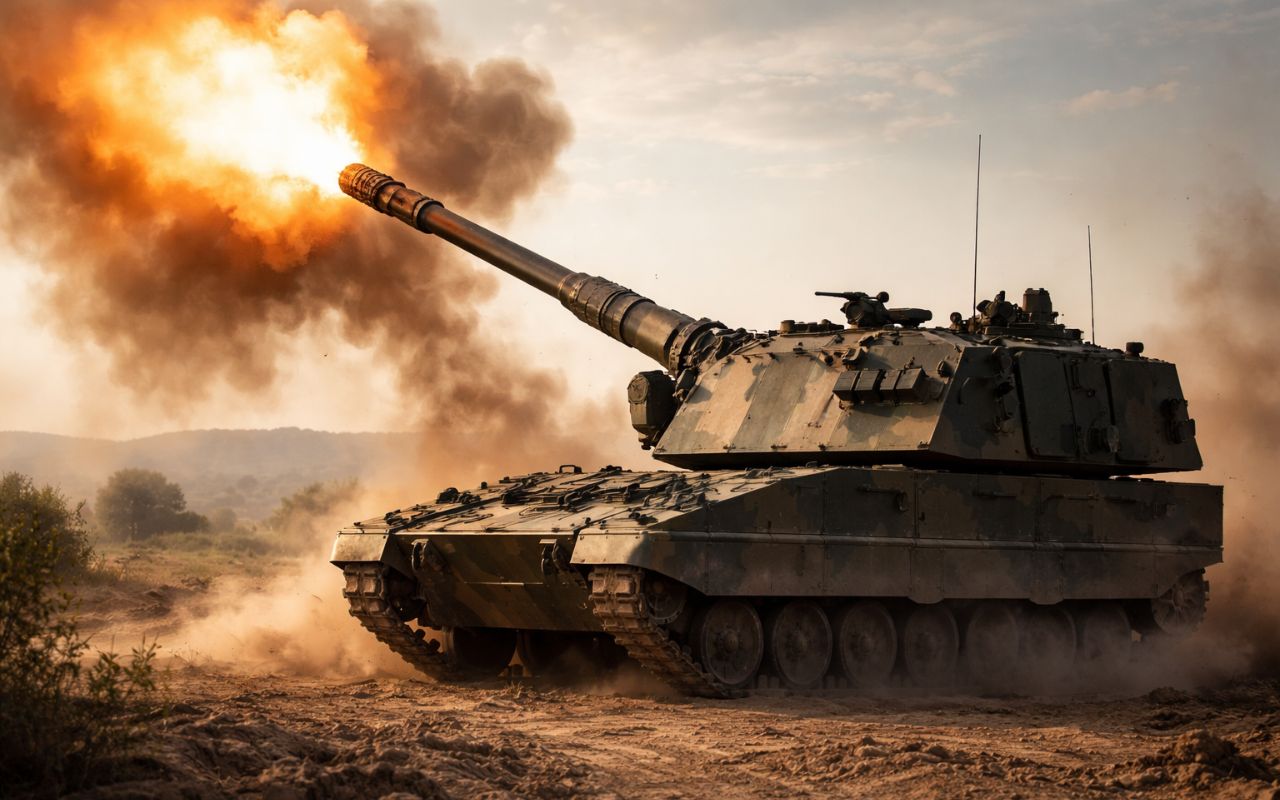
The German “steel monster” weighing 55 tons fires up to 10 projectiles per minute at over 40 km and avoids counterattacks on the battlefield by moving quickly to escape enemy attacks; meet the Panzerhaubitze 2000.
-
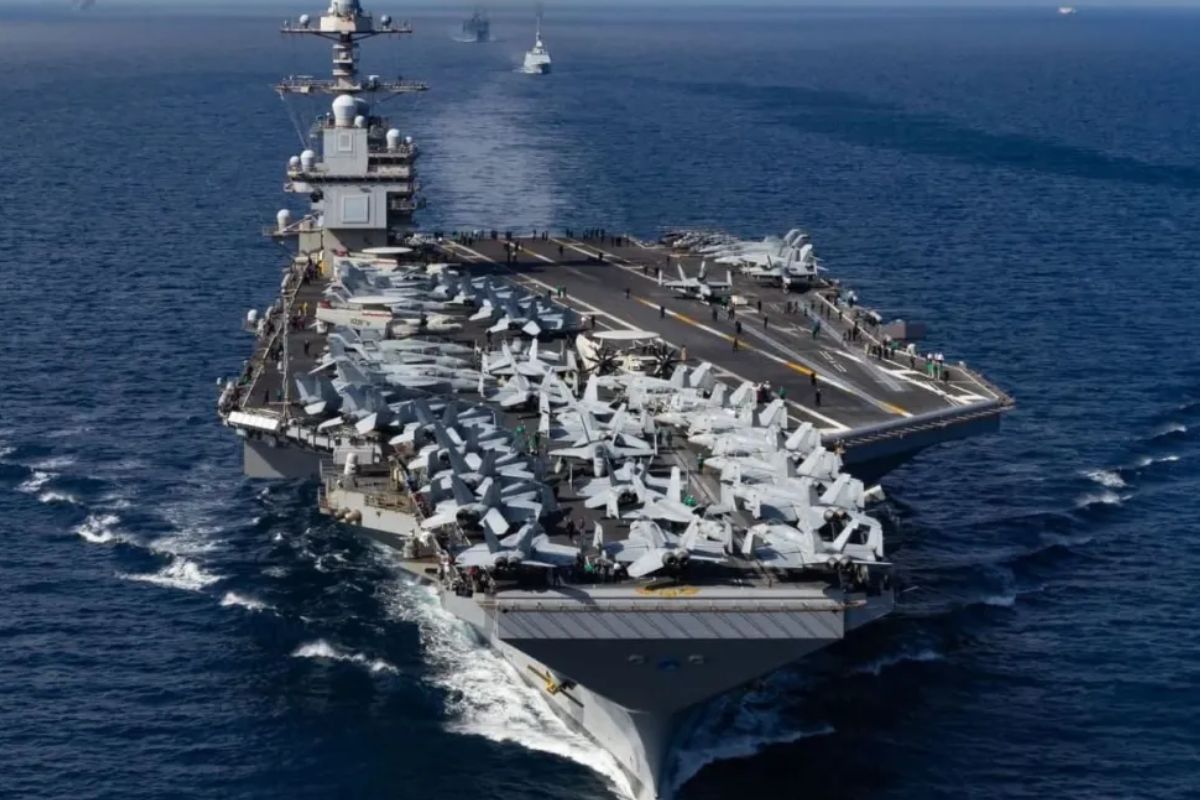
USS Gerald R. Ford, the largest aircraft carrier in the world, returns to sea after a fire in the laundry in the Red Sea; repaired in Crete, it resumes missions of Operation Epic Fury against Iran.
-
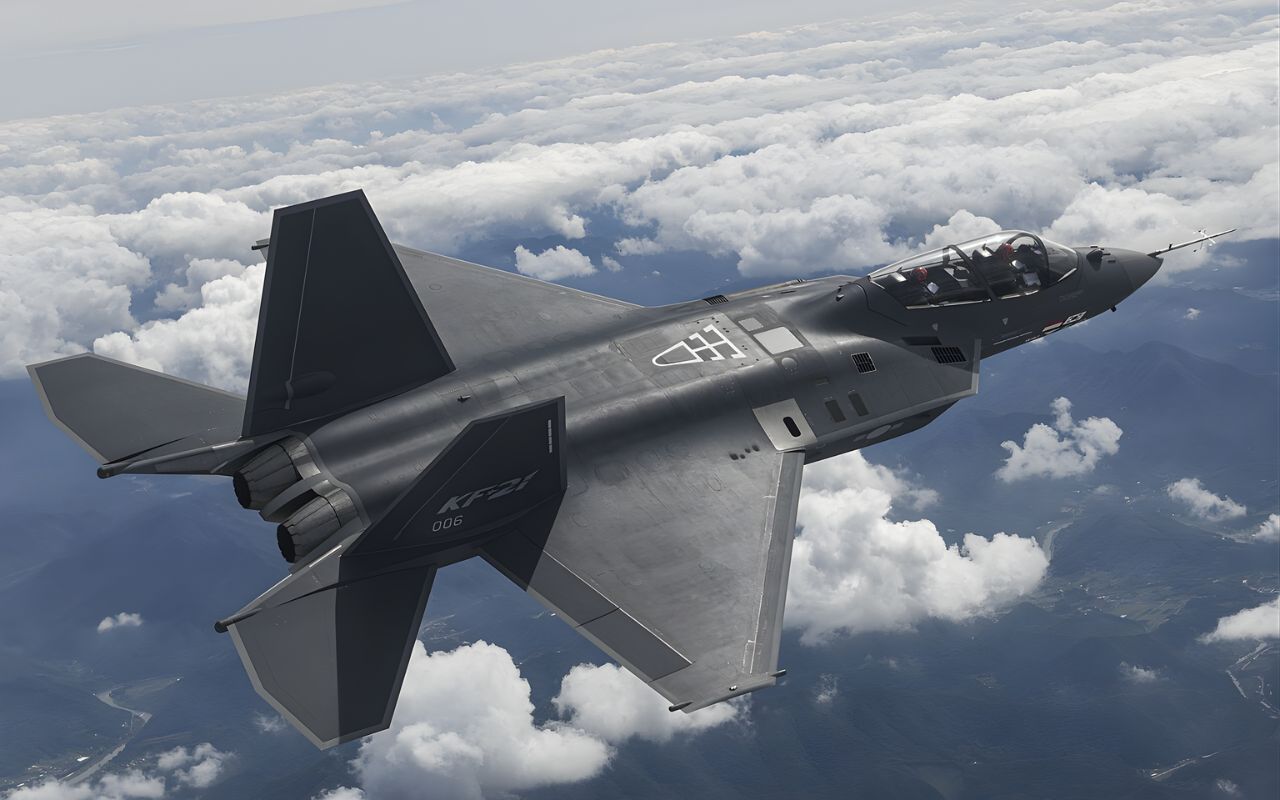
Military power: South Korea’s new KF-21 fighter jet will be a key component in replacing the aging aircraft of the air force, placing the country on the map of air military powers.
-
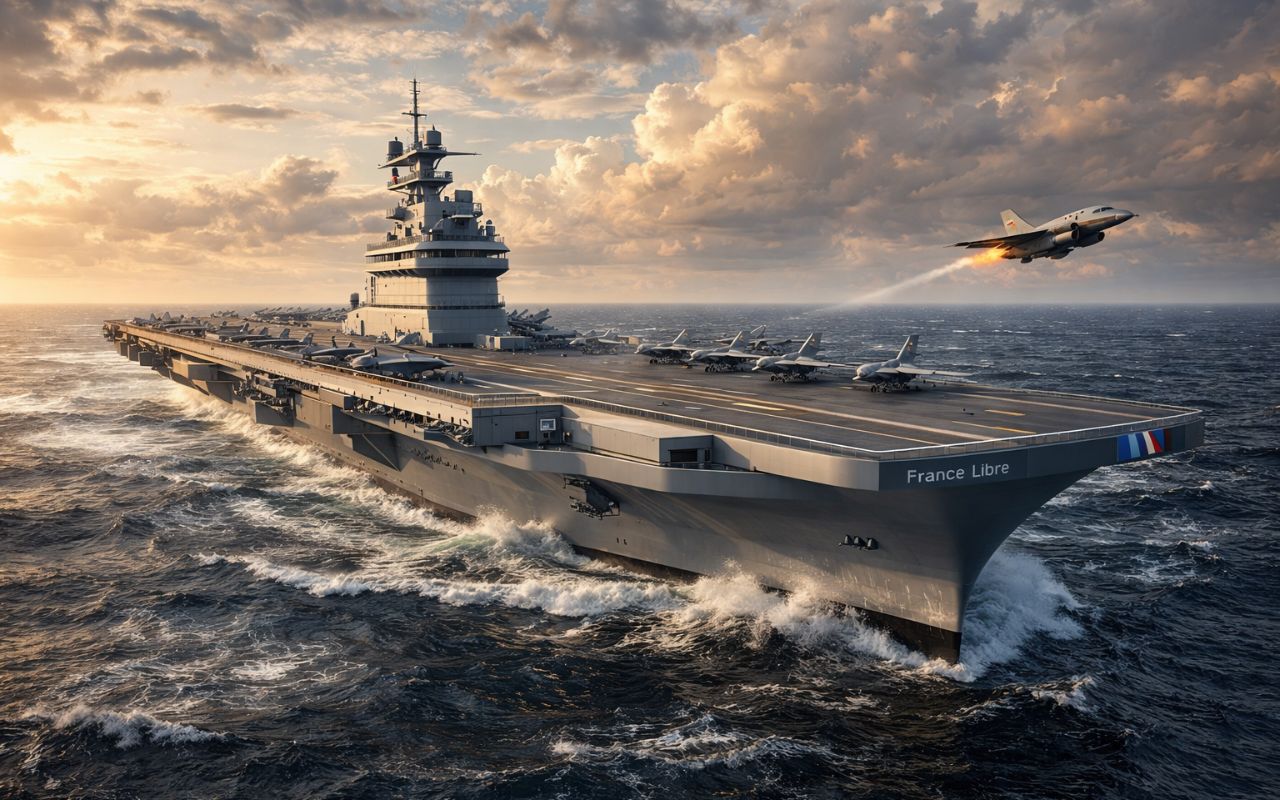
With 310 meters, 80 thousand tons, and capable of operating for 45 years, the new nuclear aircraft carrier France Libre will be the largest in France and will enter service in 2038.

The V-shape of the hull creates a hydrodynamic profile that allows silent navigation through waves while maintaining a waterline height of just 50 centimeters, making visual detection difficult even in calm sea conditions.
The choice of composite plastic materials eliminates radar reflection produced by conventional metals, making the vessel virtually invisible to standard detection systems used by warships.
Minimal thermal emission from the waterjet propulsion engines complements the stealth profile, preventing infrared sensors from identifying the threat until extremely short distances where evasion becomes impossible.

The compact design of 5.5 meters in length and 1.5 meters in beam allows launch from any remote shore without the need for complex infrastructure. This operational flexibility stands in stark contrast to the limitations of large ships that depend on specific ports, specialized docks, and heavy logistics to engage in combat.
Payload Capacity Of 320 Kg Carries Explosives Or Missile Systems
The Magura V5 platform was designed from the outset as a modular system that accommodates different mission configurations as needed tactically.
Maximum payload of 320 kilograms allows for the transport of conventional explosive warheads mounted at the bow with impact fuses that detonate upon contact with enemy hulls, causing catastrophic damage below the waterline where armor is weakest.
Alternative configurations include mounting heavy machine guns for suppression of close defense systems, guided anti-tank missiles for precision strikes against specific structures, or air defense systems that completely transform the operational role of the platform.
This versatility eliminates the need to develop multiple types of specialized vessels, reducing development costs and simplifying the logistics chain.
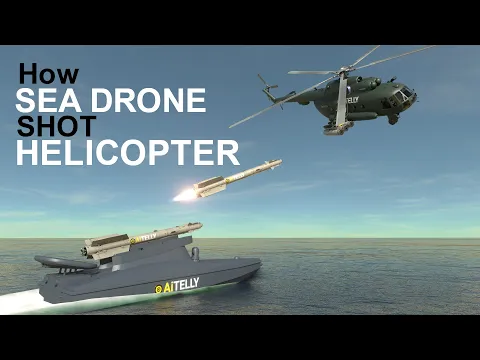
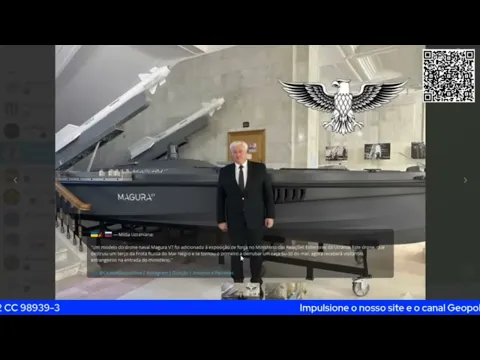
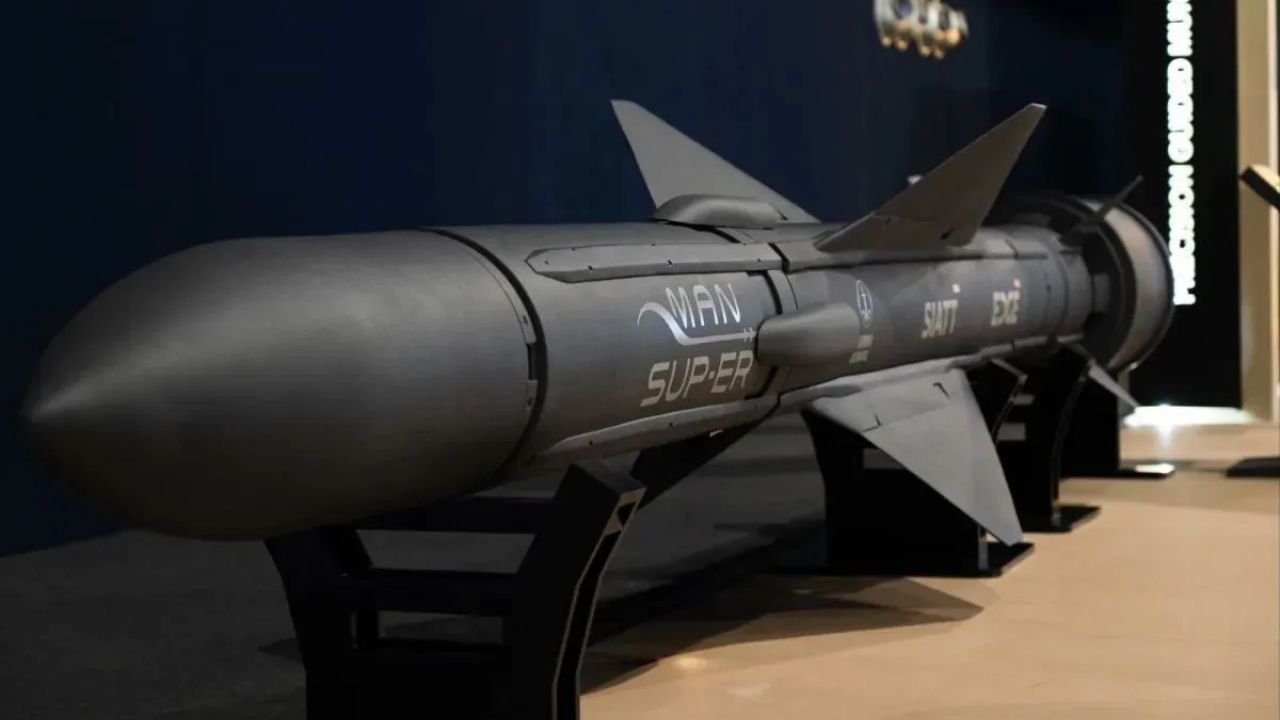
The integration of launchers for R-73 SeeDragon missiles, and later AIM-9 Sidewinder, marks a revolutionary evolution that expands the operational envelope of the Magura beyond surface targets. The Magura V7 variant increases displacement to 3.7 tons when fully loaded and extends the length to 7.3 meters, accommodating two air-to-air missiles on launch rails mounted on the upper structure.
Operational Range Of 800 Km Allows For Deep Strikes Into Enemy Territory
The fuel autonomy of the Magura V5 extends its range to 800 kilometers from the launch coast, putting the entire Black Sea within the attack envelope. This projection capability forces adversaries to disperse defenses over a much larger area than conventional fleets would require, diluting the effectiveness of protection concentrated at specific strategic points.
Cruising speed of 41 km/h balances fuel consumption with transit time, while a maximum speed of 78 km/h provides sprint capability during target approach or evasion from detected threats.
Operational reports suggest that speed peaks can reach up to 100 km/h in ideal conditions when propulsion operates under temporary overload.
Sixty hours of endurance at economical speed permits long-duration patrols or pre-positioning in attack zones before the arrival of opportunity targets.
This persistence transforms the Magura from a direct strike weapon into a surveillance platform that can await ideal tactical windows without compromising lethal capability when the right moment arises.
GPS, Inertial, And Visual Navigation Systems Ensure Precision In Jamming Environments
The sensor package of the Magura V5 combines multiple redundant navigation systems that maintain operational capability even when adversary electronic warfare attempts to degrade guidance. Primary navigation via GNSS satellite provides positioning accuracy in normal conditions, but inertial systems automatically take control when GPS signals experience interference or are completely denied.
Visual navigation through electro-optical cameras allows remote operators to conduct final approach using high-definition video transmission. Three simultaneous HD video streams provide multiple perspectives that enhance situational awareness and reduce blind spots during the critical attack phase where margin for error is zero.
256-bit encryption protects communication channels from enemy interception or manipulation. Mesh radio communication with airborne repeaters or satellite links ensures connectivity resistant to jamming through multiple transmission paths that dynamically adapt as electromagnetic spectrum conditions change during the mission.
First Naval Drone In History To Destroy Helicopter In Combat
On December 31, 2024, the special unit Group 13 of the Ukrainian Main Intelligence Directorate executed an unprecedented attack using the Magura V5 equipped with an R-73 SeeDragon missile.
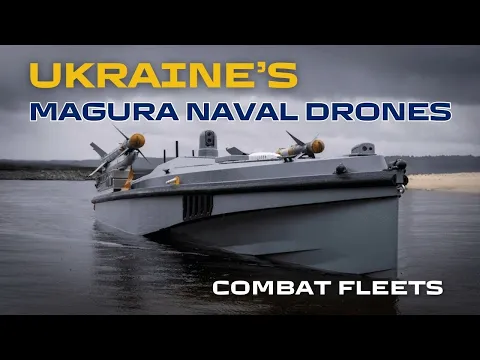
A Russian Mi-8 helicopter was destroyed near Cape Tarkhankut in occupied Crimea, marking the first time in military history that a maritime drone successfully engaged a moving aerial target.
The technical complexity of this interception cannot be underestimated. Helicopters are fast and maneuverable targets that appear on the horizon with only a few minutes of warning, requiring instantaneous calculation of the ideal launch position and precise interception trajectory. The commander of Group 13 confirmed that the temporal margin was minimal and the missile struck the target on the first attempt after careful positioning of the platform.
Subsequent evolution with the Magura V7 variant armed with AIM-9 Sidewinder missiles culminated in May 2025 when three drones shot down two Russian Su-30SM fighter jets 50 kilometers off the coast of Novorossiysk. The pilots of the first jet successfully ejected and were rescued by a civilian ship, while the crew of the second was killed.
Each Su-30 has an estimated cost of US$ 50 million, demonstrating a brutal asymmetric return where platforms costing US$ 273,000 eliminate assets that are fifty times more expensive.
Eight Ships Sunk And Six Damaged In First Operational Year
The combat history of the Magura V5 has transformed the balance of power in the Black Sea irreversibly. In February 2024, drones sank the missile corvette Ivanovets class Tarantul-III and the tank landing ship Tsezar Kunikov class Ropucha of 4,000 tons.
These were the first warships in history sunk by naval drones in direct combat.
A subsequent attack in November 2023 destroyed the Serna class landing ship and the Akula class vessel docked at the Russian naval base in Chornomorske in western Crimea. May 2023 marked the first public appearance when three Maguras attacked and damaged the Ivan Khurs class Yuriy Ivanov intelligence-gathering ship of 4,000 tons sailing hundreds of kilometers from the Ukrainian coast.
In the first year after becoming public, Magura V5 drones operating in suicide attack mode reportedly destroyed eight Russian warships and damaged six others, causing over US$ 500 million in damages to the fleet.
This performance forced Russia to reposition naval assets to more distant ports and dramatically increase perimeter defense spending, reducing the operational effectiveness of the navy in the conflict theater.
Domestic Production Of 50 Units Monthly Ensures Operational Sustainability
Ukraine has developed industrial capacity to domestically manufacture up to 50 Magura V5 drones per month when necessary, eliminating dependence on external suppliers and ensuring a constant flow of replenishment for operational losses.
Unit costs between US$ 250,000 and US$ 273,000 make the program financially sustainable even with a defense budget limited compared to adversaries.
The state company SpecialTechnoExport coordinates development and production in partnership with private entities that previously worked with the Security Service of Ukraine.
Divergences over technical specifications and budget led to the separation of programs, resulting in two parallel lines of naval drones – Magura operated by Military Intelligence and Sea Baby controlled by the Security.
Production capacity at scale allows for swarm tactics where multiple drones attack simultaneously, overwhelming the point defenses of target ships. Decoy drones create chaos and disperse defensive fire while main units with full warheads execute decisive strikes against vulnerable points identified during coordinated approach.
Modular Design Allows Rapid Adaptation To New Emerging Threats
The modular architecture of the Magura facilitates the integration of new weapon systems and sensors as operational requirements evolve during prolonged conflict. The Magura V6P variant introduces a multi-role configuration that can switch between attack, reconnaissance, electronic warfare, or launching unmanned underwater vehicles without the need for a complete redesign of the base platform.
Upgrading to the Magura V7 demonstrates the scalability of the concept, with a 270-horsepower diesel engine replacing the original propulsion and increasing payload capacity to 635 kilograms.
This larger version accommodates a turret with a mounted machine gun or a preferred configuration with two AIM-9 Sidewinder missiles, transforming the naval drone into a mobile anti-air system that denies airspace over contested maritime zones.
Continuous development explores possibilities of adding additional capabilities such as integrated air defense systems, active electronic countermeasures, or anti-submarine warfare sensors. The manufacturer and the Main Intelligence Directorate confirm they are actively exploring ways to further expand the platform beyond the already impressive operational envelope demonstrated in real combat.
Asymmetric Cost-Effectiveness Redefines Naval Investment Calculations
The cost-effectiveness relationship of the Magura V5 establishes a new paradigm in naval capability acquisition. A US$ 273,000 platform that sinks a US$ 50 million warship represents an investment return of 183:1 even before considering crew costs, training, maintenance, and support infrastructure that conventional ships require.
This radical economy forces a reevaluation of traditional naval shipbuilding strategies where navies invest billions in a few capital ships that become extremely vulnerable high-value targets. The proliferation of cheap, lethal naval drones suggests that the future belongs to distributed fleets of small unmanned platforms operating in coordinated swarms rather than concentrating on a few expensive manned assets.
The Ukrainian model proves that nations with limited resources can develop anti-access capabilities that deny maritime control to adversaries with military budgets dozens of times larger. This democratization of naval power has profound strategic implications for regional power balances and deterrence calculations in contested maritime zones around the world.









-

-

3 pessoas reagiram a isso.