Portuguese
  Spanish


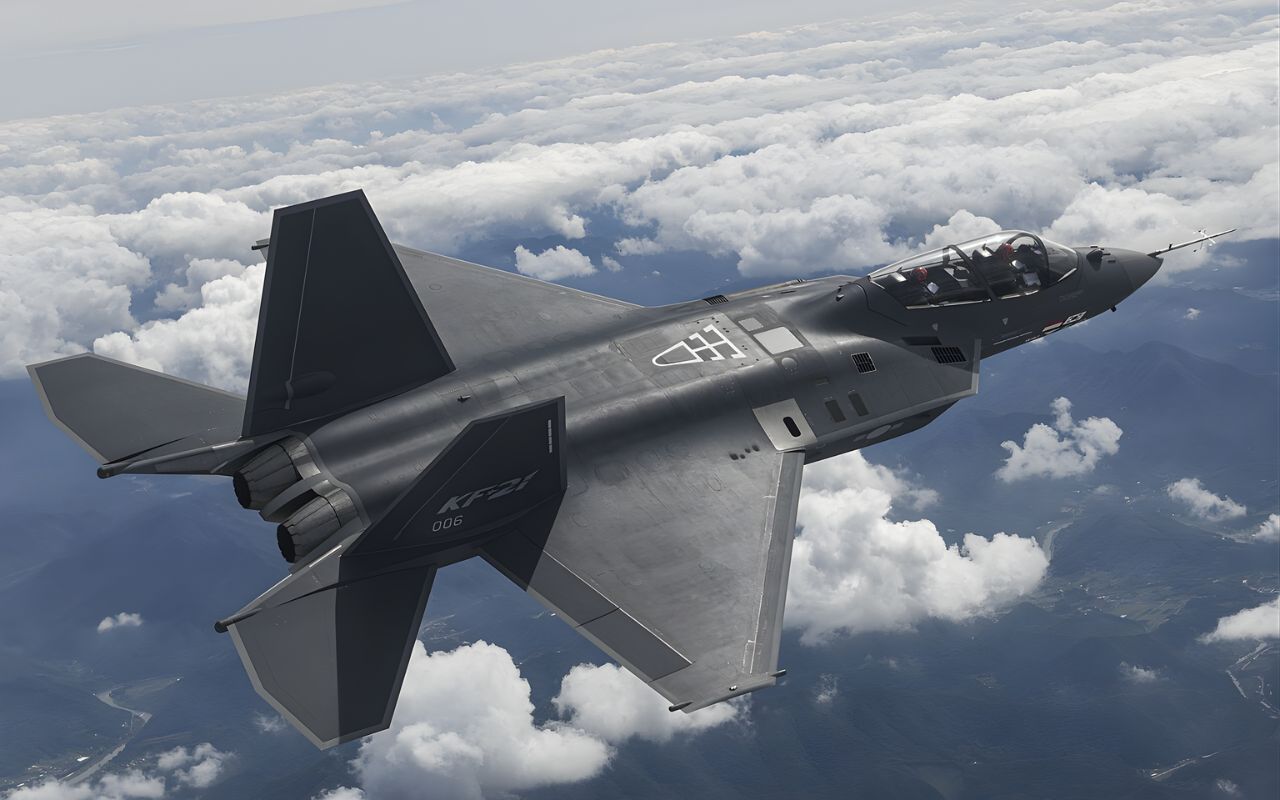

KF-21 Fighter Enters Serial Production in South Korea, Accelerates Air Force Modernization and Expands Global Ambitions of the Country.
South Korea took a strategic step by unveiling the first serial production KF-21 fighter during a ceremony held in Sacheon. The event brought together officials, including President Lee Jae Myung, and marked the beginning of a new operational phase of the program.
The aircraft, which is expected to enter service later this year, was developed to modernize the air force, replace older models, and expand the country’s military autonomy.
Additionally, the project strengthens the local industry and paves the way for exports.
-
Brazilian Air Force Seeks to Acquire More Gripen Fighter Jets

-
U.S. Air Force Launches Air-to-Air Missile Project with Range of Up to 1,850 km for Indo-Pacific Operations

-
Australia to Deploy Up to 8 Nuclear-Powered Submarines in Indo-Pacific, Establishes Billion-Dollar Naval Chain Through AUKUS, Joining Elite Group Capable of Extended Underwater Missions
-
Indonesia Begins Construction of 2,000-Ton Scorpène Stealth Submarines with Advanced Weaponry and French Steel




KF-21 Fighter Project Born with Global Ambition
Launched in 2016, the KF-21 program was conceived with a clear goal: to place South Korea among the leading developers of military technology in the world.
With an estimated investment of $12 billion, the project quickly became one of the most relevant in the Asian aerospace sector.
From the beginning, the proposal was to combine technological capability with economic viability.
Moreover, the country sought to reduce its dependence on foreign suppliers, strengthening its sovereignty.
Accelerated Evolution Leads KF-21 Fighter to Serial Production
The development of the KF-21 fighter has progressed consistently. The first flight occurred in July 2022, still in the prototype phase.
Just over three years later, the program reaches an important milestone: serial production. This indicates that the aircraft is ready for operational use.
The model presented is a two-seater, identified as 26-001. This type of configuration is essential for training and specific missions.
The arrival of the KF-21 fighter occurs amid a broad modernization of the air force. Older aircraft are being gradually retired from service.
Among them, the F-4 Phantom II and the F-5 Tiger II stand out, as they no longer meet current demands.
Meanwhile, the new fighter will operate alongside modern models. These include the F-35 Lightning II, the F-15K Slam Eagle, the KF-16 Fighting Falcon, and the FA-50 Golden Eagle.
International Partnership Expands Reach of KF-21 Fighter
The KF-21 program also has international participation. Indonesia is a partner in development and intends to acquire 16 aircraft.
The agreement provides for financing about 20% of the project. However, delays in payments have created uncertainties about the country’s level of commitment.
Still, the partnership demonstrates the global potential of the KF-21 fighter and its attractiveness in the international market.
KF-21 Fighter Technology Combines Innovation and Pragmatism
The KF-21 fighter features a design inspired by advanced aircraft, such as the F-22 Raptor.
However, in the initial versions, the armaments are carried externally. This limits stealth, as it increases radar detection.
On the other hand, future versions are expected to incorporate internal weapon compartments. This evolution will significantly enhance the aircraft’s stealth capability.
Thus, the project follows a gradual approach, balancing cost and performance.
Production of KF-21 Fighter Strengthens South Korean Industry
The entry into production of the KF-21 fighter represents an important advancement for the local industry. Although it uses some foreign components, the development was led internally.
This allows for greater control over strategic technologies. Additionally, it reduces external dependence in military decisions.
As a result, South Korea expands its operational capacity on the global stage, both as an operator and as an exporter.
The expectation is that the KF-21 fighter will continue to evolve in the coming years. New versions are expected to bring improvements in stealth, sensors, and system integration.
With information from TecnoDefesa