





 Portuguese
  English
  Spanish
  3 min of reading
  0 comments


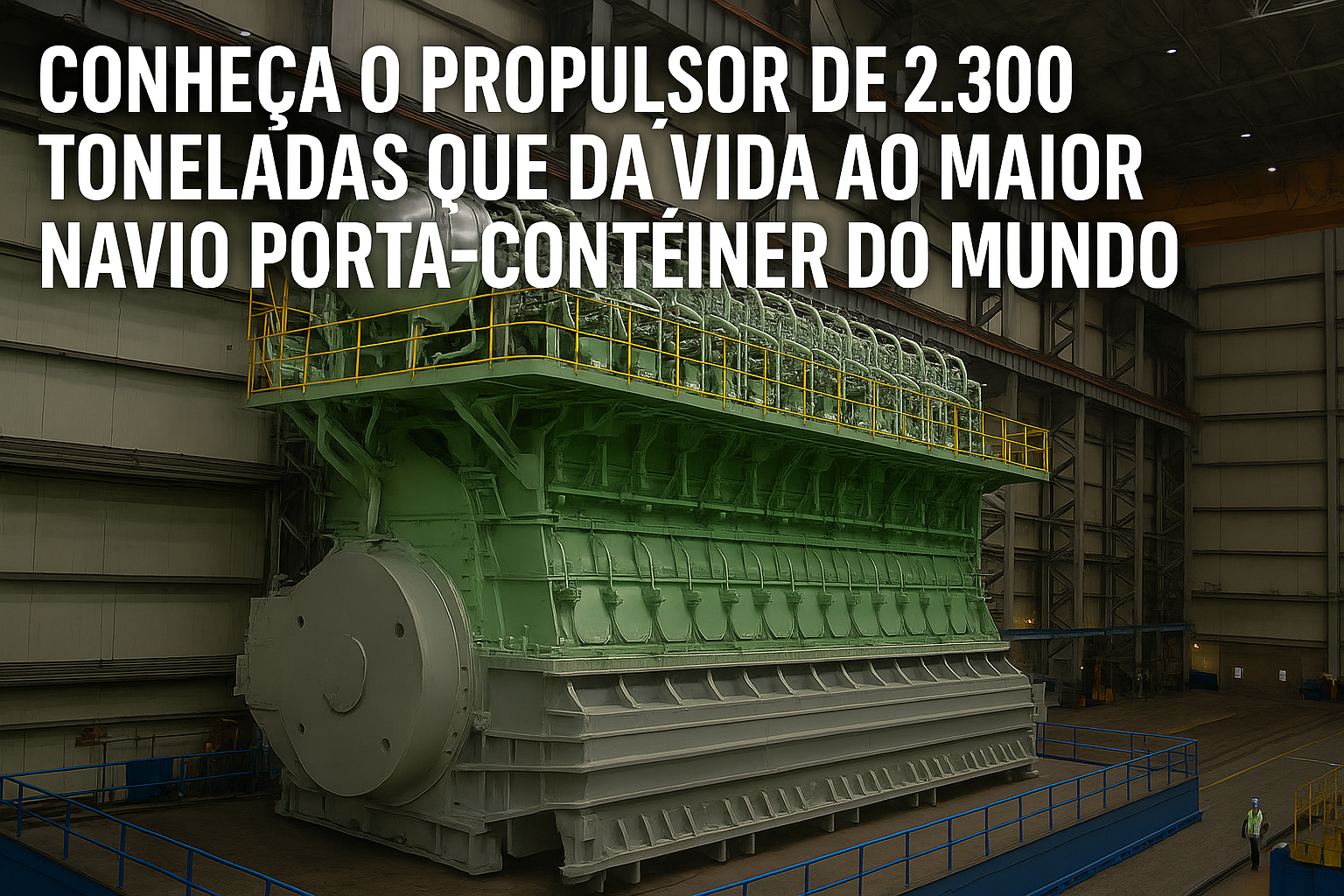
Discover the 2,300-Ton Thruster That Powers the Largest Container Ship in the World. With 107 Thousand HP and Colossal Torque, This Giant Maritime Engine Is a Masterpiece of Naval Engineering.
Imagine an engine so large and powerful that it alone weighs more than a large aircraft and costs the equivalent of a fleet of 150 Ferraris. This is the 2,300-ton thruster responsible for bringing to life the largest container ship in the world.
This is a true engineering colossus: a 14-cylinder in-line maritime engine capable of generating over 107 thousand hp, with an estimated torque of 7 million Nm, operating at very low RPM. More than just an engine, this thruster is the technological heart of vessels that cross oceans transporting thousands of tons of cargo.
Technical Specifications of the 2,300-Ton Thruster


The engine that powers the largest container ships on the planet has impressive numbers:
-
Luciano Hang revealed that Havan’s air fleet has already accumulated more than 20,000 landings, 10,000 flight hours, and 6 million kilometers traveled, and he says that without the planes, the company would never have grown so quickly.

-
A historical discovery in the Andes Mountains reveals a gold deposit valued at 770 billion reais hidden over 4,000 meters above sea level on the border between Chile and Argentina, and the whole world is watching.

-
With just joint compound, white glue, and pigment, you can make a homemade paint that yields double the conventional amount, saves up to 70%, and leaves the wall with a finish that no one would believe wasn’t store-bought paint.

-
Home environment can influence the brain, mood, and well-being: studies indicate an increase of up to 15% in productivity, a reduction of 12% in stress with plants, and a direct impact of the circadian rhythm on the 24 hours of the day.


- Number of Cylinders: 14 (in-line)
- Height: ~13.5 meters (up to 15 meters including peripheral systems)
- Length: ~27 meters
- Width: ~5.5 meters
- Weight: about 2,300 tons
- Total Displacement Capacity: exceeds 357,000 liters (25,480 liters per cylinder)
This true sea machine reaches:
- Maximum Power: approximately 107,390 hp (80 megawatts)
- Torque: about 7,000,000 Nm
- Revolutions per Minute: from 22 to 102 rpm (great for direct coupling to the propeller)
Why Is the Container Ship Engine So Big?
A giant maritime engine like this is necessary to move vessels that carry over 20 thousand containers and can measure more than 400 meters in length. The very high torque at very low RPM allows for direct coupling to the main propeller, eliminating the need for reduction gears and increasing efficiency.
Additionally, the engine is designed to operate for long periods under maximum load, facing adverse sea conditions with robustness and reliability.
The Technology Embedded in the Largest Maritime Thruster in the World
This maritime thruster impresses not only with its size but also with its technology:
- Electronic Fuel Injection: improves combustion control, reduces pollutants, and optimizes consumption.
- Heat Recovery System: utilizes exhaust gases to heat water and generate steam, enhancing the ship’s overall efficiency.
- Fuel Flexibility: operates on heavy fuel oil (HFO) and can be adapted to low-sulfur fuels or dual-fuel systems.
The average consumption is around 163 g/kWh, a surprisingly low number given the engine’s capacity and the volume of cargo it moves.
The Cost: Why Does It Equate to 150 Ferraris?
Producing and installing a 2,300-ton thruster with these specifications is a challenge that involves noble materials, specialized labor, and complex machining and assembly processes.
The estimated final value of this engine reaches the equivalent of 150 Ferrari supercars, giving a sense of the level of investment needed to operate the largest container ship in the world.
This cost, however, is justified by operational efficiency. Even with such a large engine, the consumption per ton transported is relatively low, making large container ships one of the most economical and sustainable ways to transport goods globally.
The Environmental Impact and Advances in Sustainability
The shipping industry faces the challenge of reducing emissions and increasing energy efficiency. Therefore, the new container ship engines integrate emission control technologies, the use of alternative fuels, and energy recovery.
Companies invest in:
- Exhaust Gas Filters and Scrubbers
- Dual-Fuel Systems (HFO + Natural Gas)
- Route Planning to Optimize Consumption
These innovations help reduce the environmental impact even in engines of monumental dimensions.
The 2,300-ton thruster that powers the largest container ship in the world is one of the greatest achievements of modern engineering. With its 14 in-line cylinders and cutting-edge technology, it is responsible for driving global trade, connecting continents, and ensuring market supply.
Its size, power, and sophistication demonstrate how the shipping industry has evolved to combine efficiency, sustainability, and the ability to move at a monumental scale.






-

-

-

7 pessoas reagiram a isso.