





 Portuguese
  English
  Spanish
  5 min of reading
  0 comments


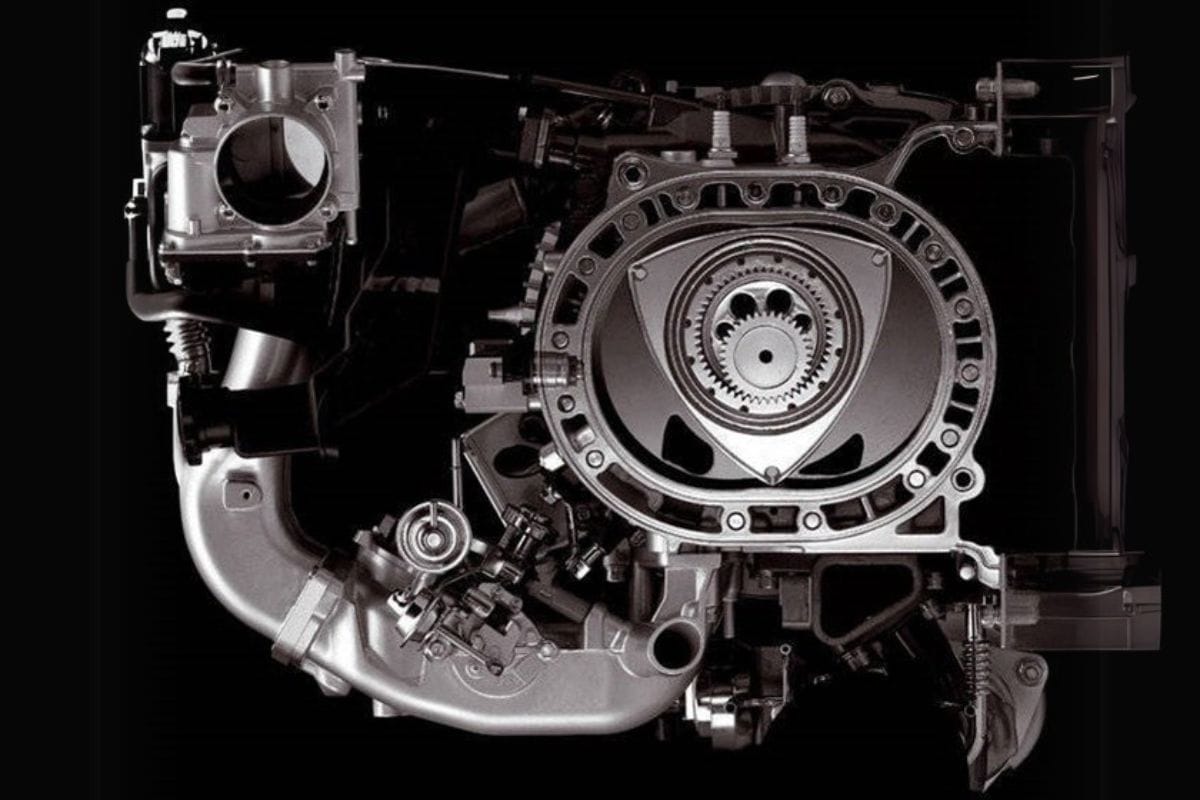
Lighter, More Compact, and with Absurd Rotation: The Rotary Engine That Doesn’t Use Pistons and Was Even Banned from the Tracks for Being Too Good
If you’ve ever heard that different sound coming from an old Mazda car or been curious seeing a piston-less engine on the track at Le Mans, then you’ve encountered the eccentric and brilliant world of rotary engines, also known as Wankel engines. Forget everything you know about conventional engines, because this one throws the engineering manual out the window and does everything its own way.
What Is a Wankel Rotary Engine?
Instead of pistons moving up and down, the Wankel engine works with a rounded triangular rotor that spins within an oval chamber (or better, an epitrochoid, if you want the fancy name). This rotor spins around an eccentric axis and creates, during its rotation, the four stages of the combustion engine: intake, compression, combustion, and exhaust. All of this happens continuously, smoothly, and without the banging of pistons going back and forth.
This design was invented by German engineer Felix Wankel in the 1950s, and it seemed to promise the future: fewer moving parts, smooth operation, reduced weight, and a compact footprint ideal for small sports cars. But, as not everything is rosy in the engine world, some problems came along as well (we’ll talk about that shortly).
-
600 km with three Chinese plug-in SUVs, same mode and air conditioning on: Jaecoo 7, BYD Song Plus, and Haval H6 hit the road, and the pump reveals who was truly the most economical.
-
With a price almost R$ 100 thousand lower, the Haval H9 surpasses the SW4 for the first time in March, but Toyota still leads in the accumulated total for 2026; the Chinese SUV bets on technology and premium finishing to compete at the top.
-
6 used cars that cost less than a new Honda CG 160 Titan and still provide trunk space, four seats, and comfort that many new motorcycles cannot offer.
-
Caoa Chery Tiggo 5X skyrockets in sales in Brazil: a 2,318% increase and waiting lists of up to 4 months to acquire the model.


Technical Advantages of the Rotary Engine
The Wankel has a few aces up its sleeve that make any engineer raise an eyebrow:
- High Power-to-Weight Ratio: The engine is compact and lightweight. A Wankel block weighs much less than a conventional engine with the same power.
- Less Vibration: Since there are no parts moving back and forth, the engine spins continuously. This means less vibration and smoother operation.
- Higher Revolutions Per Minute (RPM): These engines love to rev high. Some models reach 9,000 RPM or more, contributing to aggressive power delivery in sports cars.
- Compact Design: This allows the engine to be placed in a lower, more centralized position, aiding the car’s balance.
But Not Everything Is Perfect…
The Wankel also has its flaws — and they are not few:
- High Fuel Consumption: These engines drink fuel like there’s no tomorrow. Their thermal efficiency is lower, so range goes down the drain.
- High Emissions: The shape of the combustion chamber and the way the rotor spins make it difficult to achieve perfect combustion of the air-fuel mixture, generating more pollutants.
- Seal Wear: The famous “apex seal”, which is the tip of the rotor that maintains sealing in the chambers, often suffers quite a bit. This affects durability and efficiency.
- Low Torque at Low RPMs: Despite spinning high, torque delivery at low RPMs tends to be quite timid.
Cars That Used (or Still Use) Rotary Engines
If there’s one brand that embraced the Wankel engine like no other, it’s Mazda. The Japanese fell in love with the idea and launched some of the most iconic models with this type of engine.
- Mazda Cosmo Sport (1967): First Mazda car with a rotary engine. A futuristic sports car at the time.
- Mazda RX-7 (1978–2002): Probably the most well-known car with a Wankel engine. The RX-7 went through three generations and became a legend among gearheads. Especially the FD generation, with its 13B-REW twin-turbo engine, which is still revered by drift and tuning fans.
- Mazda RX-8 (2003–2012): Came with the Renesis engine, which improved emissions but still suffered from fuel consumption. It was the last mass-production car with a rotary engine.
And there’s more: in 2023, Mazda relaunched the rotary engine as a range extender in the MX-30, an electric car. It doesn’t drive the wheels directly but serves to generate electric power when the battery is running low. A creative way to keep the Wankel alive in times of electrification.

Wankel Engines in Competitions: Le Mans and Others
The cherry on top of this story was placed in 1991, when Mazda drove the world wild with the victory at the 24 Hours of Le Mans with the Mazda 787B, a prototype powered by a quad-rotor 26B rotary engine with about 700 horsepower. It was lightweight, powerful, and screamed with its unmistakable sound, almost like a metallic banshee wail.
It was the first (and only) time a car with a rotary engine won Le Mans, and also the first victory for a Japanese brand in the race. After that, the FIA changed the rules and banned rotary engines from the competition. Coincidence? Maybe not…
In addition to Le Mans, the RX-7 shone on the tracks of IMSA, Group B, and Touring Car, always standing out for its lightness and agility, although it wasn’t the king of reliability.

The Future of the Rotary Engine
Many thought the Wankel had been buried, but Mazda still has faith. The company continues to register patents and develop versions of the engine to function with hydrogen, hybrids, and as generators for electric cars.
Moreover, there are startups and smaller companies betting on drones, motorcycles, and ultralight airplanes with rotary engines, because of their power-to-weight ratio and compact size.
Quick Facts
- The most famous rotary engine is the 13B, but there were other versions like the 12A, 20B (tri-rotor), and even the legendary 26B quad-rotor, used in the 787B.
- Some Suzuki motorcycles and even small airplanes have used Wankel engines.
- The sound of a rotary engine is unique: high-pitched, continuous, without the rhythmic pounding of pistons. Anyone who has heard an RX-7 accelerating never forgets it.


The Wankel rotary engine is like that eccentric artist who never made it big in the mainstream but has a loyal base of passionate fans. It breaks all the rules, has its flaws, but also offers a unique driving experience, with lightness, high revs, and a rebellious spirit not found in traditional engines.
Although it has been sidelined in the mass automotive industry, the Wankel remains alive — whether in the hearts of enthusiasts or reinvented as part of an electric system. In the end, it hasn’t been forgotten. It’s just waiting for the right moment to make a comeback and show that it still has fuel (or electricity) to burn.








-

Uma pessoa reagiu a isso.