





 Portuguese
  English
  Spanish
  6 min of reading
  7 comments


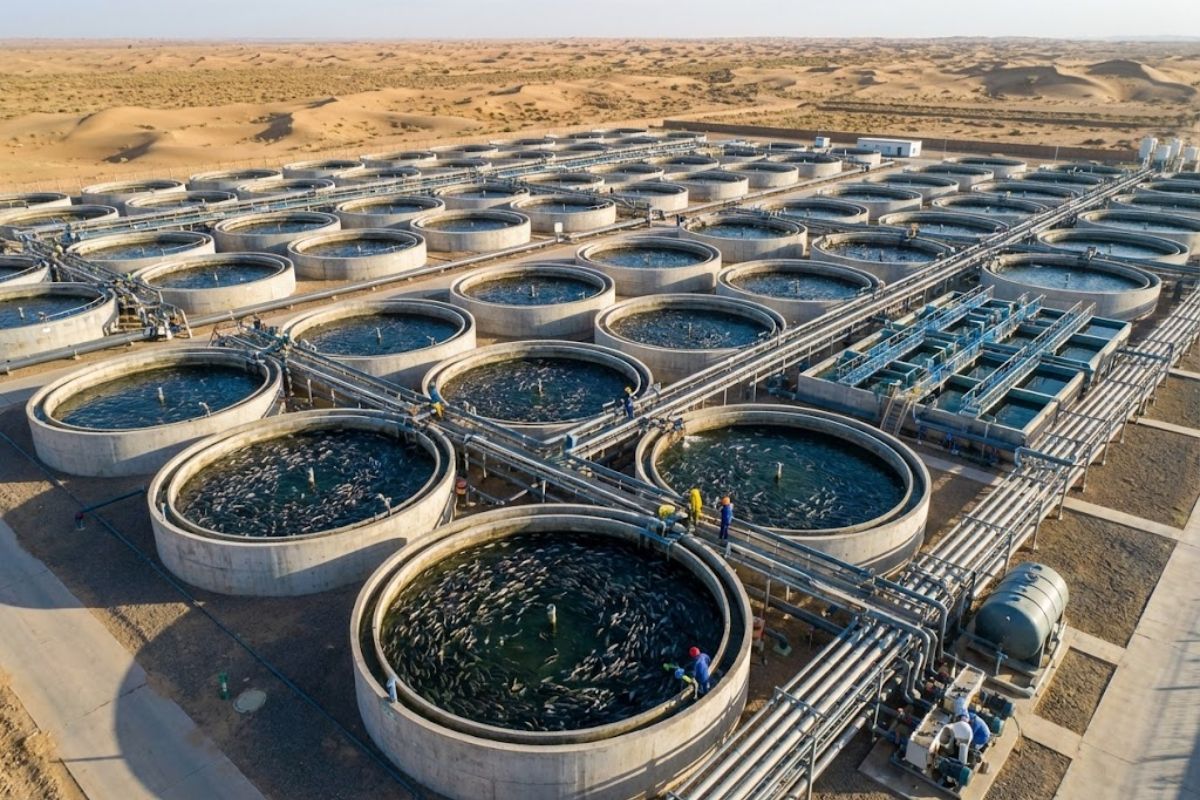


In Xinjiang, Tanks of Aquaculture Create Artificial Ocean in the Taklamakan Desert with Impermeable Membranes, Continuous Pumping, and Biological Filtration. Sensors Stabilize Oxygen, Temperature, and Salinity, Ensuring 99% Survival and Recycled Water Above 90%. In 2024, Production Reaches 196,500 Tons After a Year of Accelerated Expansion
The aquaculture tanks installed in Xinjiang have begun to rewrite a historical limit of the Taklamakan Desert: producing animal protein at a scale where water is the most scarce resource. Starting in 2022, the system began to consolidate as a high-tech operation, and by 2024, regional production advanced to nearly 196,500 tons, with a 99% survival rate and recycled water as a central operating condition.
The production leap in Xinjiang occurs because the project treats each variable as an industrial parameter, not as a climatic gamble. In the Taklamakan Desert, where heat can exceed 50°C and drop sharply at night, the model isolates the tank from the saline soil and maintains a stable aquatic environment with recycled water and continuous control through sensors and automation.
The Taklamakan Desert and the Problem That Aquaculture Needs to Overcome

The Taklamakan Desert covers an area of about 337,000 km² and is described as one of the most arid environments on the planet, with annual precipitation below 100 mm and extreme temperature fluctuations.
-
Woman arrested after receiving $1.2 million due to banking error and not returning the amount.

-
Beneath Mexico City lies an entire buried Aztec capital, and it all began when workers discovered a 3.25-meter stone disk featuring a dismembered goddess, revealing temples, skulls, and palaces beneath 22 million people.

-
How to build a 35,000-liter cistern with 60 by 50 cm panels and rainwater for drinking and cooking without relying on water trucks or the city hall.
-
A woman went out for a regular walk and ended up finding a treasure buried for over 900 years, with more than 2,000 medieval silver coins compared by archaeologists to a lottery prize and considered one of the most significant finds in recent years in the country.


In this context, any productive expansion relies on water engineering, as available water is limited, contested, and expensive.
In Xinjiang, the strategy starts from a paradox: the subsoil may have high salinity, but the region also receives water contributions linked to meltwater from mountain ranges, creating windows for capture and management.
The aquaculture tank model emerges as an attempt to convert these conditions into a controlled cycle, reducing losses due to evaporation and preventing infiltration into the soil.
How Aquaculture Tanks Operate in the Taklamakan Desert

The aquaculture tanks in Xinjiang do not function like traditional open nurseries.
The design is described as closed unit, lined with impermeable membranes, to isolate the system from the saline soil below and prevent uncontrolled water and compound exchange.
Stability comes from the combination of pumping, irrigation, and biological filtration in continuous operation, 24 hours a day and 7 days a week.
The goal is to maintain dissolved oxygen, salinity, and temperature within predictable ranges, even when the external environment changes drastically.
The most sensitive technical point is recycled water.
The project describes that more than 90% of the water returns to the circuit after treatment in settling tanks and biological filters, removing waste and uneaten feed before returning the volume to the lakes.
In the desert, this is not optimization: it is a prerequisite for viability.
99% Survival and Recycled Water as Performance Metric
99% survival is treated as an indicator that repositions the discussion on biological risk in intensive aquaculture.
The material describes that this rate is rare at scale, citing that even in leading countries like Norway, typical rates can vary from 60% to 80% depending on the environment and diseases.
This difference, in the case of Xinjiang, is attributed to environmental control.
The system trades natural variability for technical predictability, reducing temperature shocks and chemical instability that usually pressure mortality in open models.
Recycled water appears as the core of this performance because it limits the need for constant replenishment, decreases reliance on external sources, and still stabilizes the internal ecosystem with microbiological support.
In a scenario where water is the strictest bottleneck, recycling above 90% becomes an operational rule, not a target.
Production in Xinjiang, Economic Scale, and the Cost of the Model
The production numbers position Xinjiang as a major regional hub.
In 2023, aquaculture production reached approximately 184,000 tons and generated over 530 million dollars in revenue; in 2024, it rose to nearly 196,500 tons, with the region described as the largest aquaculture center in northwest China.
However, scale demands capital.
The document describes over 5 billion dollars in investments over more than a decade, with about 1.6 billion concentrated in the last two years, as the model enters the commercialization phase.
It is a technology plus infrastructure equation, not just biological management.
This cost helps explain why the narrative is not “fish in the desert” as a curiosity, but rather a test of competitiveness: economic returns are presented as partial compensation for the investment, provided the operation maintains stability, productivity, and health risk control.
Internal Microbiology and Why the System Does Not End at the Tank Edge
A decisive layer of the model is biological.
The material describes that within the settling and biological filtration units, microorganisms take on roles typical of aquatic ecosystems, decomposing waste, transforming toxic compounds, and stabilizing the environment.
The project mentions the formation of more than 500 species of microorganisms in the system, with two practical effects: aiding in water treatment and generating natural nutrients, reducing complete reliance on industrial feed.
The logic is to bring the operation closer to a living cycle assisted by machines, not to a static reservoir.
It is here that recycled water gains a second function: in addition to sustaining the aquaculture tanks, the treated, nutrient-rich water is directed to support agricultural experiments in saline soils, expanding the model’s ambition beyond fish farming.
Sea Rice in the Taklamakan Desert and the Agricultural Use of Recycled Water
The extension of the cycle appears in the cultivation of rice in saline soil, described as “sea rice.”
The material states that tests with salt-tolerant rice in Xinjiang have been conducted since 2018, in areas where soil salinity can exceed 1.7%, a threshold at which conventional rice cannot survive.
The proposal combines salt-tolerant varieties with nutrient-rich recycled water from aquaculture systems.
According to the text, the plants continued to grow and produce harvests, and in 2023 the planted area reached about 2,000 hectares, with yields exceeding 8 tons per hectare, comparable to traditional regions.
The technical argument is one of integration: fish farming provides water and nutrients; rice cultivation improves soil structure and reduces salinity; the cycle, as a whole, reduces reliance on freshwater.
It is a design of stacking systems, where the aquaculture tank becomes an input for a second production chain.
Limits and Risks: When the Desert Collects the Bill
Even with 99% survival and recycled water above 90%, the model does not eliminate physical risk.
The material describes an episode in Hoton, at the southern tip of the Taklamakan, where a sudden flood after exceptionally heavy rains swept through an aquaculture area, washing away more than 600,000 fish and causing losses of tens of millions of yuan in a short period.
There is also structural pressure on water resources.
The text points out that agriculture consumes a large portion of the regional water use and that Tonan glaciers, cited as an important supply source, are shrinking due to climate change.
This means that future availability may be as determinant as the current performance of the aquaculture tanks.
Finally, the cost and governance of biological risk appear as barriers.
The model is described as reliant on massive capital investment, rigorous management, and multiple layers of biological containment to prevent organisms from escaping into the surrounding environment.
In other words, replicating the Xinjiang case requires more than just copying the physical design of the tank.
What the Xinjiang Case Signals for Aquaculture in Extreme Areas
The case repositions the debate on food production in arid zones because it shows a path of “infrastructure + ecological control,” where efficiency does not come from the environment, but from the system.
The aquaculture tanks gain status as a platform, not just an installation, by connecting 99% survival, recycled water, and productive expansion in a territory that, by definition, should block this type of operation.
At the same time, the material itself reinforces that the Taklamakan Desert remains unpredictable, and that the sustainability of the model depends on balancing technology, resources, and natural limits.
For those following aquaculture, the message is technical: high biological performance can only be sustained with water governance, containment, and costs compatible with revenue.
If you cover food and climate innovation, it is worth monitoring how Xinjiang maintains recycled water above 90% over time, how it sustains 99% survival in successive cycles, and how the Taklamakan Desert reacts when extreme events interrupt operations.
Do you think aquaculture tanks with recycled water can be replicated in other deserts, or does the Xinjiang case depend on conditions and investments that are difficult to reproduce?







Difícil de creer. No he visto ninguna referencia o comunicación científica que cite este caso. Sospechoso que en ningún momento comente la especie de pez que crían; alguna peculiaridad del proceso; más soporte visual…..
Fish farming in xinjiang, STRANGE THE ENTIRE STORY IS TAKEN FROM CHINESE PAPERWORK 🤭🤭🤭🤭🤭 NOTICE THE FISH SPECIES IS NEVER EVER MENTIONED ?????…. AND AN OVER 95% SUCCESS RATE.
IMPRESSIVE, BUT !!!!!!!!!——-I HAVE A CHEMICAL PROCESS THAT CHANGES LEAD INTO GOLD
This is as pragmatic as it is wonderful. Men must and should be in control of his environment in totality, as per creation power vested upon him by God himself.
It is so-called men that have destroyed our environment by controlling it in its totality…
God did not give ‘men’ the power of creation, if any divine being gave men anything it was the power of control and destruction through physical strength and that is all.
Most men are nothing but little child playing in a sandpit pretending at being adult men while most women are left to be their mothers.
Ironically ranting rubbish through a device made by men, internet by men, telephone by men! And to be fair most things on this planet by men!