





 Portuguese
  English
  Spanish
  8 min of reading
  0 comments


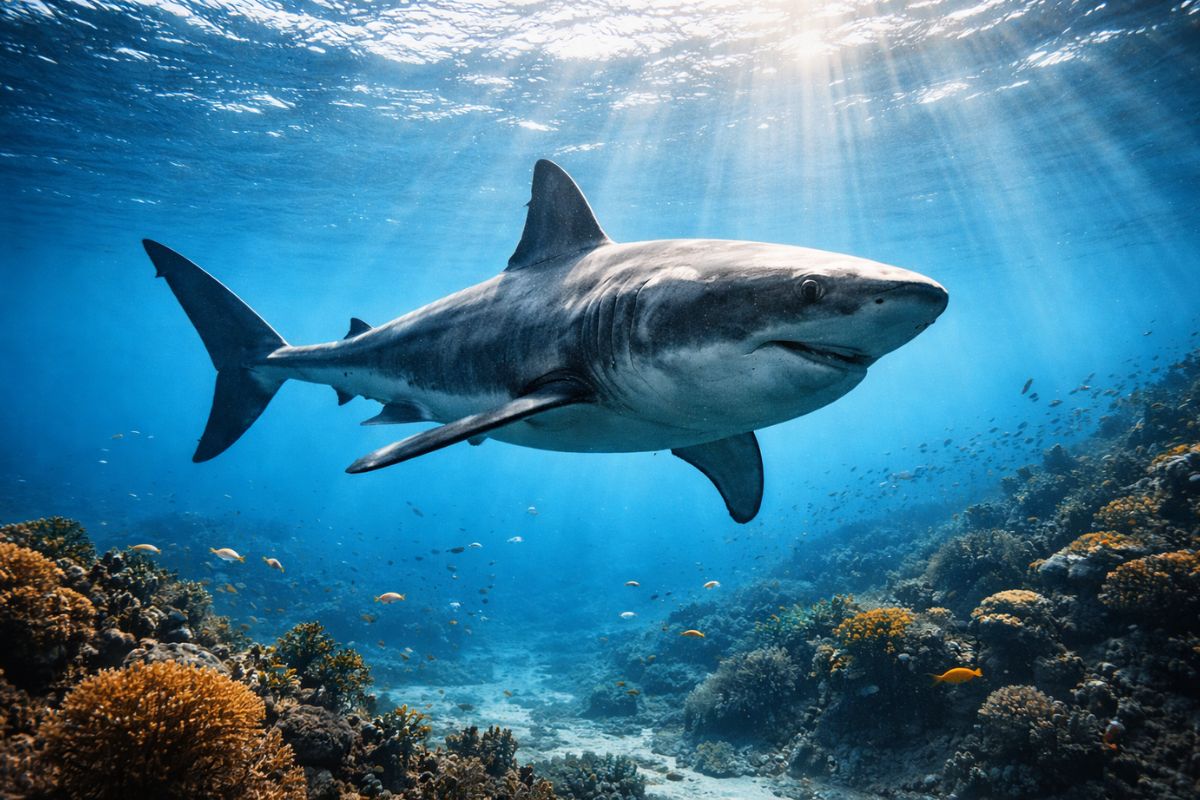
In 50 Years, More Than 90% of Sharks Have Disappeared from the Indian Ocean, Ocean Collapse Affected Coral Reefs and Wrecked Coastal Fishing and Tourism.
In the last 50 years, something that seemed impossible happened before the eyes of science: more than 90% of sharks have vanished from the Indian Ocean. In some regions, divers have spent a decade without seeing a single animal, and thousands of hours of underwater cameras returned nearly empty.
The problem is that, when the sharks disappeared, the ocean didn’t just become emptier. It collapsed. Seals grew by 520% in certain areas, coral reefs were suffocated by algae, small fish disappeared, coastal fishing collapsed, and marine tourism lost hundreds of millions of dollars. All of this caused by the removal of large top predators from the chain.
What Is the Role of Sharks in the Ocean

Before understanding what happens when sharks disappear, it is crucial to understand who they are in this system.
-
With a cost per shot close to zero, the DragonFire laser could change naval warfare in 2027 and provide British ships with nearly unlimited defense against drones.

-
A British startup creates tires that generate electricity in electric vehicles when passing over potholes, speed bumps, and cracks.

-
Scientists have created robots made with living cells that have their own nervous system, swim on their own, explore the environment, and self-organize without any genetic engineering, and now they want to do the same with human cells.

-
Students create a solar-powered ambulance that operates without a plug, without fuel, and still keeps medical equipment running in remote areas.


Today, there are more than 500 species of sharks in the world, and if we include rays, this number easily exceeds a thousand species.
They occupy almost all marine environments, from coral reefs to the deep ocean, from cold polar waters to tropical regions, and some species can even swim up freshwater rivers for hundreds of kilometers.
They sit at the top of the food chain. They are to the ocean what tigers are to the forest or lions are to the savanna.
The mere existence of sharks and their patrolling of certain areas already changes the behavior of other species. In seagrass beds, for example, the presence of sharks causes turtles and dugongs to avoid overgrazing a single spot, which prevents these meadows from being destroyed and ensures shelter for young fish.
In addition to being efficient predators, sharks have a unique biology. They can swim at speeds close to 50 km/h, have skin covered with dermal denticles that reduce friction with water, and possess organs capable of detecting tiny electric fields generated by the bodies of other creatures.
Even in the dark, in murky water, or at extreme depths, they can locate prey with precision.
This set of characteristics makes them excellent regulators of marine balance. When these regulators disappear, the entire system begins to go out of control.
How Quickly Sharks Disappeared from the Indian Ocean

Sharks have disappeared from the Indian Ocean much faster than any predator should vanish under natural conditions.
Reports from fishery commissions and scientific surveys indicate that, in about half a century, the Indian Ocean has lost more than 70% of its shark population.
For some species, the scenario is nearly absolute: the oceanic whitetip shark has declined by around 99%, the scalloped hammerhead shark by about 97%, the silky shark by approximately 90%, and the oceanic whitetip sharks have experienced declines close to 98%.
Even more seriously, this collapse is not slow. Populations plummet in windows of three to five years, as if someone has flipped a switch.
Between 2010 and 2016, for example, some species of reef sharks in Tanzania and Kenya decreased by up to 94%.
Even in marine protected areas, drones and cameras installed for thousands of hours recorded virtually no animals in certain zones.
This points to two extreme scenarios: either sharks are captured before reaching protected areas or the surrounding environment has degraded so much that there are barely any young sharks left to replenish the populations.
In either case, the outcome is the same: sharks have vanished from large areas of the Indian Ocean and left a dangerous ecological void.
Who Is Killing the Sharks
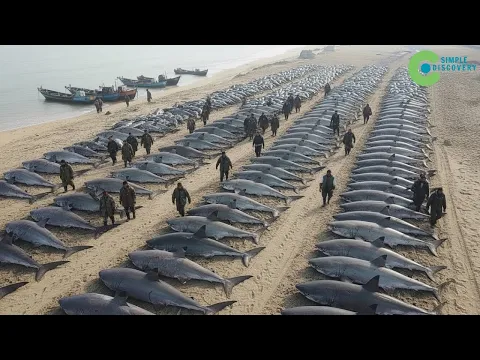

When cross-referencing data from fishing, trade, and capture effort in the Indian Ocean, all evidence points to a very clear culprit: humans.
Every year, tens of millions of sharks are killed worldwide. In the time of a short video, thousands of animals disappear from the ocean. A significant part of this killing is linked to the fin trade.
Fins represent a tiny fraction of the animal’s mass, are nearly flavorless, and are basically collagen, but have become a status symbol in luxury soups served at weddings and large events in some Asian countries.
This causes high-quality fins to be worth hundreds of dollars per kilogram and pushes fishermen to take extreme risks to capture them.
On the decks of boats, fins are cut off, and the shark’s body is thrown back into the sea, often still alive, unable to swim, dying within minutes.
Studies have already shown that most of these discarded animals are alive when thrown back, but without a chance of survival.
Aside from targeted fin fishing, bycatch is a second devastating blow. Industrial fleets targeting tuna and swordfish extend nets and longlines for dozens of kilometers and at depths exceeding 300 meters.
These lines do not choose their targets. In many fisheries, a huge portion of what is brought onboard are sharks, even when the declared focus is other fish.
Pulled from great depths, these animals suffer internal ruptures due to sudden pressure changes.
Even when released, they die quickly. Estimates indicate that a significant portion of sharks killed every year falls into this bycatch category, making the situation even more difficult to control, as much of these incidents go unreported officially.
In various areas of the Indian Ocean, artisanal fishermen have also started targeting sharks because almost all other fish have been depleted by large fleets.
When foreign vessels remove anchovies, sardines, and small fish that sustain local communities, the small-scale fisherman is left to choose between starving or seeking what remains: sharks large enough to feed a family for several days.
To top it off, less than one-fifth of shark species have any form of international protection, and much of this protection exists more on paper than in practice.
In countries like Tanzania, Kenya, Sri Lanka, and even parts of the Maldives, shark fishing continues with virtually no effective control, with little oversight and widespread underreporting.
What Happens to the Sea When Sharks Disappear

The collapse is not a theoretical exercise. When sharks disappeared, the Indian Ocean quickly demonstrated what it means to remove the top of the food chain from a complex ecosystem.
The first consequence is the explosion of intermediate-level predators. Under normal conditions, sharks keep seals, large jacks, smaller sharks, and other mid-chain hunters in check. When these regulators disappear, these species grow like a crowd without brakes.
False Bay in South Africa is an emblematic example. The region was once famous for the presence of great white sharks.
Since the end of 2018, no individuals have been recorded there. Without the top predator, Cape fur seals increased by more than 520%, spreading across rocky coasts and feeding areas, while seven-gill sharks, previously rare, began appearing in very high densities.
With an excess of intermediate predators, small fish disappear. Seals, jacks, and other hunters begin consuming entire schools of species responsible for “grazing” algae and keeping coral reefs clean.
Without these gardener fish, algae grow much faster than corals can keep up, taking over the surface, blocking light, reducing available oxygen, and preventing corals from photosynthesizing.
In just a few years, previously vibrant, colorful, and life-filled reefs become grayish and virtually dead structures.
Since about 90% of marine life depends on reefs at some point in their life cycle, the collapse of these environments triggers a domino effect.
Young fish lose shelter and are devoured even in the larval stage, crustaceans and mollusks disappear, and commercially valuable species vanish as well. The coastal system transforms into a true submerged desert.
Shortly thereafter, coastal fishing declines. In regions like Kenya and Tanzania, where hammerhead sharks have practically vanished, coastal fish production has plummeted by between 50% and 70% in just five years.
Without sharks at the top, small fish are overconsumed, and high-value commercial species like snapper, grouper, and juvenile tuna barely reach adulthood.
Entire communities lose their livelihoods and are forced to abandon fishing, migrate to tourism, or leave their homes.
Not even tourism escapes. In the Maldives and other Indian Ocean destinations, reef sharks were the stars of diving tours, attracting visitors from around the world.
After the mass disappearance, diving tourism fell by around 40% within a few years, resulting in losses of hundreds of millions of dollars annually for economies that directly depend on the sea.
When sharks disappeared, it wasn’t just the ecosystem that crumbled. National economies, jobs, and food security for millions of people were directly impacted.
What Is Being Done to Bring Back the Sharks
After experiencing firsthand the impact of an ocean where sharks have disappeared, some countries have begun to react. And results show that when there is real protection, the sea responds.
The Maldives is one of the clearest cases. In 2010, the country transformed its entire exclusive economic zone, covering more than 900,000 square kilometers, into a national shark sanctuary.
Within this area, all forms of shark fishing are prohibited, including capture as “bycatch.” Caught vessels can face heavy fines, have equipment confiscated, and even lose the right to operate in the country’s waters.
Less than a decade after the establishment of the sanctuary, the density of reef sharks in several coral areas consistently increased.
Areas where sharks were rarely seen began to receive groups of various individuals, which revitalized diving tourism to the point of compensating for the revenue lost from shark fishing.
Other governments have followed similar paths, with stricter naval patrols, enforcement of fines for illegal fishing, requirements for fins to be brought to port still attached to the fish’s body to prevent finning at sea, and greater transparency in catch data.
In some areas, the use of cameras and artificial intelligence systems onboard vessels already enables the identification of shark species when they are caught, recording their condition and alerting the captain when it comes to protected species, reducing unnecessary deaths.
Outside of governments, organizations and ordinary consumers have also begun to apply pressure. Awareness campaigns in Asian countries have already caused millions of people to reconsider consuming shark fin soup.
Hotels, event chains, and restaurants have removed the dish from their menus, cutting demand at the end of the chain.
The message emerging from these examples is clear: whenever space, enforcement, and time are created, sharks return, and with them, some of the balance of the ocean.
Is There Still Time to Reverse the Collapse?
Sharks have existed for more than 400 million years, survived five major mass extinctions, and witnessed the rise and fall of dinosaurs. Even so, the greatest challenge they face today comes from us.
If nothing changes, “the sharks have disappeared” is likely to stop being a description of the Indian Ocean and become the reality of several other seas on the planet.
If there is firm action, there is still a window for populations to recover, reefs to resurrect, and coastal economies to rebuild on more sustainable bases.
In the end, the ocean doesn’t ask for much. It needs time and space to heal and for sharks to regain their original role as guardians of marine balance.
What do you think, will the world react quickly enough to prevent more seas from repeating the fate of the Indian Ocean, or have we already passed the point where sharks can recover?







-

-

2 pessoas reagiram a isso.