





 Portuguese
  English
  Spanish
  4 min of reading
  0 comments


A Moon Never Before Seen on Uranus Has Been Identified by the James Webb Space Telescope. The Discovery Increases the Number of Known Satellites of the Planet and Reinforces the Importance of Exploring the Solar System.
Nasa has confirmed the detection of a previously unknown moon orbiting Uranus, observed by the James Webb Space Telescope on February 2, 2025, and announced to the public on August 19, 2025.
The object is about 10 kilometers in diameter, was identified in long exposure images, and brings the total number of known satellites of the planet to 29.
The campaign was conducted by a team from the Southwest Research Institute (SwRI).
-
With a cost per shot close to zero, the DragonFire laser could change naval warfare in 2027 and provide British ships with nearly unlimited defense against drones.

-
A British startup creates tires that generate electricity in electric vehicles when passing over potholes, speed bumps, and cracks.

-
Scientists have created robots made with living cells that have their own nervous system, swim on their own, explore the environment, and self-organize without any genetic engineering, and now they want to do the same with human cells.

-
Students create a solar-powered ambulance that operates without a plug, without fuel, and still keeps medical equipment running in remote areas.


Webb Reveals Unprecedented Moon in Infrared
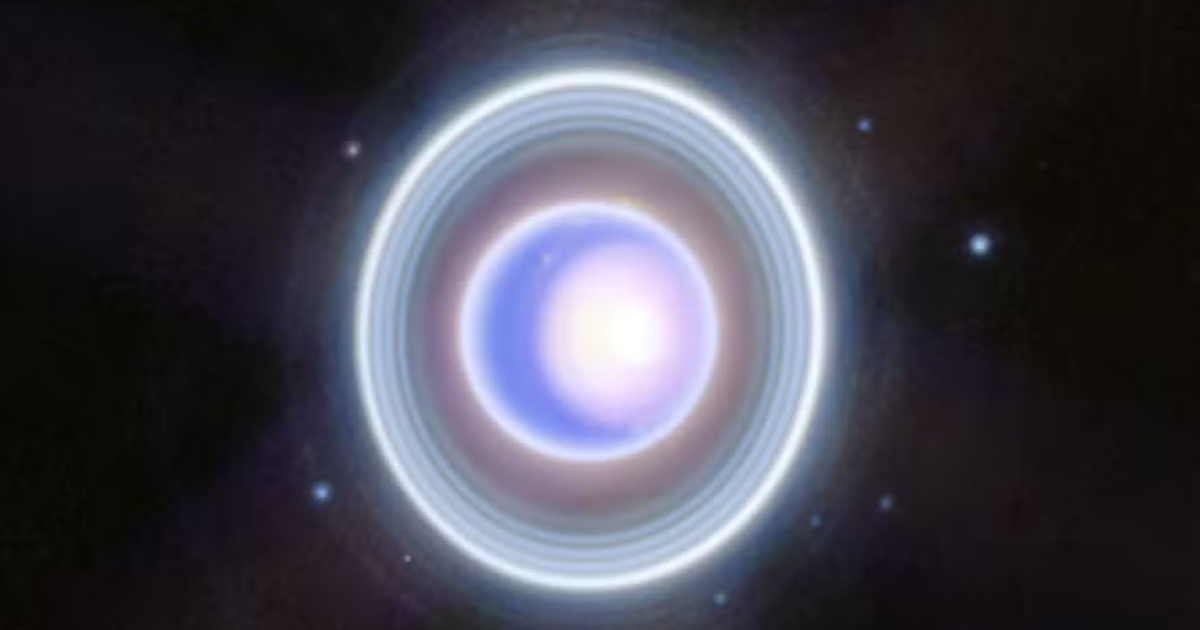
According to Nasa, the moon appeared in a series of 10 exposures of 40 minutes made by the NIRCam (Near Infrared Camera) over the course of about six hours.
The record combines different brightness treatments to reveal the atmosphere, rings, and the small inner moons of Uranus, which helped to highlight the new bright point.
The agency emphasizes that the data are still “science in progress,” meaning they have not yet undergone peer review.
The research leader, Maryame El Moutamid, from SwRI, stated that “it is a small moon, but a significant discovery – something that even Nasa’s Voyager 2 spacecraft did not see during its flyby nearly 40 years ago.”
This statement was made in the official announcement and reinforces Webb’s ability to capture extremely faint targets in the outer solar system.
Location and Invisibility for Decades
The new moon was detected in the equatorial plane of Uranus, about 56,200 kilometers from the center of the planet, in an inner region populated by small satellites that interact with the rings.
It appears between the orbits of Bianca and Ophelia, two modestly sized moons that have been known since the Voyager era.
Because it is much smaller and fainter than the other inner moons, the object remained invisible to previous telescopes and during the Voyager 2 flyby in 1986.
Astronomer Matthew Tiscareno, from the SETI Institute and a team member, explained that “more than any other planet, Uranus has many small inner moons, and their complex interrelationships with the rings suggest a chaotic history that blurs the line between a ring system and a moon system.”
For the researchers, the discovery indicates that other small bodies may be present in the Webb images.
Provisional Name and Official Choice


As per astronomical protocol, the new moon received a provisional designation: S/2025 U1.
The final nomenclature will still depend on the International Astronomical Union (IAU), which is responsible for validating names and classifications of new celestial objects.
In general, Uranus’s moons honor characters from William Shakespeare and Alexander Pope, a tradition that should be maintained when the official naming occurs.
Scientific Impact of the Discovery
The increase to 29 moons is not just a count.
The small inner moons of Uranus play an important role in the dynamics of the rings, acting as “shepherds” and influencing the distribution of particles.
By identifying a new member of this group, scientists gain another reference point to model local gravity, refine trajectories, and test hypotheses about the evolution of the planet’s system.
According to Nasa, the estimated size of 10 km results from the assumption of a similar albedo (reflectivity) to that of other small Uranian satellites.
In the short term, the priority will be to track the orbit of the newly detected moon to establish parameters such as period, eccentricity, and inclination.
The confirmation of these numbers will allow assessment of its dynamical stability and possible resonances with neighbors like Bianca and Ophelia.
The data already obtained also serves as a basis for additional searches in Webb’s archives, especially in campaigns covering the inner rings with high sensitivity in the infrared.
Uranus and the Memory of Voyager 2
Uranus was visited by a single spacecraft, the Voyager 2, which passed by the planet on January 24, 1986.
At that time, the mission recorded rings, storms, and a series of moons, but could not resolve objects as small as the newly discovered one.
Nearly four decades later, Webb offers a different window: superior angular resolution and sensitivity in the infrared that favors cold and low-reflectivity targets typical of the solar system’s periphery.
Validation and Next Steps
The team led by SwRI will follow the formal validation process, which includes independent analysis and publication of results in scientific journals.
After acceptance by the community, the IAU may ratify the status of the satellite and approve the final name.
Meanwhile, the designation S/2025 U1 will remain in official communications and in observatory databases.
This case shows how Webb has also been used for planetary science within the solar system, in addition to its deep space observations. If you could, what name would you give to this new moon of Uranus?







-

Uma pessoa reagiu a isso.