





 Portuguese
  English
  Spanish
  5 min of reading
  17 comments




The Mars Reconnaissance Orbiter, Which Sends More Data Than All Missions to Mars Combined, Detected Signals of the Largest Waterfall in the Solar System and Found 400-Meter Deposits Linked to Hydrothermal Sources in an Ancient Sea, Suggesting Initial Conditions for Life Before the Global Cooling of the Red Planet
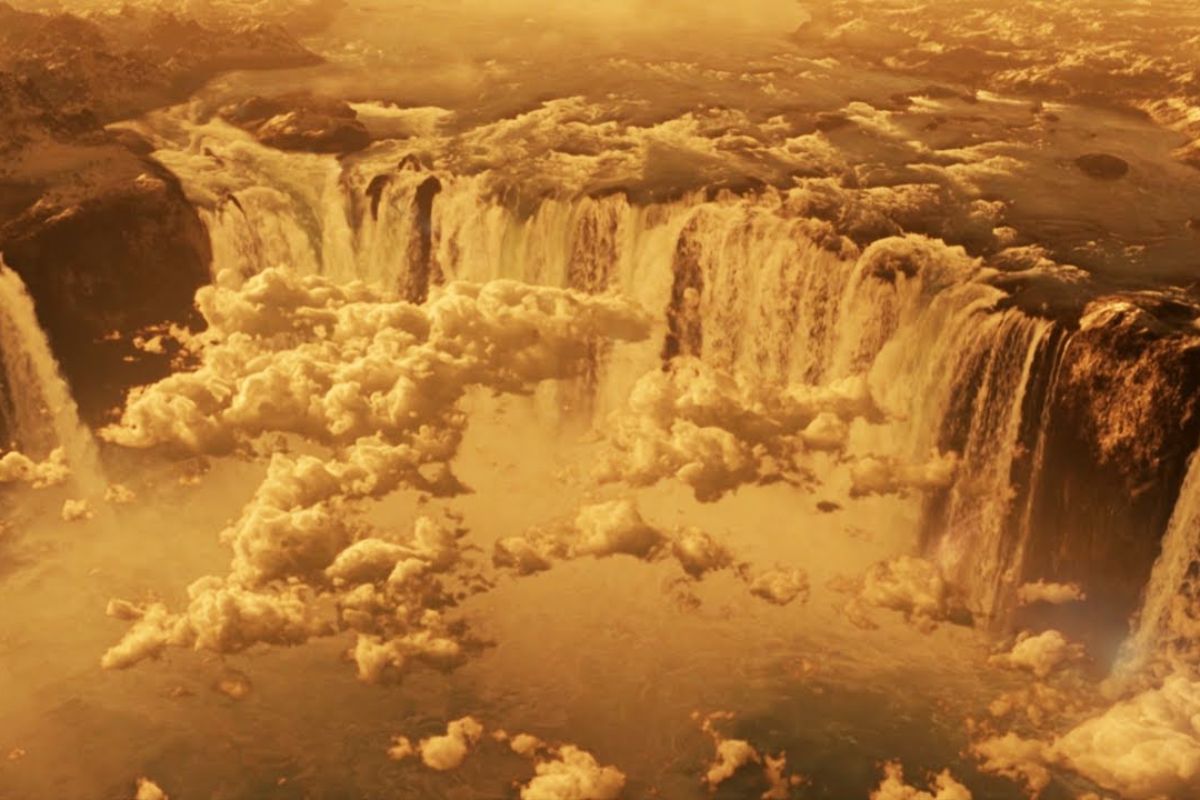
The largest waterfall in the Solar System is believed to have existed on Mars when floodwaters from catastrophic events plunged from the Southern Highlands and cascaded over cliffs four kilometers high, pouring into a canyon 10 kilometers wide by 100 kilometers long.
The scenario was reconstructed from observations by the Mars Reconnaissance Orbiter, the MRO, a NASA probe sent to search for conditions under which life could have begun. After the fury of the floods subsided, the water disappeared, and what remained was the record imprinted on the Martian surface.
The Probe That Sees Mars Every Day and Why the MRO Is Crucial

The MRO stands out for a straightforward fact: it sends more data than all other missions to Mars combined. This capability sustains continuous monitoring of the planet and allows for the cross-referencing of climate signals, topography, and ancient formations with sufficient resolution to identify repeated patterns and subtle changes.
-
He started running at 66 years old, broke records at 82, and is now a subject of study for having a metabolic age comparable to that of a 20-year-old, in a case that is intriguing scientists and inspiring the world.

-
Oldest tree on the planet reappears after 130 years of searches: Wattieza, 385 million years old, was 10 meters tall and had no leaves or seeds; Gilboa fossils in New York solved the mystery in 2007.

-
A 48-square-meter house assembled in hours with 4,000 bricks made of recycled plastic that does not absorb moisture, has natural thermal insulation, and costs less than 90,000 reais in a complete kit.

-
Luciano Hang revealed that Havan’s air fleet has already accumulated more than 20,000 landings, 10,000 flight hours, and 6 million kilometers traveled, and he says that without the planes, the company would never have grown so quickly.


Aboard, the MRO operates with three cameras. The first is a weather camera described as Marcy, capable of seeing from horizon to horizon each orbit and constructing a daily map of the planet, forming a global panorama that functions like a daily weather map of Mars.
Three Cameras, 60,000 Orbits, and 99% Coverage of the Planet

The MRO’s second camera is a context camera. It offers high resolution and has covered about 99% of the Martian surface, creating an extensive base for comparing regions and locating rare formations amidst vast landscapes.
The operational history cited is over 60,000 orbits. Throughout this accumulation, the high-resolution cameras have revealed Mars in unprecedented detail, including polar avalanches, moving sand dunes, and what appeared to be seasonal flows of sand or even liquid melted water, a sequence of findings that reinforces the focus on water and habitability.
2017 and the Focus on One of the Oldest Regions: the Eredania Basin

In 2017, the MRO directed its gaze toward one of the planet’s oldest features, referred to as the Eredalia Basin and also as the Eredania Basin. The basin is described as enormous and located in part of Mars’ oldest crust.
The formation is positioned at about 3.8 billion years and is considered an ancient sea. The water’s scale attributed to the system is extreme: it would have contained over 10 times more water than the Great Lakes, or three times that of the Caspian Sea on Earth. The central point is that it is not a small lake, but a volume of water comparable to an inland sea.
400-Meter Deposit and the Signal of Hydrothermal Sources in Deep Waters

On the ancient seabed, the MRO identified something described as remarkable: a massive thickness of 400 meters of deposit, formed from a mineral that forms in deep-water hydrothermal environments, such as those of underwater vents.
This finding supports the interpretation that Mars not only had the ingredients for life like Earth, but it also possessed an active environment capable of initiating the chemical dynamics associated with hydrothermal systems. The basin is indicated as an ancient sea existing between 3.7 and 3.8 billion years ago, approximately the same period when life was beginning to emerge on Earth, reinforcing the idea of a favorable temporal window.
A Long Fertile Period and the Climatic Shift That Changed Mars
The conditions described as actively fertile are presented as capable of surviving in places like the Eredania Basin for hundreds of millions of years. The reading is of persistence, not a rapid event, which enhances the relevance of the location for discussing habitability.
But the picture changes around 3.7 billion years ago, when a substantial transformation occurs in the Martian climate. Mars would have become colder, and the liquid water that had soaked the soil froze, or froze on the surface. A significant portion of that water would have been transported to the poles, where large, thick blocks of ice, the caps associated with present-day Mars, formed.
Volcanism, Floods, and the Largest Waterfall in the Solar System in Action
As temperatures plummeted, Mars is described as becoming more volcanically active, leading to catastrophic floods. Waters rush down violently from the Southern Highlands to a location called the ecoscape, where they plunge over cliffs four kilometers high.
It is at this drop that the landmark emerges: the largest waterfall in the Solar System, presented as an unprecedented event, with water cascading down a spectacular canyon 10 kilometers wide by 100 kilometers long. The scale of the drop and the gorge suggests an episode of extreme hydraulic energy, in which the landscape was shaped by volume and speed.
Water Disappears, but the Surface Holds the Record of What Happened
After the floods subside, the water disappears. The record of the event remains imprinted on the planet’s surface, as a trace that such hydrous fury existed, even on a Mars that would later become cold enough to freeze large volumes and reorganize its water into polar ice.
The contrast between an ancient sea past, deposits associated with hydrothermal sources, and a period of floods capable of creating the largest waterfall in the Solar System helps explain why the Eredania Basin appears as a strategic target: it combines water volume, environmental activity, and planetary transformations in a single sequence.
Do you believe that an ancient sea with hydrothermal sources on Mars makes it more likely that life arose there, or is there still a crucial piece missing to link these signs to actual organisms?








Tudo invenção para justificar dinheiro gasto e manter as pessoas no suspense. Não sabem o que há no fundo do nosso mar, mas já sabem tudo de Marte… Quem vai lá provar que é tudo uma invenção? Quando descobrem algo de verdade fica no segredo… Ora se os casos de ovini aqui na terra ficam em segredo… Eles vão mesmo falar a verdade sobre Marte? Marte é só cortina de fumaça para ****.
****ánto la ignorancia y la arrogancia se juntan. Se vuelven atrevidas. Es mucho más fácil mandar una sonda a marte que enviar una al fondo del océano por una magnitud simple. LA PRESIÓN te recomiendo estudiar un poco. Antes de pasar pena
Tenho quase certeza de que uma parte de nós veio de Marte! (Não posso ser específica!). Cheguei a essa conclusão por um detalhe corporal existente em algumas pessoas! Garanto que os cientistas já sabem disto, mas não podem divulgar! Somos seres que consomem os recursos e levam muitas espécies animais à extinção, incluindo a si próprio! Porém, “quem” nos criou não deixou que o nosso DNA se perdesse no aquecimento global de Marte, transferindo parte dos últimos sobreviventes para a Terra! Outras espécies de seres foram “acrescentadas” por meio de mudanças genéticas do DNA deliberadamente! O ser humano é muito inocente quanto à própria origem!🤔😅
ACHO QUE NOS TERRAQUEOS VIEMOS DE MARTE,NUNHA FUGA,NAO SEI COMO,MAS CHEGARAM AQUI E COMECARAM A VIDA NA TERRA…