





 Portuguese
  English
  Spanish
  6 min of reading
  10 comments


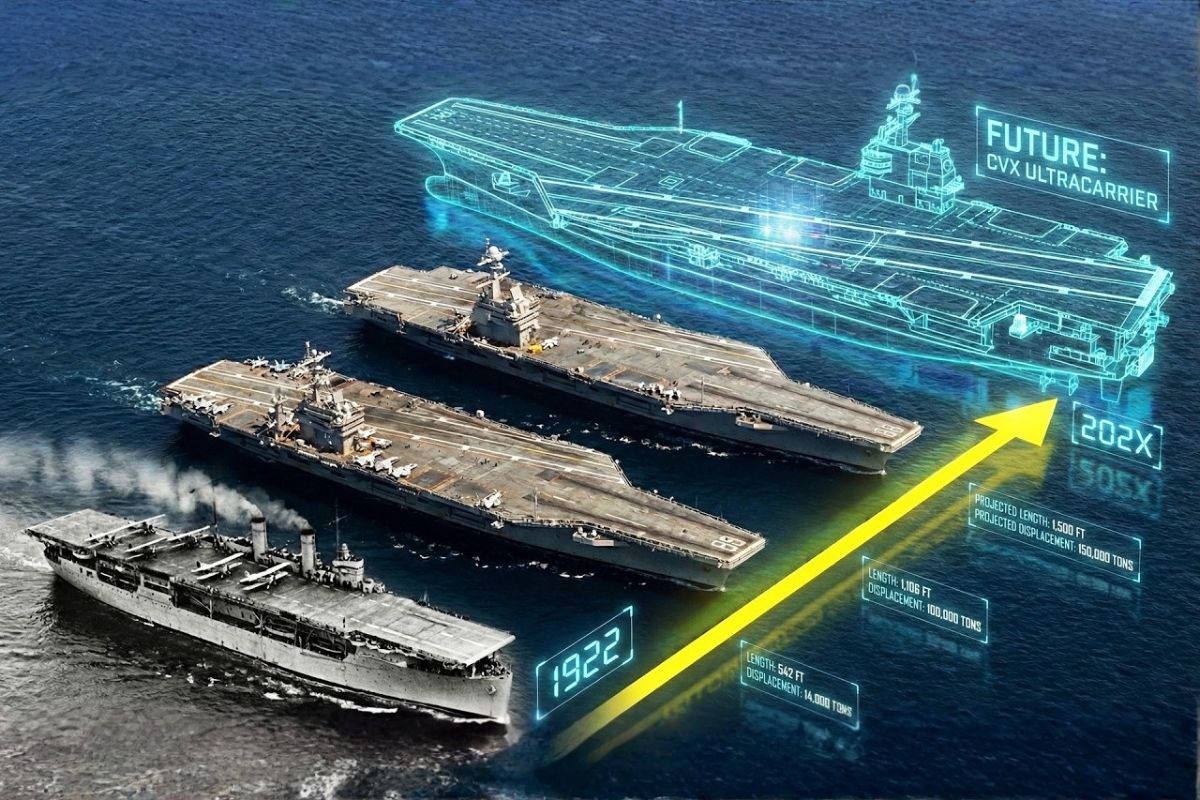


The Navy Operates the USS Gerald R. Ford With Advanced Nuclear Technology, Electromagnetic Catapults, and New Combat Systems, But Maintains the Same Physical Size as the 1970s Because Docks, Cranes, Channels, Bridges, and Naval Draft Impose a Geometric Cage That Steel Cannot Break.
The U.S. Navy commissioned the USS Gerald R. Ford in 2017, officially the most expensive warship ever built, with an estimated cost of US$ 13 billion. Even equipped with two A1B nuclear reactors capable of generating three times more power than previous models, the aircraft carrier has not grown a significant centimeter compared to units launched in the 1970s.
This fact stands out because, in virtually all other military areas, the Navy has adopted accelerated technological growth, moving from steam catapults to electromagnetic rails and multiplying sensors, radars, and digital systems. Still, the physical displacement has been frozen around 100,000 tons, a number that has ceased to be a choice and has become a structural imposition.
The Origin of the Physical Limit of Super Carriers

In 1955, the United States Navy launched the USS Forrestal, regarded as the world’s first super carrier. It displaced about 81,000 tons, had a deck 252 feet wide, and symbolized the materialization of American power in the post-World War II era. The leap was abrupt compared to previous designs and marked the definitive transition to large-scale air operations at sea.
-
With a cost per shot close to zero, the DragonFire laser could change naval warfare in 2027 and provide British ships with nearly unlimited defense against drones.

-
A British startup creates tires that generate electricity in electric vehicles when passing over potholes, speed bumps, and cracks.

-
Scientists have created robots made with living cells that have their own nervous system, swim on their own, explore the environment, and self-organize without any genetic engineering, and now they want to do the same with human cells.

-
Students create a solar-powered ambulance that operates without a plug, without fuel, and still keeps medical equipment running in remote areas.


In the following decades, the evolution was rapid until reaching the Nimitz class, which in 1975 brought the displacement to 100,000 tons. From that point, growth simply stopped. The USS Gerald R. Ford, launched more than 40 years later, maintains practically the same external proportions, with the command bridge measuring 256 feet wide, just four feet more than the Forrestal from 1955.
This freezing contrasts with the technological evolution of the same period. While the Navy moved from conventional engines to nuclear propulsion, from analog radars to digital sensors, and from subsonic aircraft to stealth fighters, the hull remained essentially the same.
Newport News and Dry Dock 12 as an Industrial Bottleneck

The first concrete limit of the Navy is in Newport News, Virginia, described as the only shipyard in the Western Hemisphere able to build a nuclear aircraft carrier. The heart of this process is Dry Dock 12, a massive reinforced concrete structure 2,172 feet long and only 249 feet wide.
This gives rise to a physical paradox. The USS Gerald R. Ford has a flight deck that is 256 feet wide, meaning seven feet wider than the width of the dry dock itself. To resolve this, naval engineers resort to a structural technique known as cantilever. The submerged hull, which enters the dock, measures about 134 feet wide, while the deck extends outward, suspended over the concrete walls.
During construction, the edges of the deck literally hang in the air, hovering over service passages and worker circulation areas. The margin for error is minimal and does not allow for additional expansion without redesigning the entire industrial infrastructure.
Big Blue and the Crane Trap

The limitation does not end at the dock. Parallel to it operates Big Blue, described as the largest gantry crane in the Western Hemisphere. It runs on tracks positioned next to Dry Dock 12 and is essential for lifting gigantic modules of the aircraft carrier.
The distance between Big Blue’s leg and the edge of the Ford’s deck is measured in inches, not feet. Any attempt to widen the deck would result in a direct collision with the crane, requiring the demolition of the dock, the removal of the tracks, and the complete reconstruction of the Newport News shipyard.
Studies from the CVX program, still in the 1990s, concluded that the cost of this industrial reconstruction would consume billions of dollars even before welding the first steel plate, making any larger project unfeasible.
Suez Canal as a Global Mobility Limit

Even if the Navy overcame the industrial obstacle, the next limit is geographical. The Suez Canal connects the Mediterranean to the Persian Gulf and reduces travel time between strategic theaters by weeks. For a nuclear aircraft carrier, each extra week of navigation means higher logistical consumption and direct wear on the reactor core’s lifespan.
The rules of the Suez Canal impose a maximum permitted width of 254 feet. The Ford, with its 256-foot deck, already operates at the extreme limit. While the hull fits, the deck dangerously extends over the banks, turning the crossing into a special risk operation.
Desert wind gusts act on a gigantic surface area, requiring constant corrections to prevent the ship from drifting toward the sandy shores. The issue is not only width, but aerodynamic stability in a narrow corridor.
Al Salam Bridge and the Physical Roof of the World
Over the Suez Canal, the Al Salam Bridge adds a second critical restriction. The clearance under the bridge is approximately 230 feet. On older ships, the Navy used foldable masts to reduce height during crossing.
On the Ford, this has become impossible. The ship carries a dual-band radar with enormous panels that require a rigid, solid, and absolutely stable base. These systems cannot be folded without compromising structural integrity and sensor accuracy.
The result was an integrated mast, fixed, sculpted to pass under the bridge with minimal clearance. The crossing becomes an exercise of extreme precision, where tide, wind, and structural calculation must be perfectly aligned.
Norfolk, Dredging, and the Draft Limit
Another decisive point is at the naval bases. At Naval Station Norfolk, home of the Atlantic Fleet, the channels are artificially maintained at about 50 feet deep. Nature, however, works against this, with silt and sand filling these channels at an estimated rate of 2 feet per year.
The Army Corps of Engineers maintains continuous dredging to ensure access for current aircraft carriers. A 150,000-ton ship would have a draft greater than 45 feet, eliminating the safety margin and creating a permanent grounding risk.
This would mean that a larger super aircraft carrier would not be able to enter Norfolk or bases in Japan, such as Yokosuka, being forced to operate far from the coast, relying on auxiliary vessels for refueling.
Operational Efficiency Against Excess Size
The Navy has assessed that more embarked aircraft do not necessarily mean more combat power. The decisive indicator is SGR, the mission generation rate, which measures how many attacks can be executed in 24 hours.
The Nimitz class supports about 120 daily missions. The Ford was designed to achieve 160, an increase of 33% without enlarging the hull. The solution came from internal reorganization inspired by NASCAR logic, focusing on flow, speed, and elimination of bottlenecks.
On the Ford, the island was moved back 140 feet, freeing up space forward for continuous operations. Electromagnetic weapon elevators take ammunition directly from the magazine to the deck, alongside the aircraft, without crossing active taxiways. The cycle of landing, refueling, rearming, and takeoff has become shorter and more predictable.
CVX, Hydrodynamics, and Strategic Risk
When the Navy studied aircraft carriers of 150,000 or 200,000 tons in the CVX program, it encountered another obstacle: hydrodynamics. Water is about 800 times denser than air, and drag increases exponentially with the widening of the hull.
To maintain 30 knots and generate enough wind on the deck, a ship of that size would require three or four nuclear reactors. Each additional reactor would mean more weight, more drag, and even more power requirements, creating a negative design spiral.
Moreover, a single gigantic aircraft carrier would concentrate cost, crew, and airpower in a single target. A successful attack would mean not just the loss of a ship, but a decisive portion of the Navy’s offensive capacity.
The Real Meaning of 100,000 Tons
For the Navy, 100,000 tons have ceased to be a limitation and have become discipline. It is the exact point where the aircraft carrier fits in the docks, passes through Suez, enters bases, and still delivers global air power efficiently.
The USS Gerald R. Ford symbolizes this choice: to grow internally, with technology, logistics, and operational cadence, not externally, where concrete, mud, bridges, and channels impose insurmountable limits.
In your view, should the Navy insist on breaking these physical limits, or is the discipline of 100,000 tons the true secret of modern naval supremacy?







Quem estabelece o limite são os estudos analíticos que visam a melhor operacionalidade do navio visando todos os aspectos inerentes. Pela descrição no post acho muito importante manter este nível de construção até porque permite construções novas e manutenções mais rápidas.
Na minha visão, no fundo, toda essa inteligência e recursos poderiam ser usados pra fins mais humanos do que a guerra…
Mas, entrando no tema, a abordagem deveria iniciar com a busca pela META do sistema, que certamente não é deslocar mais volume de água. Se for essa métrica de “missões diárias” deveria ser investigar nos conceitos, definições e sistemas que, sequencialmente, realizado uma “missão”. Uma vez mapeado o fluxo, encontrar nesse fluxo qual a RESTRIÇÃO, e começar daí as ações/replanejamento… Se fizer um sistema existente, como por exemplo o USS Gerald R. Ford, começar a aplicar os 5 passos da TOC.. e e for um projeto novo, já partir pra aumento da capacidade (passo 4), o que vai fazer nascer um novo Gargalo… E assim vai.
Já mandou seu currículo para a marinha Americana? Não? Esta perdendo seu tempo, corre lá.
Com base nessas informações, está bem exato, isso não é nenhum sonho de guerra nas estrelas, mesmo porque é impossível, a engenharia naval sabe seus cálculos!